Pool equipment repair in San Antonio TX costs $75 to $1,200 depending on which component needs attention, filters run $75 to $800, pumps $250 to $1,200, heaters $300 to $1,200, and salt chlorinators $600 to $1,200. A standard diagnostic visit runs $149 in the local market. Most repairs cost significantly less than replacement, but knowing the threshold matters.
If your pool stopped circulating properly, your heater won’t fire up, or your filter pressure is reading all wrong, you’re already past the “maybe it’ll fix itself” stage. Pool equipment repair in San Antonio TX covers a wide range of components, and the cost, urgency, and right course of action are completely different depending on which piece of equipment is actually failing. This guide covers all of them, with real 2026 pricing, the signs to watch for on each component, and what separates a repair worth doing from one where replacement makes more financial sense.
What pool equipment repair actually costs in San Antonio TX
Real 2026 repair costs by equipment type
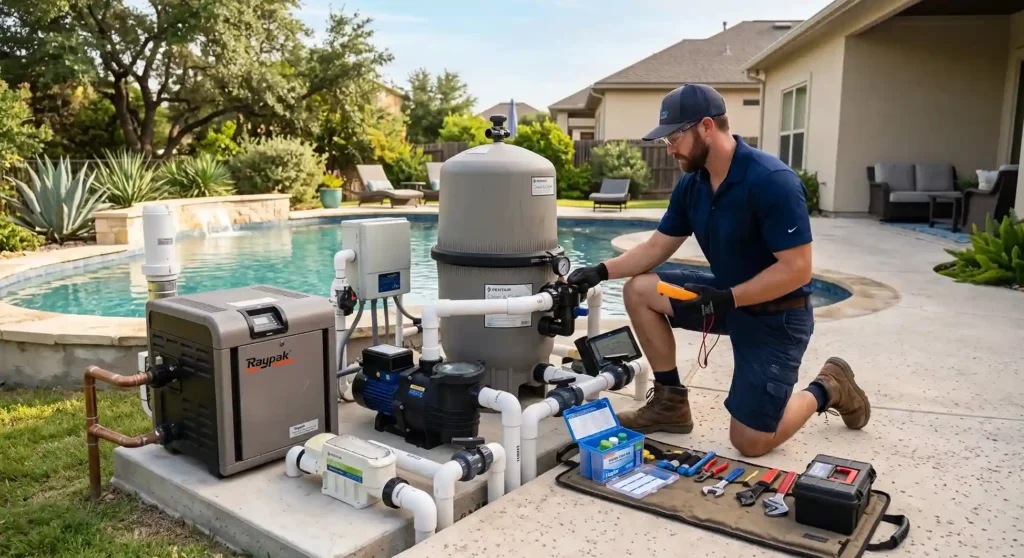
According to Bluewater Pools’ 2026 pool repair cost guide for San Antonio, the most common residential pool equipment repairs in the San Antonio market fall into these ranges:
- Pool pump repair: $250 to $1,200 depending on whether it’s a bearing, seal, motor repair, or full pump replacement. Labor rates for routine pump work run $45 to $65 per hour; electrical components require a licensed technician at $75 to $150 per hour. A standard diagnostic call in San Antonio runs approximately $149 before any repair work begins.
- Pool filter repair: $75 to $800. Cartridge filter cleaning or replacement runs on the lower end, $75 to $200. Multiport valve replacement on a sand filter runs $150 to $350. Full filter replacement, when the tank itself has cracked or the media is exhausted beyond cleaning, runs $400 to $800 installed.
- Pool heater repair: $300 to $1,200 for gas heaters covering issues like burner cleaning, thermostat replacement, or gas valve work. Electric heat pumps run $300 to $800 to repair. Heat exchanger failures (the most serious heater issue) often make full replacement more economical than repair, with new units running $1,500 to $3,500 installed. Note that copper prices in 2026 have pushed heat exchanger repair costs higher, making this calculation more relevant than in previous years.
- Salt chlorinator repair: $600 to $1,200. Salt cells have a finite lifespan, typically three to seven years, and calcium scale from San Antonio’s hard water accelerates that deterioration. A cell that’s lost significant chlorine output often needs replacement rather than repair, since the electrolytic plates themselves are the failing component.
- Pool lights: $65 to $1,700. Simple bulb or LED replacement runs on the lower end. Full fixture replacement, particularly for older incandescent systems being upgraded to LED, runs toward the higher end of that range.
Plumbing issues (leaks, cracked fittings, return jet problems): $200 to $1,000 depending on accessibility and severity.
According to Bluewater Pools’ broader Texas repair cost analysis, “pool repairs in Texas typically range from a few hundred to over a thousand dollars depending on which component needs attention”, and San Antonio’s cost of living running approximately 8% below the national average means local quotes often land toward the lower end of those national ranges, though licensed electrical work commands premium rates regardless of market.
When to repair vs. when to replace
The industry-standard threshold is clear and worth knowing before you get a quote: replace when repair costs exceed 60% of the replacement value, or when the equipment has exceeded 75% of its expected lifespan. For a pump that costs $1,400 new, that means repairs above $840 make replacement the smarter financial call. For a 10 year old single-speed pump already past its reliable operating window, even a $400 motor repair deserves scrutiny, you’re investing in something that may fail again within a season.
The energy efficiency argument is particularly compelling in San Antonio’s extended swim season. As Bluewater Pools’ research notes, “a 10 year old single-speed pump might consume $800 per year in electricity. A modern variable-speed replacement runs closer to $250 per year. That $550 annual saving pays off a $1,400 variable-speed pump in under three years”, and the payback period is even shorter here, where pumps run for eight to nine months annually rather than the four to five months typical of northern markets.
Signs each component needs attention, and what’s actually failing
How to tell what’s wrong with your pool equipment
One of the most frustrating things about pool equipment repair situations is that different components can produce similar symptoms from the outside. Cloudy water might mean a filter problem, a chemistry issue, or a pump that isn’t circulating properly. High filter pressure might mean a dirty filter or a return line restriction. Reading the symptoms correctly before calling a technician (or before agreeing to a repair quote) helps you have a more informed conversation and avoid paying to fix the wrong thing.
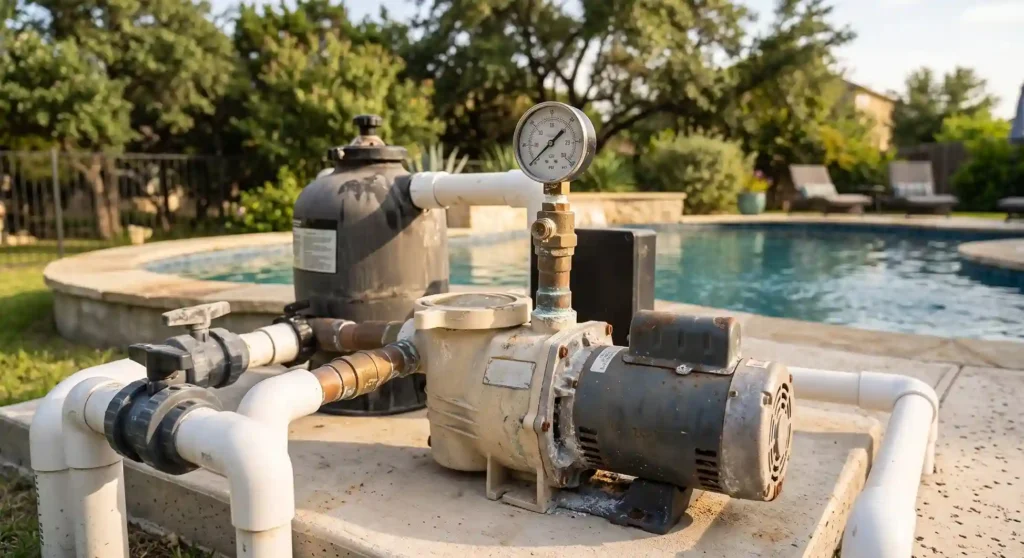
Your pump is failing when you hear grinding, screeching, or rattling sounds during operation; when suction at the skimmer feels noticeably weaker than normal; when water is pooling around the equipment pad; or when your electric bill has climbed without explanation. Air bubbles pushing into the pool through the return jets signal a suction-side air leak rather than a mechanical failure, often an O-ring or fitting issue rather than a motor problem.
Your filter needs attention when the pressure gauge reads 8 to 10 psi higher than its clean baseline, that’s the standard backwash trigger for sand and DE filters. For cartridge filters, reduced return flow and cloudy water that doesn’t clear despite correct chemistry usually indicates the cartridge is overloaded beyond what backwashing alone can fix. A cracked tank, visible water leaking from the filter body, or a multiport valve that doesn’t hold position are signs that repair or replacement is needed rather than just cleaning.
Your heater is failing when it fires briefly and then shuts off (often a pressure switch or flow sensor issue), when it doesn’t fire at all despite correct settings (often a gas valve, igniter, or thermostat), or when it’s producing noticeably less heat than it used to at the same settings (often scaling on the heat exchanger from San Antonio’s hard water, which reduces heat transfer efficiency over time).
Your salt chlorinator is underperforming when your free chlorine stays consistently low despite the cell running at full output, when the cell display shows error codes, or when visible calcium deposits have built up on the cell plates. San Antonio’s hard water makes regular cell inspection and descaling more important here than in softer water markets, a salt cell coated in calcium scale produces a fraction of its rated chlorine output even at full power settings.
What causes pool filter problems and how to repair them
Filter problems are the most frequently misdiagnosed pool equipment issue because they produce symptoms (cloudy water, reduced flow, high pressure) that overlap with chemistry problems and pump problems. The diagnostic sequence matters: check filter pressure first, then chemistry, then pump suction.
For sand filters, the most common repair needs are multiport valve failure (the valve doesn’t hold position or leaks when set to Filter) and channeling in the sand media (water flows through channels rather than the full sand bed, reducing filtration effectiveness). Multiport valve replacement typically runs $150 to $350 installed. Sand replacement, when the media has compacted or fouled beyond backwashing, runs $200 to $400 for a standard residential filter.
For cartridge filters, the repair is usually straightforward (cartridge replacement runs $50 to $200 for most residential sizes) but the housing O-ring and pressure gauge should also be inspected whenever the cartridge is changed. A cracked housing is a full replacement scenario at $400 to $800.
For DE (diatomaceous earth) filters, the most common issue is torn or damaged grids that allow DE powder to pass back into the pool. Grid replacement runs $200 to $500 depending on filter size. Proper recharging after every backwash is the preventive step most homeowners skip, and skipping it significantly shortens grid life.
How to find affordable pool equipment repair companies in San Antonio
Finding genuinely affordable pool equipment repair in San Antonio doesn’t mean finding the cheapest quote, it means finding a technician who diagnoses accurately before recommending repair, quotes transparently before starting work, and holds a valid Texas license for any electrical components involved.
Texas requires a Residential Appliance Installer’s License (RAIL) for electrical pool equipment work, this covers motor replacements, electrical connections, and any work involving the pool’s electrical system. A technician who can’t produce this credential for electrical repairs isn’t just cutting corners; they’re creating liability for the homeowner if something goes wrong.
The most reliable way to evaluate a quote in San Antonio is to get the diagnostic finding in writing before approving any work. A quote that says “pump motor replacement” with a price is meaningful. A quote that says “pool repair needed” with a price is not. The specific component, the specific failure, and the specific repair approach should be documented before you approve anything, and a technician confident in their diagnosis will have no problem providing that detail.
For a complete breakdown of what pump-specific repairs cost and the repair versus replace decision framework specifically for San Antonio pumps, our detailed guide on pool pump repair in San Antonio TX covers the motor, bearing, and seal scenarios with precise 2026 pricing.
And if you’re ready to schedule a professional equipment diagnosis for your San Antonio pool (whether it’s a pump issue, filter problem, heater failure, or something your current technician hasn’t been able to identify) our pool equipment repair service in San Antonio covers the full range of residential pool equipment with same-week scheduling and transparent upfront pricing before any work begins.
FAQ
How much does pool equipment repair cost in San Antonio TX?
Pool equipment repair in San Antonio TX costs $75 to $1,200 depending on the component. Filters run $75 to $800, pumps $250 to $1,200, heaters $300 to $1,200, and salt chlorinators $600 to $1,200. A standard diagnostic visit costs approximately $149 before repair work begins. Labor runs $45 to $65 per hour for routine work and $75 to $150 per hour for electrical components requiring a licensed technician. San Antonio’s cost of living runs about 8% below the national average, so local quotes often land toward the lower end of national pricing ranges.
How do I find affordable pool equipment repair companies in San Antonio TX?
Look for companies that provide a written diagnostic finding before quoting repair work, not a vague estimate, but a specific component and failure description. Verify that any technician handling electrical pool equipment holds a Texas Residential Appliance Installer’s License (RAIL), which is required by state law for motor replacements and electrical connections. Get at least two quotes for repairs above $400. Local San Antonio pool equipment specialists often provide faster response and more competitive pricing than large national service chains, particularly for pump and filter work that doesn’t require specialized parts.
What causes pool filter problems and how are they repaired?
Pool filter problems most commonly stem from a dirty or overloaded filter media needing cleaning or replacement, a failed multiport valve that doesn’t hold position or leaks under pressure, channeling in sand media that reduces filtration effectiveness, or torn DE grids that allow powder to pass back into the pool. Cartridge replacement runs $50 to $200, multiport valve replacement $150 to $350, sand replacement $200 to $400, and DE grid replacement $200 to $500. Always check filter pressure against its clean baseline first, 8 to 10 psi above baseline is the standard service trigger for sand and DE filters.
How do I know if my pool equipment needs repair or full replacement?
The standard threshold: replace when repair costs exceed 60% of the replacement value, or when equipment has exceeded 75% of its expected lifespan. For a $1,400 pump, repairs above $840 make replacement the better financial choice. Age matters as much as cost, a 10 year old single speed pump facing a motor repair is also a strong candidate for variable-speed replacement, since modern pumps use up to 70% less electricity and the energy savings pay back the investment in under three years in San Antonio’s long swim season.
What are the most common pool equipment repair calls in San Antonio TX?
The most frequent pool equipment repair calls in San Antonio involve pump motor failure or bearing wear (often accelerated by hard water mineral buildup and the long nine-month operating season), filter issues including cartridge overload and multiport valve failure, heater problems ranging from igniter failure to heat exchanger scaling from hard water, and salt chlorinator cell deterioration from calcium buildup. San Antonio’s hard water and extended season create more frequent equipment wear than in softer-water, shorter season markets, making annual professional equipment inspections particularly valuable here.
