
A pool pump that won’t prime in Hondo TX is almost always caused by one of four things, an air leak on the suction side, a failed or dried-out O-ring, low pool water level, or a clogged impeller. Most of these are fixable without a service call if you know where to look and what to do in the right order.
If your pump is running but water isn’t circulating (you hear it humming, maybe gurgling, but the returns aren’t pushing water and the pressure gauge isn’t moving the way it should) you’re dealing with a priming failure. In Hondo’s summer heat, a pool pump not priming isn’t something you want to leave running and hope it works itself out. A pump that runs dry overheats fast, and in triple-digit temperatures that process happens even faster than it would in a cooler climate. Here’s how to diagnose it and fix it, step by step.
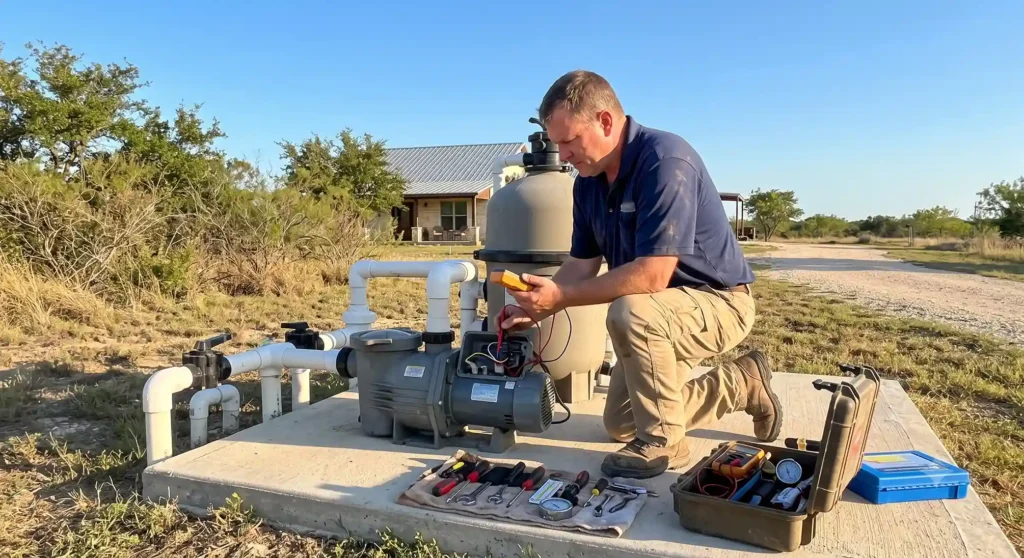
What “losing prime” actually means and why it happens
Why your pump needs water to survive
Before getting into causes, it helps to understand what priming actually is and why it matters so much, especially in Hondo’s conditions. According to Swim University’s pump priming guide, “the pump is like the heart of your pool’s circulation system, and the water is its lifeblood. Without water moving through it at all times, the pump’s motor will begin building friction, which creates heat. This will cause the seal to overheat and melt.”
That description gets more urgent in the context of Hondo’s climate. In ambient temperatures above 100°F (routine for most of July and August in Medina County) a pump running dry builds heat faster than the same scenario in a cooler climate. What might take 30 minutes to cause damage in a mild-weather market can cause meaningful seal damage in 10 to 15 minutes out here during peak summer. The moment you notice your pump isn’t priming, turning it off while you diagnose is always the right first move.
Priming refers to the pump’s ability to fill its housing with water and maintain a solid column of water flowing through the system. When that column is broken (typically by air getting into the suction side of the system somewhere) the pump loses its ability to move water efficiently. It runs, it hums, but it’s essentially spinning in air rather than pushing water. That’s a pool pump lost prime situation, and it has specific, identifiable causes.
The four most common causes in Hondo TX
According to Angi’s 2026 pool pump losing prime guide, “air leaks in your pool pump’s suction line are the top reason for losing prime, often caused by loose fittings, cracked O-rings, or leaky pipes.” For Hondo specifically, a few of those causes show up with extra frequency given the local conditions.
Cause 1: Failed or dried-out pump lid O-ring. This is the single most common cause of priming failure across all pool types and climates, and Hondo’s summer heat makes it more prevalent here than in cooler markets. The O-ring inside your pump lid creates the airtight seal that allows the pump to create the suction needed to pull water from the pool. When it dries out, cracks, or flattens from heat and age, air gets pulled in through the lid connection instead of water getting pulled in from the skimmer. The pump runs but can’t establish prime.
According to Trouble Free Pool’s comprehensive priming guide, “something often overlooked is the small drain plug on the side of the pump-pot, they have a small O-ring that can dry, crack, and allow a pump to not prime.” In Hondo’s extreme heat, these small rubber components degrade faster than in milder climates, making O-ring inspection the right starting point before assuming a more serious mechanical failure.
Cause 2: Low pool water level. This one is particularly relevant for Hondo and Medina County during the height of summer. Evaporation rates in South Texas during July and August are significant, a pool can lose several inches of water in a week of triple-digit temperatures without rain. When the water level drops below the skimmer opening, the skimmer starts pulling air instead of water, breaking the suction column and preventing the pump from maintaining prime. This is the easiest cause to rule out and should always be the first check before touching anything else.
Cause 3: Air leak on the suction side plumbing. Loose union fittings, hairline cracks in PVC pipes, or failed shaft seals can all introduce air into the system between the pool and the pump, breaking prime without any obvious external sign of a problem. In Hondo’s environment, where caliche soil movement from drought and rainfall cycles can subtly shift underground plumbing over time, suction-side connection integrity deserves attention even on relatively newer pool installations.
Cause 4: Clogged or debris-blocked impeller. A blocked impeller prevents normal water flow through the pump housing, creating conditions where the pump can’t establish or maintain prime. In Hondo’s rural environment, where fine caliche dust, dried grass, and debris from surrounding open land regularly find their way into pool water, impeller blockage is more common than in more sheltered suburban settings.
The step by step fix: What to check and in what order
Step 1: Check your pool water level first
Walk to your pool and look at the skimmer. The water level should sit approximately halfway up the skimmer opening, not below the bottom of the skimmer throat. If it’s low, add water with a garden hose until it reaches the correct level, then try restarting the pump. Given Hondo’s summer evaporation rates, low water level is responsible for a surprising percentage of priming calls during July and August, and it’s a completely free fix that takes five minutes.
Step 2: Inspect and lubricate the pump lid o-ring
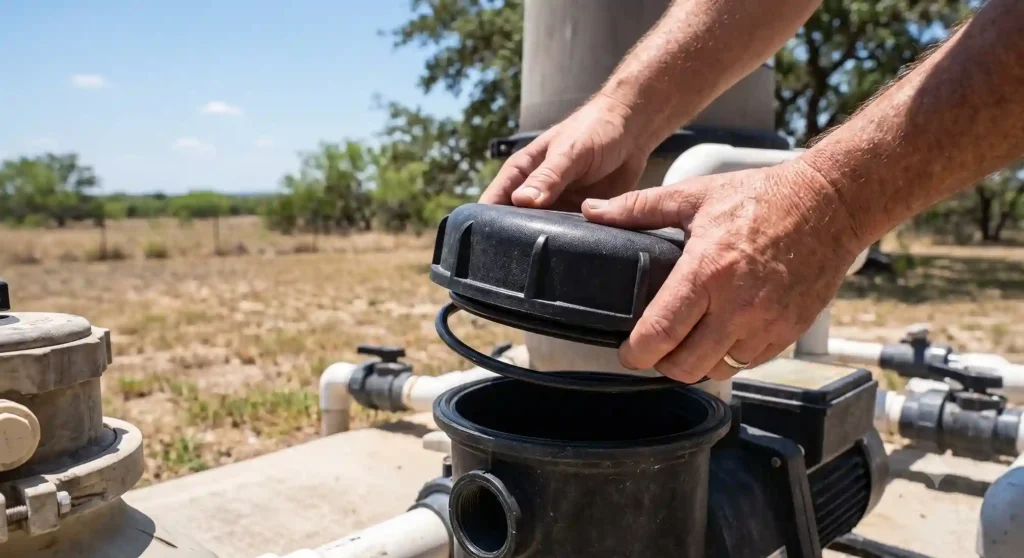
Turn the pump off at the breaker before touching anything. Remove the pump lid by unscrewing it counterclockwise, it should come off by hand. Look at the O-ring sitting in the groove inside the lid. You’re looking for visible cracking, flattening, brittleness, or any point where the ring isn’t sitting fully and evenly in its groove.
If the O-ring looks intact but dry, apply pool-grade silicone lubricant (not petroleum-based products, which degrade rubber) along the entire circumference of the ring. Reseat it carefully, replace the lid, and restart the pump. A dried-out O-ring that’s still structurally intact often resolves with lubrication alone. If the O-ring shows visible cracking or damage, replace it, they cost $5 to $15 at any pool supply store and are one of the most cost-effective fixes in pool maintenance.
According to Angi’s pump priming step-by-step guide, after addressing the O-ring, “remove the lid from the pool pump housing and, using a garden hose, fill the pump basket with water” before restarting, manually pre-filling the housing gives the pump a head start on establishing prime rather than having to pull water from scratch against an air-filled system.
Step 3: Check the pump basket and housing drain plug
While you have the pump lid off and the housing exposed, check the pump basket for debris buildup, a clogged basket restricts flow enough to prevent consistent priming. Empty it completely. Also inspect the small drain plug on the side of the pump body, this small component has its own O-ring that dries and cracks in Hondo’s heat, creating a tiny air leak that prevents prime. Apply silicone lubricant to the drain plug O-ring or wrap it with Teflon tape if the O-ring looks compromised.
Step 4: Check for suction side air leaks
With the pump running and attempting to prime, run your hand along the suction side plumbing, the pipes leading from the pool’s skimmer to the pump inlet. Feel for air movement at union fittings, valve connections, and pipe joints. You can also listen for a hissing sound at connections under load. Visible bubbles shooting into the pool from the return jets while the pump runs is a clear confirmation that air is entering the suction side somewhere.
Tighten any loose union fittings by hand first, over-tightening PVC connections can crack them, so hand-tight plus a quarter turn is the appropriate standard. Apply silicone lubricant to union O-rings if they’re accessible. If the leak point isn’t obvious from external inspection, tracing it requires pressurizing the system, a diagnostic step better handled by a professional than attempted blind.
Step 5: Check the impeller for blockage
If water level, O-ring, and suction-side connections all check out and the pump still won’t prime, impeller blockage is the next thing to examine. With the pump off and power disconnected at the breaker, reach into the pump housing past the basket and try to access the impeller opening at the back, you should be able to feel whether it’s blocked with debris. A small flat screwdriver or impeller cleaning tool can clear a blocked impeller opening in most cases. In Hondo’s environment, fine caliche dust can pack into the impeller passages in a way that isn’t immediately obvious from visual inspection but creates enough flow restriction to prevent normal priming.
When DIY doesn’t solve it: What that usually means
If you’ve worked through all five steps above and the pump still won’t maintain prime, the remaining possibilities require professional diagnosis. A failed shaft seal (the internal seal between the motor and the wet end) can cause priming failure that looks identical to a suction side air leak from the outside but requires disassembling the pump to confirm and repair. Underground suction line cracks or separations that aren’t accessible from the equipment pad need pressure testing equipment to locate accurately. And a motor that’s running but not generating adequate suction due to internal wear requires a hands-on assessment to distinguish from the air leak scenarios that have the same external symptoms.
The urgency of the pool pump priming fix in Hondo’s summer conditions makes this a situation where waiting more than a day or two to get professional help if DIY steps haven’t resolved it carries real risk, both to the pump itself and to your pool’s water quality while the filtration system is down.
Our pool equipment repair service covers the Hondo and Medina County area with same-week scheduling for priming failures and other equipment issues that can’t wait for a routine appointment, bringing the diagnostic tools to identify suction-side leaks accurately and the parts inventory to address common causes same-visit rather than ordering and waiting.
For a broader understanding of what pool pump repair costs, what the repair versus replace decision looks like, and the specific ways that Hondo’s well water and climate conditions affect pump equipment over time, our article on pool pump repair in Hondo TX covers the full picture, worth reading alongside this guide if your priming issue turns out to require more than a DIY fix.
FAQs
Why is my pool pump not priming in Hondo TX?
The most common causes of a pool pump not priming in Hondo TX are a failed or dried-out pump lid O-ring, low pool water level from Hondo’s high summer evaporation rates, an air leak on the suction side plumbing, or a debris clogged impeller. In Hondo’s rural environment, fine caliche dust and open-land debris block impellers more frequently than in sheltered suburban settings. The extreme summer heat also degrades rubber O-rings faster than in cooler climates, making O-ring failure a particularly common cause in Medina County during peak summer months.
How do I fix a pool pump that won’t prime in Texas?
Work through these steps in order: first check your pool water level and add water if it’s below the skimmer midpoint. Then inspect and lubricate the pump lid O-ring, replace it if cracked or flattened. Pre-fill the pump housing with a garden hose before restarting. Check the drain plug O-ring on the pump body. Inspect union fittings on the suction side for air leaks. Finally, check the impeller for debris blockage. In Hondo’s heat, completing this diagnosis quickly matters, a pump running dry in triple-digit temperatures can damage seals within minutes, so turn the pump off while diagnosing rather than letting it continue running.
Can a pool pump lose prime from low water level in Hondo TX?
Yes, and in Hondo’s summer conditions, this is more common than most homeowners expect. Evaporation rates in Medina County during July and August are significant enough that a pool can lose several inches of water in a week of triple-digit temperatures without rainfall. When the water level drops below the skimmer opening, the skimmer pulls air instead of water, breaking the pump’s suction and preventing it from maintaining prime. Always check water level first before assuming a mechanical problem, it’s the fastest and least expensive cause to rule out.
How long can a pool pump run without priming before it gets damaged?
In normal temperatures, a self-priming pool pump can typically run dry for several minutes while attempting to establish prime. In Hondo TX’s summer ambient temperatures above 100°F, that window is significantly shorter, heat stress from the environment compounds the friction heat generated by a dry-running pump, accelerating seal damage and motor overheating. If your pump has been running without circulating water for more than a few minutes in summer heat, turn it off immediately. Let it cool for 15 to 20 minutes before attempting to manually prime and restart rather than letting it continue running dry.
When should I call a professional for pool pump priming issues in Hondo TX?
Call a professional for pool equipment repair in Hondo if you’ve worked through the basic DIY checks (water level, O-ring inspection and lubrication, manual pre-filling, suction fitting inspection) and the pump still won’t maintain prime after restarting. Remaining causes typically require professional diagnosis: a failed shaft seal, an underground suction line crack or separation requiring pressure testing to locate, or internal motor wear reducing suction capacity. In Hondo’s summer heat, don’t wait more than a day or two to escalate if DIY steps haven’t resolved the issue, continued attempts to run a pump that won’t prime risk progressive damage to seals, motor windings, and connected PVC plumbing.
