
Most residential pools in San Antonio should be professionally serviced every week during the active swim season, which runs approximately March through November. Biweekly service is acceptable for pools with minimal use, simpler equipment, and less surrounding vegetation. Monthly service is generally not sufficient for San Antonio’s climate conditions.
That’s the direct answer, and it’s worth stating upfront because the real question behind “how often should a pool be serviced” is almost always “do I actually need weekly service or is that just what pool companies recommend to sell more visits?” The honest answer takes San Antonio’s specific conditions seriously, and in a city with nine months of active swim season, hard water, intense UV, and temperatures that regularly hit triple digits, the frequency question has a more clear-cut answer here than in most other markets.

Why service frequency matters more in San Antonio than most places
What San Antonio’s climate does to an unattended pool
The baseline reality that drives the service frequency question in Bexar County is this: pool water left without attention in San Antonio’s summer heat deteriorates faster than in almost any other major U.S. city. Chlorine burns off rapidly under the city’s intense UV exposure, without adequate stabilizer, half your chlorine can disappear in under an hour of direct midday sun. Bacteria and algae reproduce faster in warm water, meaning a pool that’s perfectly balanced on Monday morning can show early signs of algae formation by Thursday afternoon after a week of 103°F days and heavy use.
According to Angi’s 2026 pool maintenance guide, “weekly service is common for active pools, ensuring water stays clean and balanced,” while “monthly or biweekly service is less expensive but may allow more buildup or issues.” That general framework understates the specific risk in San Antonio’s climate, the buildup and issues that “may” develop with biweekly service in a mild-climate market often “will” develop here, given the speed at which chemistry shifts under extreme heat and UV.
Bluewater Pools’ Texas maintenance research puts it plainly: “pool water left unattended in Texas heat can turn green within days.” That’s not marketing language, it’s an accurate description of what happens when a San Antonio pool misses a service visit during July or August, particularly one that already had marginal chemistry going into the gap.
The nine month season changes the math entirely
Most national pool service frequency guides are written for markets where pools operate four to five months per year. In those markets, a biweekly or monthly service schedule has a narrower window to cause problems, and the chemistry environment is generally less aggressive during the shorter season.
San Antonio’s active swim season runs from roughly mid-March through mid-November, approximately 36 weeks or nine months of meaningful pool use in most years. That’s nearly double the active season length of a northern market. Over 36 weeks at biweekly service, a pool receives 18 professional visits. At weekly service, it receives 36. In a demanding climate where chemistry can shift meaningfully within 48 hours of a heavy rain event, a pool party, or a sharp temperature spike, that difference in visit frequency isn’t just a number, it’s the difference between catching and correcting small chemistry drift versus arriving at each biweekly visit to find a water quality situation that needs more than routine adjustment to resolve.
According to Angi’s pool maintenance Q&A, “you should schedule weekly chemical balancing at minimum, with more frequent visits during heavy use or after parties to keep your pool safe and ready.” For San Antonio’s conditions during the peak summer months, that minimum standard translates directly to weekly professional visits for most residential pools.
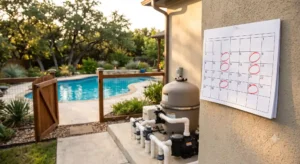
Service frequency by pool type, usage, and situation
When weekly service Is the right call
Weekly professional service makes the most sense (and delivers the clearest value) for the following San Antonio pool situations:
Actively used pools during the core summer season. Any pool being used regularly by a family through June, July, August, and September in Bexar County benefits from weekly service. The combination of bather load introducing organic contaminants, UV burning through chlorine rapidly, and ambient heat temperatures creating ideal conditions for bacterial growth means a week between chemistry adjustments is genuinely the right interval, not an upsell.
Pools surrounded by mature trees. Neighborhoods like Alamo Heights, Leon Valley, Helotes, and Boerne have pools under established oak, pecan, and cedar canopies that deposit leaves, pollen, tannins, and organic debris continuously. This debris load consumes chlorine, introduces phosphates that feed algae, and accumulates on pool surfaces faster than in more open suburban settings. In these environments, biweekly service often means arriving to find significant debris accumulation that requires extra treatment time rather than a routine visit.
Pools with older equipment. An aging pump, filter, or salt cell benefits from more frequent professional eyes, weekly visits catch early equipment warning signs that might not be obvious between biweekly visits, when a problem that started Monday can have significantly progressed by the time a technician arrives two weeks later.
Saltwater pools. Salt cells require monitoring for calcium scaling (an especially relevant concern in San Antonio’s hard water environment) and the salt system’s chlorine output needs regular calibration based on water temperature and usage patterns. Weekly visits provide the monitoring frequency that keeps salt systems running efficiently rather than reactively.
When biweekly service can work, with conditions
Biweekly service isn’t the wrong answer for every San Antonio pool, but it requires more active engagement from the homeowner to work well here than in milder climates. According to Angi’s weekly pool checklist, pool owners who aren’t getting weekly professional service should at minimum “test the water and chemical levels” and handle basic skimming between professional visits.
Biweekly service has the best chance of working adequately in San Antonio for pools with minimal use, primarily a second home or vacation property used only occasionally, or a pool that genuinely sits unused for extended periods. Pools in newer developments with minimal surrounding vegetation, away from mature tree canopy, also experience lower organic debris loads that make biweekly intervals more manageable. And during the fall transition months (October and November) when temperatures moderate, UV intensity decreases, and pool use declines, biweekly service becomes more viable than it is during peak summer.
When monthly service Is not enough in San Antonio
Monthly professional service for an actively used San Antonio pool during the summer months is, in most cases, insufficient, and it’s worth being direct about that rather than hedging. A 30 day gap between professional visits means your pool spends the better part of a month in conditions where: chlorine fluctuates without correction, pH drifts and reduces sanitizer effectiveness, filter loading increases without intervention, and early equipment issues go undetected. During San Antonio’s peak summer, any one of those factors can turn a minor chemistry drift into a full algae bloom within the 30 day window between visits.
The reactive costs of addressing what develops during monthly service gaps (algae recovery treatments running $300 to $500, emergency chemical corrections, more intensive filter cleaning from excess buildup) frequently exceed the cost savings from choosing monthly over weekly service in the first place. That math works differently in cooler, shorter-season markets where monthly service has less opportunity to allow serious deterioration.
Adjusting frequency through the off season
Even San Antonio’s milder winter months don’t completely remove the need for professional pool care, they just change its intensity. November through February is when most local homeowners reasonably step down from weekly to biweekly service, maintaining the pool in reduced operation while keeping chemistry stable and equipment monitored through the cooler period. Completely dropping professional service through winter (a reasonable approach in colder climates where pools close) often creates a spring startup situation that requires significantly more work and chemical investment to recover from than a pool that received basic maintenance attention through the milder months.
The full circle answer to how often your pool should be serviced in San Antonio comes down to one clear principle: during the active season, weekly. During the transition and off-season, biweekly at minimum. Monthly through the core summer is a risk that San Antonio’s climate conditions make consistently more costly than the visit savings suggest.
For a complete breakdown of what each of those visits should include (so you know whether the service you’re getting matches the frequency you’re paying for) our article on what a full-service pool maintenance plan includes in San Antonio covers the complete weekly and monthly checklist in detail.
And if you’re ready to establish a consistent service schedule built specifically for your pool’s size, equipment, and location in Bexar County, our weekly pool maintenance service covers the full program that keeps San Antonio pools clear, balanced, and equipment-protected through every week of the long South Texas swim season.
FAQ
How often should a residential pool be serviced by professionals in San Antonio TX?
Most residential pools in San Antonio should be professionally serviced weekly during the active swim season, which runs approximately March through November. San Antonio’s intense UV exposure, extreme summer heat, and nine-month swim season create conditions where pool chemistry can deteriorate meaningfully within 48 to 72 hours without attention, making weekly service the appropriate baseline rather than an upsell. Biweekly service is acceptable for pools with minimal use or during the cooler transition months of October through February. Monthly service is generally insufficient for actively used pools during San Antonio’s core summer months.
Is weekly pool service really necessary in San Antonio, or is biweekly enough?
For most actively used pools in Bexar County during the summer months, weekly service is genuinely the right interval, not just what pool companies recommend for revenue reasons. San Antonio’s combination of triple-digit temperatures, intense UV exposure that burns through chlorine rapidly, and a swim season nearly twice the length of northern markets creates chemistry deterioration rates that make biweekly intervals risky from June through September. Biweekly service works better for pools with minimal use, less surrounding vegetation, and during the cooler fall transition months when chemistry shifts more slowly.
How often should pool water chemistry be tested in San Antonio TX?
During the active summer season in San Antonio, professional water chemistry testing at every weekly visit is the appropriate standard, covering free chlorine, pH, and total alkalinity as a minimum, with calcium hardness and cyanuric acid tested on a regular monthly rotation. Homeowners managing their own chemistry between professional visits should test every 3 to 5 days during peak summer heat rather than once weekly, since San Antonio’s UV intensity and temperatures can shift chlorine and pH noticeably within that window. After heavy rain events, testing immediately rather than waiting for the next scheduled visit prevents chemistry drift from compounding.
Can I reduce pool service frequency in winter in San Antonio TX?
Yes, stepping down from weekly to biweekly service during November through February is a reasonable adjustment for most San Antonio pools, since cooler temperatures reduce UV exposure, slow bacterial and algae growth, and create a less demanding chemistry environment. However, completely dropping professional service through winter (a reasonable approach in cold climates where pools fully close) often creates a more intensive and expensive spring startup situation than maintaining basic biweekly care through the milder months. San Antonio pools that receive minimal winter maintenance typically require more chemical correction, deeper cleaning, and sometimes equipment service to recover by March.
How do I know if my pool needs more frequent service than the standard schedule?
Your pool likely needs more frequent service than a standard weekly schedule if you experience recurring algae despite regular visits, consistent chemistry drift between service appointments, heavy debris accumulation from surrounding mature trees, frequent large gatherings that add significant bather load, or older equipment that benefits from more frequent monitoring. Pools in neighborhoods with heavy tree canopy (Alamo Heights, Helotes, Leon Valley) often need more attentive schedules during peak pollen seasons. Discussing these factors specifically with your service provider allows them to calibrate visit frequency and scope to your pool’s actual conditions rather than a generic one-size-fits-all schedule.
