
A full service pool maintenance plan in San Antonio includes weekly water chemistry testing and balancing, surface skimming, wall and tile brushing, floor vacuuming, skimmer and pump basket cleaning, and a visual equipment check, plus monthly filter cleaning, calcium hardness testing, and a full equipment inspection.
That’s what every visit should cover. But if you’ve ever hired a pool service and found yourself wondering whether you were actually getting full service or something considerably lighter dressed up with the same label, you’re asking exactly the right question. A full-service pool maintenance plan in San Antonio should mean something specific and consistent, and in a climate that pushes pool chemistry harder than almost anywhere in the country, the difference between a genuinely complete plan and a basic chemical-only visit shows up fast. This breakdown tells you precisely what to expect, what to ask for, and what to watch for if something’s being skipped.
What happens on every weekly visit: The non negotiable checklist
The core tasks that define full service
According to Angi’s 2026 pool maintenance cost guide, a proper weekly service covers tasks “such as brushing, vacuuming, and testing chemicals,” while “monthly and seasonal tasks (such as filter cleaning and equipment inspection) ensure everything runs smoothly.” That framework is accurate, but it understates the specificity of what each of those tasks actually involves on a proper visit.
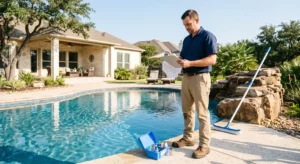
Here’s the complete weekly checklist that defines genuine full service for a San Antonio residential pool:
- Water chemistry testing: a full panel at minimum, covering free chlorine, pH, and total alkalinity. In San Antonio’s hard water environment, calcium hardness and cyanuric acid should also be checked on a regular rotating schedule, not just at season start.
- Chemical adjustment: based on what the test results actually show, not a standard predetermined dose applied regardless of what the water needs. This distinction matters more than it sounds. A technician who adds a fixed chemical amount without testing first isn’t doing chemistry management — they’re doing chemical addition, which is a different thing entirely.
- Surface skimming: removing floating debris, pollen, and organic material from the water’s surface before it sinks, absorbs chlorine, and contributes to chemistry imbalance. San Antonio’s oak and cedar trees make this task more impactful here than in neighborhoods with less established vegetation.
- Brushing walls, steps, and tile line: every single visit, not selectively. This is the single most commonly skipped task among lower-quality services, and it’s the one that prevents algae from establishing in surface texture before it becomes visible. Brushing disrupts early biofilm formation that no amount of chemical treatment resolves as effectively as physical removal.
- Emptying skimmer and pump baskets: completely, not just a quick visual check. Full baskets restrict water flow, stress your pump, and reduce filtration efficiency. In Bexar County’s windy, debris-heavy environment, baskets fill faster than in more sheltered suburban markets.
- Vacuuming: as needed based on actual floor debris, not on a rigid weekly schedule that ignores what the pool actually looks like. A good technician reads the pool and responds to what it needs, rather than following a fixed script regardless of conditions.
- Visual equipment check: listening for pump irregularities, checking filter pressure gauge against baseline, confirming normal return jet flow. This five-minute step catches early warning signs that homeowners almost never notice on their own — and catching a bearing issue early at $200 beats discovering a failed motor at $700.
What separates full service from “basic” or “chemical only” plans
The pool service market in San Antonio includes providers offering everything from complete professional management to chemical-only visits where a technician adds chemicals without any physical cleaning or equipment attention. Understanding where a quoted service sits on that spectrum before signing up saves a lot of frustration.
A pool cleaning checklist in San Antonio for genuine full service always includes physical cleaning (skimming, brushing, vacuuming) alongside chemistry. A chemical-only plan that skips the physical tasks keeps the water balanced in a narrow chemical sense while allowing debris accumulation, biofilm development, and equipment wear that aren’t visible week to week but compound over a season.
According to Swim University’s pool maintenance guide, “a clean pool is not just about chemistry, it’s about circulation, filtration, and cleaning working together.” That three-part framework is exactly what separates full service from a partial service. Chemistry alone, without proper circulation verified through equipment checks and without the physical cleaning that removes what chemicals can’t dissolve, produces water that tests well but doesn’t actually perform well over time.
The monthly and seasonal tasks that full service must also include
What should happen every month, not just weekly
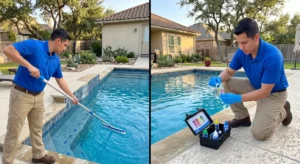
A genuinely complete pool maintenance plan goes beyond the weekly checklist. According to Angi’s weekly pool maintenance checklist, certain tasks “work best on a monthly schedule” because they address parameters that shift slowly rather than weekly. These are the tasks that many service providers quietly drop from their routine without telling homeowners, and they’re the ones whose absence shows up in long-term water quality and equipment health rather than on any given week’s test results.
Filter cleaning or backwashing: Frequency depends on your filter type and debris load, but every full-service plan should include this on a rotating basis. Sand and DE filters need backwashing when pressure rises 8 to 10 psi above baseline. Cartridge filters need physical cleaning when pressure rises similarly. In San Antonio’s dusty, pollen-heavy environment, filters load faster than in cleaner-air markets and need attention more frequently than the standard manufacturer recommendations assume.
Calcium hardness testing: Monthly minimum in San Antonio’s hard water environment. The city’s naturally mineral-rich tap water pushes calcium levels upward continuously through evaporation top-offs, and letting calcium hardness climb past 500 ppm without catching it creates scale deposits on tile, equipment, and surfaces that are expensive to remove and preventable with monitoring.
Cyanuric acid testing: Monthly during the active season, since CYA accumulates gradually in pools using stabilized chlorine products and can reach the point where it traps chlorine rather than protecting it, producing water that tests normal but fails to actually sanitize effectively.
Full equipment inspection: A more thorough look at pump motor condition, filter system health, O-rings and seals, return jet flow patterns, and any equipment with sensors or automation. This monthly inspection catches the slow-developing issues that a quick weekly visual check might miss, the seal that’s starting to weep slightly, the filter pressure that’s trending upward week over week, the pump that’s drawing slightly more current than it should.
Tile line cleaning: San Antonio’s hard water deposits a calcium film along the waterline tile faster than in softer water regions. Monthly light cleaning prevents that film from hardening into the stubborn scale that requires acid treatment or mechanical removal to address.
Seasonal add-ons that complete the picture
Beyond weekly and monthly tasks, a comprehensive full service pool maintenance plan in San Antonio includes seasonal services that bookend and support the year-round routine. Spring startup involves a complete chemistry reset from winter’s reduced maintenance, equipment inspection after months of lower intensity operation, and filter service before the heavy summer demand begins. Fall transition involves adjusting chemistry for cooling water temperatures and reduced UV, and preparing equipment for the reduced-service winter period.
After significant weather events (heavy rain, spring storms, the occasional cold front) a responsive service provider adjusts their visit timing or adds a follow-up treatment rather than waiting until the next scheduled visit while the pool’s chemistry deteriorates from the event’s impact. San Antonio’s “weather whiplash” between drought conditions and sudden heavy precipitation, as industry researchers have noted, creates chemistry disruptions that a rigid fixed schedule service doesn’t handle as effectively as one that responds to actual conditions.
If you want to understand what fair pricing looks like for the level of service described here, our previous article on how much pool cleaning costs in San Antonio TX breaks down the 2026 local price range in detail, useful context before you evaluate any service quote against what the plan actually covers.
And if you’re ready to see what a consistently executed version of this complete maintenance approach looks like for a Bexar County pool through the full swim season, our comprehensive pool cleaning service covers every task on this checklist as part of a locally calibrated routine built specifically for San Antonio’s water conditions and climate demands.
FAQ
1. What does a standard full-service pool maintenance plan include?
A standard full-service pool maintenance plan includes weekly water chemistry testing and balancing, surface skimming, wall and tile brushing, floor vacuuming, skimmer and pump basket emptying, and a visual equipment check on every visit. Monthly tasks include filter cleaning or backwashing, calcium hardness and cyanuric acid testing, a full equipment inspection, and tile line cleaning. In San Antonio, where hard water and intense UV exposure create additional chemistry demands, these monthly tasks are especially important and should be consistently performed rather than quietly dropped from the routine.
2. What’s the difference between full-service and basic pool maintenance?
Full-service pool maintenance includes both physical cleaning (skimming, brushing, vacuuming) and chemistry management, equipment checks, and monthly maintenance tasks. Basic or chemical-only plans add chemicals without performing physical cleaning or equipment inspection. The distinction matters significantly in San Antonio’s climate: a chemical-only service keeps water balanced on paper while allowing debris accumulation, biofilm development, and undetected equipment wear that compounds over a long swim season. Full service addresses all three components (circulation, filtration, and cleaning) that together produce consistently clear, safe water.
3. How often should a pool be professionally serviced in San Antonio TX?
Weekly professional service is appropriate for most active residential pools in San Antonio during the swim season, which runs approximately March through November. San Antonio’s heat accelerates chlorine loss and bacterial growth faster than in milder climates, and the city’s hard water requires more consistent mineral management than a biweekly or monthly schedule provides. Pools with heavy tree coverage, heavy usage, or older equipment benefit most from weekly attention. Biweekly service may be adequate for pools with minimal use and simpler equipment, but the gap in water quality outcomes between weekly and biweekly service is more pronounced here than in cooler, shorter-season markets.
4. What monthly pool maintenance tasks are often skipped by providers in San Antonio?
The most commonly skipped monthly tasks include filter cleaning or backwashing, calcium hardness testing, cyanuric acid testing, and thorough equipment inspection. In San Antonio’s hard water environment, skipping calcium hardness monitoring allows levels to climb past 500 ppm, creating scale deposits on tile and equipment that are expensive to remove. Ignoring CYA levels allows gradual accumulation to the point where chlorine becomes ineffective despite normal test readings. These tasks don’t produce immediately visible results when performed, which makes them easy for providers to quietly omit, but their absence shows up clearly in long-term water quality and equipment health.
5. What questions should I ask before hiring a pool maintenance service in San Antonio?
Ask specifically whether brushing happens on every visit or only when visibly needed, it should be standard every time. Confirm how often the filter is actually cleaned and whether that’s included or billed separately. Ask what monthly tests are performed beyond basic chlorine and pH. Find out what happens when a technician finds an equipment issue, do they flag it immediately with documentation, or does it go unaddressed until something fails? And ask how long a typical visit actually takes for your pool size, a thorough weekly service for a standard residential pool takes at minimum 20 to 30 minutes. Consistently shorter visits are a reliable indicator that tasks are being skipped.
