
There’s a particular sound every San Antonio pool owner dreads, that grinding, screeching, or rattling noise coming from the equipment pad that wasn’t there last week. If you’ve heard it, you’re probably already searching for answers about pool pump repair in San Antonio TX, and you want to know two things right away: how bad is this, and what’s it going to cost me. Fair questions, and ones that deserve straight answers rather than vague reassurances or scare tactics designed to upsell you into a full replacement you might not need.
Your pump is the single hardest-working piece of equipment your pool owns. It runs 8 to 12 hours a day through a South Texas summer that regularly pushes past 100°F, and it’s the reason your water actually circulates instead of sitting stagnant. When it starts struggling, everything downstream (chemistry, clarity, filtration) struggles with it.
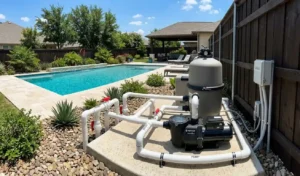
How to tell what’s actually wrong with your pump
Reading the warning signs before they become emergencies
Most pool pump failures don’t happen overnight. They announce themselves first, usually through sound, then through performance, and finally through visible damage if nothing’s done in between. Catching the problem at stage one is the difference between a $150 repair and a $700 replacement.
Strange noises are the first and clearest signal. A healthy pump runs with a low, steady hum, barely noticeable from a few feet away. According to Angi’s pump lifespan guide, “anything above a low hum (including popping sounds, screeches, or grinding) is likely a sign that you either have a broken motor or a leak.” Grinding or screeching almost always points to worn bearings, while a loud humming or buzzing without the impeller actually spinning usually means the motor is seized or the capacitor has failed.
Weak suction or reduced water flow at your returns is the next sign worth paying attention to. If the jets that used to push water with noticeable force are now barely trickling, something is restricting flow, and the cause could be anywhere from a clogged impeller to a failing motor that’s lost its full power output. In San Antonio, where caliche dust and organic debris load filters and impellers faster than in many other regions, a gradual decline in flow is sometimes mistaken for normal seasonal variation when it’s actually an early equipment warning sign.
Visible leaks around the pump housing point to a different category of problem entirely, not the motor, but the seals and connections that keep water contained within the system. Puddles forming around your equipment pad, or air bubbles shooting into your pool from the returns, both indicate a seal or fitting issue that needs attention before it worsens.
A sudden jump in your electric bill is the sign most homeowners miss completely. A struggling motor draws more current trying to do the same job, and that shows up on your utility statement weeks before it shows up as an obvious mechanical failure. If your bill has crept up without an obvious explanation, your pump deserves a look.
What’s actually failing, motor, seals, or bearings?
Understanding which component is failing helps you have an informed conversation with whoever ends up doing the pool pump repair San Antonio TX work, and helps you sanity check a quote before agreeing to it.
The motor is the heart of the system, and according to Angi’s 2026 pool pump repair cost data, most motors last five to seven years before requiring repair or replacement, though San Antonio’s heat and the long, demanding swim season here often shorten that window compared to cooler climates where the pump runs fewer hours annually. Motor repair typically runs $200 to $500, while a full motor replacement runs $350 to $700.
Seals keep water contained and maintain proper pressure. Signs of seal failure include visible leaking and a noticeable drop in suction, exactly the symptoms described above. Seal and leak repairs typically cost $120 to $350 depending on severity and what’s actually failing.
Bearings keep the motor shaft spinning smoothly. Worn bearings are the most common cause of that grinding or screeching noise, and according to Angi’s data, bearing replacement runs $150 to $350, one of the more affordable fixes if caught before it causes secondary motor damage. Letting worn bearings run unaddressed for too long is how a $200 bearing job turns into a $500 motor replacement, because the excess friction and vibration eventually damages the motor itself.
What repair actually costs in San Antonio, and the repair vs. replace decision
Real San Antonio pricing for pool pump repair
Putting it all together, here’s what San Antonio homeowners can realistically expect to pay for pool pump cost Texas repairs in 2026. Bearing replacement runs $150 to $350. Seal and leak repairs run $120 to $350. Motor repair runs $200 to $500, while motor replacement runs $350 to $700. According to Bob Vila’s pool repair cost guide, a full pool pump replacement (the entire unit, not just a component) typically runs $700 to $1,300 once you include both the equipment and professional installation labor.
San Antonio’s specific conditions affect these numbers in a few predictable ways. Hard water accelerates mineral buildup inside pump components, which can increase the frequency of seal and bearing issues compared to pools in softer water regions. Extended runtime through a swim season that stretches eight to nine months means more operating hours annually than pumps in shorter-season climates accumulate, which is part of why local pumps often need attention closer to the five-year mark than the seven-year mark referenced in national averages.
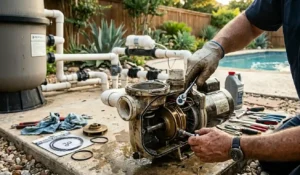
The repair vs. replace decision, a practical framework
This is where most homeowners get stuck, and it’s worth having a clear rule of thumb rather than guessing. The standard industry guidance: if repair costs exceed roughly 50% of the cost of a new pump, replacement is the better financial decision. A $1,750 average new pump means that once a single repair quote climbs above $850 to $900, you’re generally better off putting that money toward a new unit, especially one that comes with a fresh warranty rather than aging components that may fail again soon after.
Pump age matters just as much as the repair quote itself. A pump that’s 3 years old with a failed bearing is worth repairing, it has years of useful life ahead. A pump that’s 8 or 9 years old with a failed motor is a different conversation entirely; you’re likely looking at a second failure within a year or two even after repair, making replacement the more sensible long-term choice.
One more factor worth weighing for San Antonio homeowners specifically: if your pump is more than five years old and you’re facing a motor repair, this is also a reasonable moment to consider whether a pool pump replacement San Antonio TX upgrade to a variable-speed model makes sense. Variable-speed pumps cost more upfront but use significantly less electricity over their lifespan, a meaningful consideration given how many hours a San Antonio pump runs annually compared to pumps in shorter-season climates.
Why a professional diagnosis matters more than a quick online guess
Here’s the honest reality: diagnosing the exact cause of a pump problem from symptoms alone gets you in the right neighborhood, but it doesn’t replace an actual hands-on inspection. A grinding noise usually means bearings, but it can also mean a failing motor in its early stages, and only opening the unit up reveals which one you’re actually dealing with. Guessing wrong and ordering the wrong part wastes both time and money.
A professional pool equipment technician brings the diagnostic experience to identify the actual failure point quickly, the parts inventory to fix common issues same-visit rather than ordering and waiting, and (just as importantly in San Antonio’s climate) the local knowledge of which failure patterns show up most often in this region’s hard water and heavy-use conditions. That last point matters more than it might seem: a technician who services pumps across Bexar County daily recognizes the specific wear patterns that hard water and extended runtime create here, patterns that don’t always match generic national repair guides.
If your pump is showing any of the warning signs covered above (unusual noise, weak flow, visible leaking, or a rising electric bill) catching it early through our pool equipment repair service in San Antonio is almost always less expensive than waiting until the problem forces an emergency call. A same-week diagnostic visit catches a $200 bearing issue before it becomes a $700 motor replacement.
And if you’ve noticed your equipment seems to be working harder than it should lately (more frequent cleaning, more frequent adjustments, components wearing faster than expected) San Antonio’s hard water is often a contributing factor working quietly in the background. Our article on hard water and pool chemical balancing in San Antonio explains how the city’s mineral-rich water supply affects everything from your tile to your equipment, including the pump components covered here.
FAQs
How much does pool pump repair cost in San Antonio TX?
Pool pump repair costs in San Antonio typically range from $120 for minor seal repairs up to $700 for a full motor replacement. Bearing replacement runs $150 to $350, seal and leak repairs run $120 to $350, and motor repair runs $200 to $500. A complete pump replacement, including unit and professional installation, runs $700 to $1,300. San Antonio’s hard water and extended swim season can push repair frequency slightly higher than national averages, since pumps here accumulate more operating hours annually than in shorter-season climates.
What are the warning signs that my pool pump needs repair?
The clearest signs are unusual noises, grinding or screeching usually indicates worn bearings, while loud humming without movement suggests a seized motor. Weak suction or reduced flow at your return jets points to a clogged impeller or declining motor performance. Visible leaks or puddles around the pump housing indicate failing seals. A sudden, unexplained increase in your electric bill often means the motor is straining and drawing more current than normal. Catching any of these signs early and scheduling pool pump repair San Antonio TX service promptly typically costs significantly less than waiting until the pump fails completely.
Should I repair or replace my pool pump in San Antonio?
A practical rule of thumb: if a repair quote exceeds roughly 50% of the cost of a new pump (averaging $1,750), replacement is generally the better financial decision. Pump age matters too, a pump under 5 years old with a single component failure is usually worth repairing, while a pump 8 years or older facing a motor failure is more likely to fail again soon, making replacement the smarter long-term choice. If you’re already facing a motor repair on an aging pump, it’s also a reasonable time to consider upgrading to a variable-speed model for long-term energy savings.
How long do pool pumps last in San Antonio TX’s climate?
Most pool pump motors last five to seven years nationally, but San Antonio’s extended eight-to-nine-month swim season and consistently high operating hours often push local pumps toward the lower end of that range. Hard water mineral buildup inside pump components can also accelerate bearing and seal wear compared to pools in softer water regions. Regular maintenance, checking O-rings, monitoring for early noise changes, and keeping the pump shaded from direct afternoon sun where possible, helps extend operating life closer to the upper end of that fiv to seven year window.
Why is my pool pump making a loud grinding noise?
A grinding or screeching noise almost always points to worn bearings inside the motor housing, these are inexpensive to replace ($150 to $350) if addressed promptly, but the friction and vibration from worn bearings can damage the motor itself if ignored, turning an affordable bearing fix into a far more expensive motor replacement. While bearings are the most common cause, only a hands-on inspection from a qualified technician confirms the exact source, since early-stage motor failure can sometimes produce similar sounds. Scheduling a diagnostic visit as soon as you notice the noise is the most cost-effective response.
