
If you’re thinking about installing a pool in San Antonio (or buying a home with one already built) the fiberglass versus concrete question is probably one of the first things you’ll run into. And if you’ve started researching online, you’ve likely found plenty of opinions but not much information specific to what those differences actually mean in a South Texas climate. That’s the gap this article fills. Fiberglass vs. concrete pool in San Antonio TX isn’t the same comparison it is in Seattle or Chicago — the hard water, the intense UV exposure, the long swim season, and the extreme summer heat change the math on both sides of the equation in ways that generic guides don’t account for.
This isn’t a pitch for either option. Both work well in San Antonio with the right maintenance approach. But they work differently, cost differently to maintain, and suit different homeowner priorities, and understanding those differences before you install or before you buy is exactly the kind of information that prevents expensive surprises three years down the road.
What each pool type is and how San Antonio’s conditions affect It
Concrete pools in San Antonio the most common choice and why
Walk through most established San Antonio neighborhoods (Alamo Heights, Stone Oak, Terrell Hills, King William) and the majority of inground pools you’ll see are concrete. Specifically, they’re gunite pools, which are a form of concrete pool where a mixture of sand and cement is sprayed under pressure over a rebar framework to form the shell. Gunite is the dominant pool construction method in Texas, and for good reasons: it allows complete design flexibility in shape, size, depth, and custom features, it’s extremely durable structurally, and a well-built gunite shell can last 50 years or more.
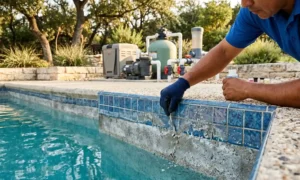
The tradeoff is on the maintenance side, and in San Antonio, that tradeoff is more significant than in softer water regions. Concrete is porous. Its surface, whether finished with standard plaster, quartz aggregate, or pebble finishes, develops microscopic irregularities over time that algae can grip onto. Brushing twice weekly isn’t optional for a concrete pool in San Antonio, it’s the baseline that prevents algae from establishing in the surface texture rather than just floating in the water.
San Antonio’s hard water compounds this significantly. According to Bob Vila’s pool maintenance cost guide, concrete pools are the most expensive to maintain of the three main pool types, with 10-year maintenance costs ranging from $27,000 to $40,000 nationally. In South Texas, where calcium-rich water accelerates surface deterioration and requires more frequent acid washing and resurfacing than softer water regions, those maintenance costs tend toward the higher end of that range. Concrete pools in San Antonio typically need professional acid washing every 3 to 5 years and full resurfacing every 7 to 10 years, more frequently than the national average suggests for pools in mild water conditions.
The chemical management demands of pool types in Texas also differ between concrete and fiberglass. Concrete’s porous surface absorbs and interacts with pool chemicals differently than the smooth, non-porous surface of fiberglass, typically requiring higher chemical inputs (more chlorine, more pH adjustment, more alkalinity management) to maintain the same water quality. In San Antonio’s already-demanding chemistry environment, that additional chemical load adds up over a season.
Fiberglass pools in San Antonio the maintenance advantage in a demanding climate
Fiberglass pools work differently from the ground up. Rather than being built in place like concrete, a fiberglass pool shell is manufactured offsite as a single molded unit (a smooth, non-porous gelcoat surface over a fiberglass-reinforced shell) and then installed whole into the excavated hole. The manufacturing constraint this creates is real: you’re choosing from available shell shapes and sizes rather than designing from scratch, which limits custom configuration options compared to concrete.
But in the context of San Antonio’s specific maintenance challenges, the non-porous smooth surface of fiberglass changes the maintenance equation meaningfully. Algae cannot grip smooth fiberglass the way it can grip the microscopic texture of plaster or aggregate, which means lower algae incidence, less frequent brushing requirement, and significantly lower chemical consumption than a comparable concrete pool. According to This Old House’s inground pool cost comparison, fiberglass pools carry 10-year maintenance costs of $5,000 to $15,000 roughly one-third to one-half of what concrete pools cost over the same period.
For San Antonio homeowners specifically, fiberglass pool maintenance has another important advantage related to the city’s hard water: the smooth gelcoat surface is significantly more resistant to calcium scale formation than porous concrete or plaster surfaces. Calcium deposits can still form on fiberglass (particularly along the waterline) but they adhere less aggressively and clean off more easily than the same deposits on a roughened plaster surface. In a city where calcium hardness management is a year-round challenge, that surface characteristic has real practical value.
Fiberglass also handles San Antonio’s summer heat well from a structural standpoint. The material has some flexibility that concrete lacks, which means thermal expansion and contraction from the city’s extreme temperature cycles (hot summer days followed by relatively cooler nights) causes less surface stress cracking than the more rigid concrete shell experiences over time.
The real cost comparison and which makes more sense for San Antonio homeowners
Installation costs where concrete still leads on price range
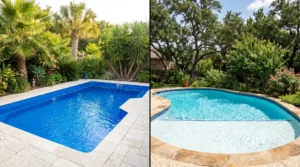
On the installation side, the comparison runs roughly as follows for San Antonio in 2026. According to Bob Vila’s fiberglass pool cost guide, fiberglass inground pools typically cost $20,000 to $60,000 installed, while concrete pools run $35,000 to $65,000 making concrete generally more expensive at the top end, though overlapping in the middle range depending on pool size and features.
The installation time difference is also worth noting if you’re planning around a swim season. A fiberglass shell can typically be installed and filled in 2 to 4 weeks once excavation is complete. A concrete gunite pool requires 8 to 12 weeks minimum, the gunite application, curing time, plaster finishing, and startup process all add up. If you’re hoping to swim this summer in San Antonio, that timeline difference may be the deciding factor.
One meaningful limitation of fiberglass in South Texas: the pool shell must be transported to the site on a flatbed truck, which means there’s a practical size maximum determined by what can be safely transported on local roads. Very large pools (those over approximately 16 feet wide or 40 feet long) are typically not achievable in fiberglass and require concrete construction regardless of other preferences.
Long term maintenance costs in San Antonio where fiberglass pulls ahead
This is where the comparison shifts most clearly in South Texas conditions. The 10 year maintenance cost gap between fiberglass and concrete pools nationally is already significant, roughly $10,000 to $25,000 in favor of fiberglass depending on pool size and conditions. In San Antonio, where concrete pools require more frequent acid washing, earlier resurfacing due to hard water surface degradation, and higher ongoing chemical inputs, that gap widens.
A practical way to think about it: a San Antonio concrete pool owner spending $150 to $200 per month on professional maintenance and $2,000 to $4,000 every few years on surface maintenance is operating on a meaningfully higher long term cost basis than a fiberglass pool owner with lower chemical needs and a surface that doesn’t require acid washing. Over a 15 to 20 year ownership period, those differences compound into real money.
That said, concrete pools offer something fiberglass cannot: the ability to be completely resurfaced and essentially renewed when the surface reaches the end of its life. A concrete pool that’s been properly maintained can serve a San Antonio family for 40 or 50 years. A fiberglass gelcoat, while durable, has a finite lifespan (typically 25 to 30 years before the surface shows significant wear) after which refinishing or replacement becomes necessary.
Which type makes more sense for your situation in San Antonio?
Honestly, there’s no universal right answer, it depends on your priorities. Here’s how to think about it:
Fiberglass makes more sense if you want lower ongoing maintenance costs and chemical demands, you value the easier care during San Antonio’s demanding swim season, you’re comfortable with standard shell shapes rather than a custom design, and you plan to sell the home within 10 to 15 years where the lower maintenance history is attractive to buyers.
Concrete makes more sense if you want complete design flexibility for a custom pool with specific shapes, depths, or features, you’re planning a long-term ownership scenario where the durability and renewability of concrete over 40+ years matters, and you’re prepared to invest in consistent professional maintenance that addresses the higher surface care demands that South Texas hard water creates.
Regardless of which type you choose, San Antonio’s specific water conditions (the hard water, the UV intensity, the long season) make professional maintenance more impactful here than in most other markets. A well-maintained concrete pool in Bexar County stays beautiful and functional. A neglected fiberglass pool develops its own set of problems. The type matters less than the consistency of care.
For a deeper understanding of how San Antonio’s hard water specifically affects your pool surface over time (whether you have fiberglass or concrete) our article on hard water and pool chemical balancing in San Antonio covers the local water conditions that every pool owner in the city needs to understand, regardless of what their pool is made of.
And if you already own a pool in Bexar County and want to make sure it’s receiving the level of care your investment deserves, our comprehensive pool cleaning service covers the full-service maintenance approach that keeps both fiberglass and concrete pools in San Antonio performing at their best through the entire swim season.
FAQ
1. Is a fiberglass or concrete pool better for San Antonio TX?
Both work well in San Antonio, but they suit different priorities. Fiberglass pools offer lower ongoing maintenance costs, significantly less chemical demand, and better resistance to calcium scale formation, advantages that matter more in South Texas than in softer water regions. Concrete pools offer complete design flexibility, greater customization potential, and the ability to be fully resurfaced and renewed over a lifespan that can exceed 50 years. For most San Antonio homeowners prioritizing lower long-term maintenance costs and easier care through the city’s demanding swim season, fiberglass has a meaningful practical advantage.
2. How much does a fiberglass pool cost in San Antonio TX in 2026?
Fiberglass inground pool installation in San Antonio typically runs $20,000 to $60,000 depending on shell size, features, and site conditions. Concrete pools run $35,000 to $65,000. While concrete costs more upfront in many configurations, the more significant financial difference appears over time, fiberglass pools carry 10-year maintenance costs of $5,000 to $15,000 nationally, compared to $27,000 to $40,000 for concrete. In San Antonio, where hard water accelerates concrete surface degradation and increases chemical demands, that maintenance cost gap tends to be wider than national averages suggest.
3. Does San Antonio’s hard water damage fiberglass pools?
Hard water affects fiberglass pools less severely than concrete pools, but it still requires active management. Calcium scale deposits can form on fiberglass gelcoat surfaces (particularly along the waterline) though they adhere less aggressively and clean off more easily than the same deposits on plaster or aggregate concrete surfaces. Keeping pH at the lower end of the acceptable range, using a monthly metal sequestrant, and testing calcium hardness regularly are the same preventive measures that apply to both pool types in Bexar County’s hard water environment. The difference is that fiberglass surfaces respond better to those measures than porous concrete does.
4. How long does a fiberglass pool last compared to a concrete pool in Texas?
Fiberglass pools typically last 25 to 30 years before the gelcoat surface shows significant wear requiring refinishing or replacement. Concrete pools can last 40 to 50 years with proper maintenance, though they require acid washing every 3 to 5 years and full resurfacing every 7 to 10 years in San Antonio’s hard water conditions, more frequently than in softer water climates. For long-term ownership scenarios where pool longevity over multiple decades matters, concrete has a structural lifespan advantage. For typical homeownership periods of 10 to 20 years, fiberglass delivers lower total cost of ownership in most San Antonio situations.
5. Which type of pool requires less maintenance in San Antonio TX?
Fiberglass pools require significantly less maintenance than concrete pools in San Antonio, and that difference is more pronounced here than in most other markets. The smooth, non-porous gelcoat surface resists algae attachment and calcium scale formation more effectively than porous concrete or plaster surfaces, requiring less frequent brushing, lower chemical inputs, and no acid washing. Concrete pools in Bexar County’s hard water environment require more aggressive chemistry management, more frequent surface maintenance, and higher ongoing professional service investment to stay in optimal condition. For homeowners comparing pool types on maintenance demand, fiberglass has a clear practical advantage in South Texas conditions.
