
There’s a particular kind of Saturday morning energy in San Antonio when summer is fully underway, you’re expecting guests in a few hours, the backyard smells like sunscreen and cut grass, and that pool had better be ready. Not just “eh, it looks okay” ready. Actually ready. Crystal clear, properly balanced, equipment humming quietly in the background while everyone enjoys themselves without a second thought. Getting your pool party ready in San Antonio TX is a little different from the generic advice you’ll find online, because the local conditions here (the heat, the hard water, the UV intensity) mean your pool needs specific attention in the 24 to 48 hours before guests arrive, not just a quick skim and a hope for the best.
This checklist covers everything that actually matters, in the order it actually matters. No filler, no obvious stuff you already know, just the practical pre-party prep that keeps the water safe, the guests comfortable, and the post-party recovery manageable.
The 48 hour window: Chemistry first, everything else second
Why chemistry has to come before cleaning
Here’s something that catches people off guard the first time they host a pool party: the chemical side of pre-party prep needs to happen before the physical cleaning, not after. Specifically, if your water needs shocking, and after a week of regular summer use in San Antonio, it almost always does, that shock needs to go in at least 24 hours before your first guest steps into the water.
Shock treatment temporarily elevates free chlorine levels well above the normal swimming range. It destroys chloramines, resets your sanitizer, and essentially gives the water a full reset. But you cannot swim in freshly shocked water safely, and in San Antonio’s heat, where chlorine burns off faster than in cooler climates, that 24-hour window before a party is exactly the right time to run that shock cycle and let the pool return to normal swimming levels naturally.
According to the CDC’s residential pool water treatment guidelines, proper free chlorine levels for safe swimming should sit between 1 and 4 ppm, with pH maintained between 7.0 and 7.8. Those numbers aren’t suggestions, they’re what separates water that’s genuinely safe for a pool full of guests from water that looks fine but is quietly accumulating irritants.
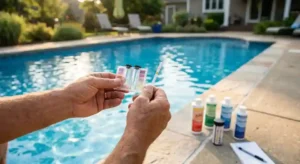
Your 48 hour chemistry checklist before any pool gathering:
- Test free chlorine: If it’s below 2 ppm, shock the pool that evening. Use calcium hypochlorite shock for a full reset.
- Test and adjust pH: Target 7.2–7.4 for a party situation, the lower end of the range gives chlorine maximum effectiveness when bather load is about to increase significantly.
- Check total alkalinity: Target 80–120 ppm. If alkalinity is off, pH will be nearly impossible to hold stable during the event.
- Test calcium hardness: San Antonio’s hard water means this number climbs constantly. Above 500 ppm, the water starts feeling uncomfortable against skin, not what you want for guests.
- Check cyanuric acid (stabilizer): Should be 30–50 ppm. Without adequate stabilizer, San Antonio’s UV exposure will burn through your freshly added chlorine before the party even starts.
The night before: Shock, run, and leave it alone
The evening before your party is shock night. Add your shock product according to the package instructions for your pool size, turn the pump to run overnight (at least 8 hours) and let the filtration system do its work while you sleep. Running the pump through the night does several things simultaneously: it distributes the shock treatment evenly throughout the water, it filters out any fine particles the shock has broken down, and it ensures your water is circulated and ready by morning.
One thing worth saying plainly: don’t skip the shock because the water looks clear. Clear water and safe water aren’t the same thing. After a week of regular swimming in Texas heat, your pool’s combined chlorine level is almost certainly elevated even if the water looks perfectly blue. That’s the chloramine load, invisible, odorless at low levels, and irritating to eyes and skin at higher concentrations. The shock clears it. The overnight pump run finishes the job.
As the Pool & Hot Tub Alliance’s water quality resources note, “the most important result to look at is free chlorine” and ensuring that number is in proper range before guests arrive is the single most important thing a pool owner can do before hosting a swimming event.
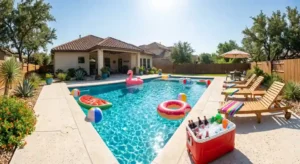
Party morning: Physical prep, safety check, and the post-party plan
The morning of: Physical cleaning in the right order
With chemistry handled the night before, party morning is about physical preparation. And like chemistry, there’s a right order to do things, work from top to bottom, from walls to floor, so debris you dislodge higher up gets captured by the vacuum rather than settling back on a surface you’ve already cleaned.
Start with the walls. Brush the entire perimeter of the pool, walls, steps, around the lights, along the waterline tile. In San Antonio’s hard water environment, a light calcium film accumulates on waterline tile faster than in softer water regions, and a party is exactly when you want that tile looking clean. A waterline tile brush and a damp cloth handles this in a few minutes.
Next, skim the surface thoroughly. Even if you skimmed yesterday, San Antonio’s wind and surrounding trees mean fresh debris has almost certainly arrived overnight. Empty the skimmer baskets completely, you’re about to add significantly more bather load to the system, and you want maximum filtration capacity going into the event.
Then vacuum. For party prep, vacuuming to filter rather than to waste is fine unless you can see visible sediment on the floor. A clean pool floor makes a genuine visual impression on guests, it’s the first thing people notice when they look into the water.
Finally, check your equipment one more time. Make sure the pump is running smoothly, the pressure gauge on your filter is within normal range, and your return jets are flowing well. A struggling filter on a busy pool day compounds quickly, the more people in the water, the more the filtration system matters.
According to This Old House’s backyard hosting guide, the physical condition of your outdoor space sets the entire tone for a gathering before a single guest arrives. That principle applies doubly to pool condition, people form an immediate impression the moment they see the water.
Safety check: The part most hosts skip entirely
Here’s an honest observation: most pool party prep focuses entirely on aesthetics and chemistry, and almost nobody thinks about safety until something goes wrong. Take ten minutes on party morning to run through the basics.
Check that your drain cover is secure and undamaged, the CDC’s pool safety guidelines consistently identify proper drain cover compliance as one of the top residential pool safety priorities. If yours is cracked or visibly deteriorated, replace it before the party, it’s a quick, inexpensive fix that matters more than most decorative prep work.
Make sure your pool steps and ladder are secure and not slippery. Wet pool decks are slippery by nature, but rough or deteriorated step surfaces are a specific hazard worth checking. If you have a pool fence or gate, confirm that it latches properly, particularly important if any children are attending.
Know where your first aid kit is. Know where the nearest life ring or reaching pole is. These aren’t morbid preparations, they’re the same kind of practical readiness that makes any outdoor hosting situation genuinely safe rather than just visually appealing.
The post-party recovery: What to do within 2 hours of guests leaving
This part doesn’t get nearly enough attention, and it’s where a lot of San Antonio pool owners end up with a green pool three days after a successful party. The chemistry impact of a full pool of swimmers, the sunscreen, the body oils, the organic load from a crowd of people on a hot Texas afternoon, is significant. Your chlorine takes a major hit. Your pH shifts. Your combined chlorine climbs.
The fix is simple but time-sensitive: within two hours of your last guest leaving, shock the pool again. Run the pump overnight. Test in the morning and adjust as needed. That’s it. Two hours of delay on that post-party shock, in South Texas summer conditions, is often the difference between crystal clear water the next day and cloudy, slightly off-color water that takes three days and multiple treatments to recover.
A pre-party pool checklist that also includes a written post-party protocol, shock timing, pump schedule, morning test, is the kind of system that keeps pool owners out of trouble through a full summer of entertaining. It sounds more organized than most people actually are, and that’s exactly why it works.
If you want to make sure your pool chemistry foundation is solid before the season’s first big gathering (and that your water is genuinely ready rather than just visually appealing) our guide on pool chemical balancing in San Antonio covers the full picture of what your water actually needs in South Texas conditions, and why the numbers on your test kit tell a more complete story than the color of the water ever will.
FAQ
1. How far in advance should I prepare my pool for a party in San Antonio TX?
Start your pre-party pool prep at least 48 hours before guests arrive, not the morning of. The night before is when you shock the pool and run the pump overnight, giving the water a full cycle to return to safe swimming levels before anyone gets in. In San Antonio’s summer heat, where UV exposure burns through chlorine faster than in cooler climates and bather load significantly increases chemical demand, that 48-hour window gives you time to correct any chemistry issues before they become a problem during the event rather than after.
2. What chemical levels should my pool have before hosting guests?
Before a pool gathering, target free chlorine between 2 and 3 ppm, pH between 7.2 and 7.4, total alkalinity between 80 and 120 ppm, and cyanuric acid between 30 and 50 ppm. In San Antonio’s hard water environment, also check calcium hardness, above 500 ppm the water starts feeling uncomfortable against skin. The CDC recommends maintaining free chlorine at 1–4 ppm and pH at 7.0–7.8 for safe swimming in residential pools. For a party situation where bather load will be higher than usual, leaning toward the higher end of the chlorine range before guests arrive gives you a meaningful safety buffer.
3. Do I need to shock my pool before AND after a pool party?
Yes, and both shocks serve different purposes. The pre-party shock, done the night before, destroys accumulated chloramines and resets your sanitizer so the water is genuinely clean when guests arrive. The post-party shock, done within two hours of your last guest leaving, addresses the significant chemical load a crowd of swimmers introduces (sunscreen, body oils, organic matter) before it has time to compound into a larger chemistry problem. In San Antonio’s summer conditions, skipping the post-party shock frequently results in cloudy or hazy water within 48–72 hours that takes multiple treatments to fully recover.
4. How do I clean my pool the morning of a party in San Antonio?
Work top to bottom: brush walls and waterline tile first, then skim the surface, then vacuum the floor. Empty skimmer and pump baskets completely, you want maximum filtration capacity during the event. Check your filter pressure gauge and confirm your pump is running smoothly. In San Antonio’s windy conditions, fresh debris accumulates overnight even after a clean the day before, so a quick morning skim is worth the ten minutes. Your physical pool cleaning before a party should take 30–45 minutes if your chemistry was handled the night before, it’s the chemistry prep that takes time, not the cleaning.
5. What pool safety checks should I do before hosting a pool party?
Run through these basics on party morning: confirm your drain cover is secure and undamaged, check that pool steps and ladder are stable and non-slippery, make sure any pool fence gate latches properly, and know where your reaching pole and first aid kit are located. These checks take less than ten minutes and address the most common pool safety issues at residential gatherings. The CDC identifies proper drain cover compliance as one of the top residential pool safety priorities, it’s a quick check that matters significantly, especially when children are attending.
