
Standing at your pool with a test strip in one hand and a phone in the other, trying to remember whether your pH should be above or below 7.4, is one of those small frustrations almost every pool owner knows well. A clear pool chemical levels chart solves that problem instantly, but most charts you’ll find online are generic, written for an average climate, and don’t account for the fact that San Antonio’s heat, sun, and hard water shift the practical targets in ways worth understanding.
This guide gives you the quick numbers to glance at on test day, plus the local context that explains why a few of those numbers deserve extra attention here specifically.
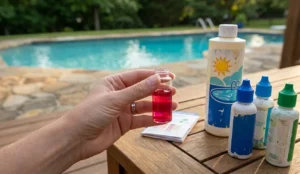
The core numbers every San Antonio pool owner should know
Your at a glance pool chemistry ranges
Here’s the baseline pool chemistry ranges chart, reflecting the standards used across the pool industry and confirmed by the Pool & Hot Tub Alliance’s official water balance guidelines:
- Free Chlorine: 1–3 ppm (target the higher end during heavy summer use)
- pH: 7.2–7.6 (lean toward 7.2–7.4 in San Antonio’s hard water)
- Total Alkalinity: 80–120 ppm
- Calcium Hardness: 200–400 ppm for concrete/plaster pools; 175–225 ppm for vinyl or fiberglass
- Cyanuric Acid (CYA): 30–50 ppm for chlorine pools; up to 70–80 ppm acceptable for saltwater pools
Keep this list somewhere easy to grab, taped inside a pool storage bin, saved as a phone photo, whatever sticks. The goal of a pool chemical levels chart isn’t to memorize anything; it’s to remove the guesswork on test day so you’re adjusting with confidence instead of second-guessing every reading.
Why these numbers matter more and shift slightly in San Antonio
Each of these five parameters interacts with the others, which is exactly why following the order matters. According to Swim University’s pool chemistry guide, “high pH can lead to high calcium hardness,” which is precisely why pH and alkalinity get corrected first, before touching calcium hardness, adjusting calcium before pH is settled means you’re often chasing a moving target.
In San Antonio specifically, two of these numbers deserve more attention than a generic chart suggests. Calcium hardness tends to run high by default here because the local water supply is naturally mineral rich, many San Antonio pools sit above 300 ppm without anyone adding a single calcium increaser. That means the practical task for most local pool owners isn’t raising calcium hardness, it’s managing it so it doesn’t climb past 400 ppm and start depositing scale on tile and equipment.
Cyanuric acid is the other number that behaves differently here. San Antonio’s intense, near-constant summer UV exposure burns through unprotected chlorine fast, which makes hitting that 30–50 ppm CYA range less optional than in milder climates. Skip this step and you’ll find yourself adding chlorine that disappears within hours, wondering why your ideal pool chemical levels never seem to hold.
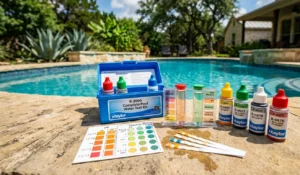
How to use this chart correctly and when the numbers don’t add up
Testing in the right order
A pool chemical chart is only useful if you test and adjust in the correct sequence, otherwise you end up correcting one number only to watch it drift again because something upstream wasn’t settled first. The standard order: total alkalinity first, then pH, then calcium hardness, then chlorine, with CYA checked periodically rather than every single test (it doesn’t fluctuate as quickly as the others).
According to Swim University’s chemical dosing guide, for a standard 10,000-gallon pool, raising alkalinity by 10 ppm takes roughly 1.5 pounds of alkalinity increaser, while raising pH by 0.2 typically requires 6 to 8 ounces of soda ash. Knowing these rough dosing benchmarks means you’re not guessing at quantities every time you open a chemical container, you’re working from a number that gets you close on the first try.
When your readings don’t match the chart what that usually means
If your numbers consistently sit outside the ideal pool chemical levels despite regular testing and adjustment, the issue usually isn’t your math, it’s an underlying factor the chart alone doesn’t capture. Calcium hardness that keeps climbing back above 400 ppm despite no calcium additions points to San Antonio’s hard tap water being added through evaporation top-offs faster than it’s being diluted out. pH that won’t hold steady often traces back to total alkalinity being out of range first, which keeps dragging pH along with it. Chlorine that disappears within a day of adding it almost always means CYA is too low to provide adequate UV protection, a fix that pays for itself quickly once corrected.
For a deeper breakdown of exactly why San Antonio’s local conditions affect each of these parameters individually (and the full reasoning behind every number on this chart) our complete guide on ideal pool chemical levels and what San Antonio owners need to know covers the science and local context in much greater depth than a quick-reference chart can.
Building testing into a routine that actually sticks
The most useful pool chemical levels chart in the world doesn’t help if testing only happens when something already looks wrong. A simple weekly habit (same day, same time, five minutes) keeps you ahead of problems instead of reacting to them. During peak San Antonio summer, when heat and UV exposure work hardest against your chemistry, testing every 4 to 5 days rather than a strict once a week schedule catches drift before it becomes visible in the water.
If you’ve been testing consistently and still can’t get your numbers to hold steady, that’s usually the point where a professional water analysis pays for itself, catching subtler issues like phosphate contamination or total dissolved solids that a basic test strip simply doesn’t measure. Our chemical balancing service in San Antonio includes a full diagnostic panel that goes beyond the five core numbers on this chart, identifying exactly what’s driving persistent imbalance rather than just treating the symptom one test at a time.
And if you’ve already nailed the basics here but want to understand the one chemistry parameter that trips up more San Antonio pool owners than any other (the one where “more” isn’t always better) our article on cyanuric acid in San Antonio pools goes deep on exactly that relationship between CYA and chlorine effectiveness.
FAQs
What are the ideal pool chemical levels for a San Antonio pool?
The standard ranges are free chlorine at 1–3 ppm, pH at 7.2–7.6 (lean lower in San Antonio’s hard water), total alkalinity at 80–120 ppm, calcium hardness at 200–400 ppm for concrete pools or 175–225 ppm for vinyl/fiberglass, and cyanuric acid at 30–50 ppm. San Antonio’s naturally mineral-rich water means calcium hardness often runs high by default, while the city’s intense summer UV exposure makes hitting the CYA range especially important for keeping chlorine from burning off too quickly.
What order should I test and adjust my pool chemicals in?
Test and adjust total alkalinity first, then pH, then calcium hardness, then chlorine, checking cyanuric acid periodically since it shifts more slowly than the others. This order matters because each parameter affects the next: high pH can drive calcium hardness up, and unstable alkalinity makes pH impossible to hold steady. Adjusting calcium or chlorine before alkalinity and pH are settled often means correcting the same number repeatedly as it keeps drifting from an unaddressed root cause.
Why does my pool’s calcium hardness keep going above 400 ppm in San Antonio?
San Antonio’s municipal water supply is naturally mineral-rich, so every time you top off your pool to replace water lost to evaporation (which happens often in the summer heat) you’re adding more calcium along with it. This is why many San Antonio pools sit above 300 ppm even without anyone adding a calcium increaser. Managing it usually means using a metal sequestrant monthly, keeping pH on the lower end of its range to slow precipitation, and considering a partial drain and refill if levels climb consistently above 500 ppm.
Why does my chlorine disappear so fast even though I just added it?
This almost always points to low cyanuric acid (CYA), the stabilizer that protects chlorine from being destroyed by UV rays. Without adequate CYA — the target is 30 to 50 ppm — San Antonio’s intense summer sun can burn through chlorine within hours rather than days. Testing your CYA level and bringing it into range, if it’s below 20 to 25 ppm, typically resolves chlorine that seems to vanish no matter how much you add.
How often should I test my pool’s chemical levels in San Antonio?
A weekly testing routine works for most of the year, but during peak summer (when heat and UV exposure work hardest against your chemistry) testing every 4 to 5 days catches drift before it becomes a visible problem like cloudiness or algae. Calcium hardness and cyanuric acid can be checked less frequently than chlorine and pH, since they shift more gradually, but should still be part of your routine at least monthly given how quickly San Antonio conditions can push them out of range.
