
Your pool needs professional cleaning in San Antonio when you see persistent cloudiness, green or yellow tinting, visible algae on walls or floor, a strong chemical smell, water that irritates skin and eyes, debris accumulating faster than you can remove it, or equipment that seems to be working but isn’t keeping the water clear. Any one of these signals warrants a professional visit, not just more chemicals.
Most pool problems don’t announce themselves dramatically. They show up quietly, a slight haze in the water, a smell that wasn’t there last week, walls that feel slippery when you brush your hand along them. Knowing the signs your pool needs professional cleaning in San Antonio means catching those signals early, before they escalate into a green pool recovery situation or equipment damage that costs significantly more to fix than a single service call would have.
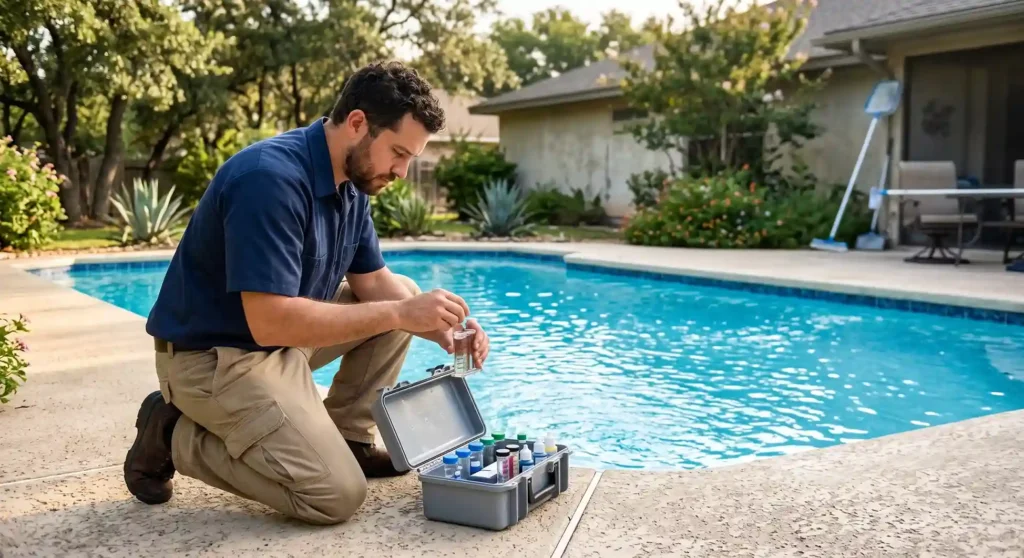
The visual signs you shouldn’t ignore
Your water looks cloudy, hazy, or off-color
Clear water is the most basic indicator of a healthy pool. When that clarity starts to go (even slightly, even just a hint of haze that makes the floor look blurry rather than sharp) something in the chemistry, filtration, or circulation system isn’t doing its job.
According to Angi’s 2026 guide on common pool problems, “cloudy water in your pool indicates chemical imbalances or clogged filters”, and the appropriate response is testing water chemistry while cleaning filters to restore clarity. The reason this warrants professional attention rather than just adding more chlorine is that cloudiness has three different root causes, each requiring a different fix. Chemistry imbalance, filtration failure, and circulation problems all look identical from the surface. Treating the wrong one wastes time, money, and chemicals while the actual problem continues developing.
In San Antonio specifically, cloudiness shows up faster and more frequently than in milder climates. The combination of intense UV exposure burning through chlorine, San Antonio’s hard water chemistry that shifts more easily than soft water, and a swim season that runs nearly nine months means there are simply more opportunities for chemistry to drift between service visits. A pool that was crystal clear on Monday can develop a noticeable haze by Thursday afternoon after a week of 105°F days and regular use.
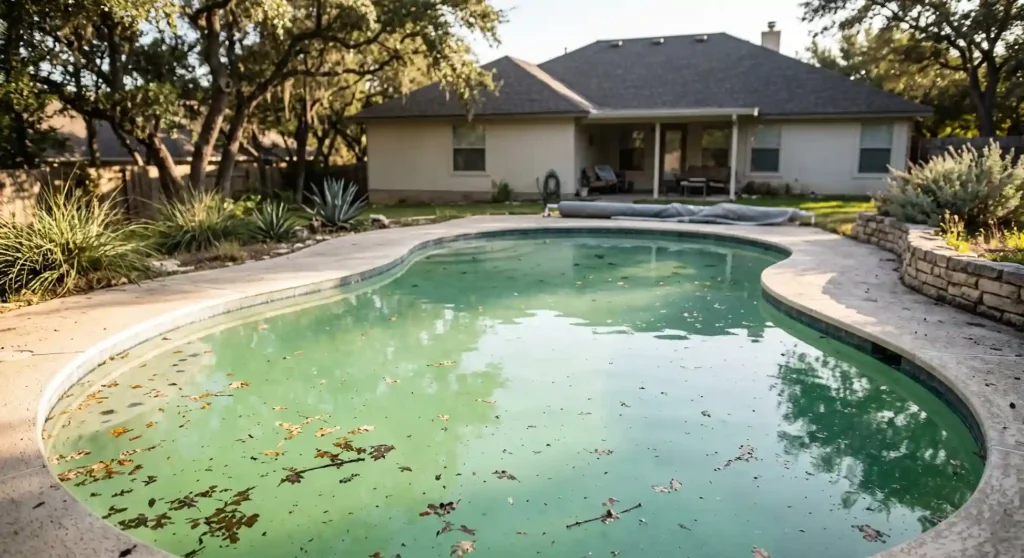
Green, yellow, or black discoloration, anywhere
Any visible discoloration beyond the natural blue of the water or the color of your pool surface is a sign that something biological has taken hold. Green tinting throughout the water almost always means algae growth, early-stage bloom where the algae is still suspended in the water rather than attached to surfaces. Yellow-green patches on walls or floor corners are mustard algae, a more resistant variety that doesn’t respond as dramatically to standard shock treatment. Black spots on the floor or steps are black algae, the most stubborn type, which roots itself into porous plaster and requires aggressive mechanical removal alongside chemical treatment.
As Angi’s pool maintenance guidance notes, “low sanitizer levels are the most common cause of pool issues like algae growth, which means your chlorine needs adjusting to keep water clear.” That’s accurate as far as it goes, but in San Antonio it understates the picture. Algae growth here is rarely just a chlorine problem, it’s typically a phosphate problem (cedar and oak pollen loading the water with algae food), a cyanuric acid problem (CYA too high, rendering chlorine ineffective), or a combination of both. A professional who can run a complete water analysis, not just a basic chlorine and pH check, identifies the actual driver rather than just dumping shock and hoping.
Visible debris accumulating despite regular maintenance
If you’re skimming regularly but still finding significant debris on the pool floor within 24 to 48 hours, your filtration system isn’t capturing what it should, your pump isn’t circulating water thoroughly enough, or the debris load from your surrounding environment has exceeded what your current maintenance routine can handle.
Neighborhoods like Helotes, Alamo Heights, and Leon Valley (with mature oak, pecan, and cedar canopies) experience this more acutely than newer developments with minimal tree coverage. After a windy afternoon in Helotes during spring, a pool can accumulate enough pollen, leaf fragments, and organic debris to visibly affect water clarity before evening. When debris accumulation consistently outpaces your maintenance effort, that’s not a homeowner failure, it’s a signal that the service frequency or scope needs to match the actual environmental conditions of your specific property.
The less obvious signs that most homeowners miss
A strong chemical smell coming from the pool
This one surprises almost everyone the first time they hear it: that sharp, harsh chemical smell coming off your pool water isn’t a sign of too much chlorine. It’s almost always the opposite. According to Angi’s pool cleaning guidance, the smell comes from chloramines, compounds formed when chlorine reacts with organic contaminants introduced by swimmers, pollen, and environmental debris. A well-maintained pool with effective chlorine levels has virtually no smell. The pungent chemical odor develops when free chlorine has been consumed and what remains is combined chlorine that’s no longer sanitizing effectively.
In San Antonio during peak summer, chloramine buildup happens faster than in cooler climates because the water is warmer, bather load is heavier, and the organic debris inputs (sunscreen, body oils, pollen) are higher. A strong smell after a pool party or a week of heavy use is a reliable signal that the water needs professional shock treatment and a full chemistry reset, not just a routine chemical check.
Water that irritates skin or eyes after swimming
Red eyes, itchy skin, and a general discomfort after swimming that you didn’t experience earlier in the season all point to water chemistry that’s out of balance in a way that basic home testing may not fully capture. High pH reduces chlorine effectiveness while also making water harsher on eyes and skin. Elevated calcium hardness from San Antonio’s mineral-rich water makes water feel abrasive. Chloramine buildup causes the same irritation symptoms as excess chlorine but requires a completely different treatment response.
When multiple swimmers in your household consistently experience irritation after pool use, that’s a pattern worth having professionally evaluated rather than self-diagnosed with home test strips. A full professional water analysis measures parameters that standard home kits miss (combined chlorine, total dissolved solids, phosphates) giving you a complete picture rather than a partial one.
Equipment running but not keeping the water right
A pump that hums normally, a filter that shows reasonable pressure, and a pool that still develops problems within days of a service visit, this combination usually points to equipment that’s running but not performing effectively. A sand filter with channeling circulates water but doesn’t filter it well. A pump running at insufficient flow rate moves water without distributing chemicals evenly. A salt cell coated in calcium scale from San Antonio’s hard water generates far less chlorine than its settings suggest.
According to Angi’s professional pool maintenance guide, “expect to pay around $1,200 per year for professional pool maintenance services that keep your water safe and your equipment running smoothly”, a figure that reflects not just cleaning but the ongoing equipment assessment that catches these performance issues before they compound into visible water quality problems. A technician who knows what normal looks and sounds like on each piece of equipment spots the underperforming filter or marginal pump months before a homeowner notices anything wrong.
You’ve lost track of when things were last done
This one is honest rather than diagnostic, if you genuinely can’t remember when you last cleaned the filter, tested calcium hardness, or checked your cyanuric acid level, that gap is itself a signal. In San Antonio’s demanding climate, the monthly tasks that many homeowners deprioritize (calcium hardness testing, CYA monitoring, filter deep-cleaning, equipment inspection) are the ones where falling behind creates the most expensive problems. A professional visit that includes a full assessment resets that baseline and identifies what’s been accumulating in the background.
How to choose the right professional cleaning service for your situation
Once you’ve identified that your pool is showing one or more of these signs, the question shifts from “does my pool need help” to “who should I call.” A routine maintenance provider and a company that handles deep-clean and recovery situations aren’t always the same, and matching the right service scope to your pool’s actual condition determines how quickly and cost-effectively the problem gets resolved.
For pools showing early warning signs (slight cloudiness, minor algae, equipment that seems slightly off) a standard professional service visit with full chemistry testing and physical cleaning typically resolves the issue in one visit. For pools that have developed visible algae blooms, persistent discoloration, or multiple simultaneous chemistry problems, a targeted deep-clean service addresses the immediate situation and establishes the proper baseline for ongoing maintenance.
Our comprehensive pool cleaning service in Bexar County covers both scenarios, routine maintenance visits for pools staying ahead of problems and full-scope deep clean services for pools that have developed visible issues from heat, pollen, or deferred maintenance during San Antonio’s demanding summer season.
For a clear breakdown of exactly what a professional pool cleaning service should include at every visit (so you know whether the service you’re considering is genuinely comprehensive or cutting corners) our article on what a pool cleaning service in San Antonio includes covers the complete checklist with the local context that makes San Antonio’s maintenance demands different from most national guides.
FAQ
What are the signs my pool needs professional cleaning in San Antonio TX?
Your San Antonio pool needs professional cleaning when you notice persistent cloudiness or haze that doesn’t clear with basic chemistry adjustments, green or yellow discoloration indicating algae growth, a strong chemical smell from chloramine buildup, skin or eye irritation after swimming, visible debris accumulating faster than routine maintenance can handle, or equipment that’s running normally but failing to keep the water clear. In San Antonio’s nine-month swim season with hard water and intense UV exposure, these signs appear faster than in milder climates, making early professional intervention more important here than in most markets.
Why does my San Antonio pool keep getting cloudy even when I maintain it?
Persistent cloudiness in San Antonio pools despite regular maintenance usually points to one of three causes: calcium precipitation from the city’s hard water (elevated calcium hardness combined with high pH causes mineral particles to cloud the water even with correct chlorine levels), filtration underperformance from a loaded cartridge or channeled sand media, or phosphate contamination from cedar and oak pollen loading the water with algae nutrients that consume chlorine before it can sanitize. Standard home test kits don’t measure phosphates or total dissolved solids, so persistent cloudiness that doesn’t respond to chemistry adjustments almost always warrants a professional water analysis that goes beyond the basic parameters.
What does a strong chemical smell from my pool mean in San Antonio?
A strong chemical smell from your pool almost always means chloramine buildup, not excess chlorine, but depleted chlorine that has reacted with organic contaminants and formed compounds that smell harsh but no longer sanitize effectively. In San Antonio during peak summer, chloramine formation happens faster because warmer water, heavier bather loads, and higher organic debris input from pollen and surrounding vegetation all accelerate the reaction. The fix is shock treatment to break down chloramine compounds, not simply adding more chlorine on top of the existing situation. A professional who can measure both free and combined chlorine levels determines the correct treatment approach.
How do I know if my pool has algae in San Antonio TX?
Early algae in a San Antonio pool shows as a slight green or yellow-green tint to the water, wall surfaces that feel slippery when touched rather than smooth and slightly rough, or visible green patches forming in shaded corners, on steps, or along the waterline. Established algae growth produces more obvious green coloring throughout the water or visible patches on surfaces. Black spots on the pool floor or steps indicate black algae, the most resistant type, which roots into porous plaster and requires mechanical brushing with a stainless steel brush alongside chemical treatment. Any visible algae sign warrants professional attention, since DIY treatment that doesn’t address the phosphate or chemistry root cause allows rapid regrowth.
How often should I have my San Antonio pool professionally cleaned?
Most actively used San Antonio pools benefit from weekly professional service during the swim season, which runs approximately March through November. San Antonio’s combination of intense UV exposure, triple-digit summer temperatures, hard water chemistry demands, and a season nearly twice the length of northern markets creates conditions where chemistry can shift noticeably within 48 to 72 hours of a service visit. Biweekly service works for pools with minimal use or during the cooler fall transition months. Monthly service is generally insufficient for actively used pools during San Antonio’s core summer, the gap between visits is long enough for visible problems to develop that are more expensive to correct than prevent.
