
You walk out to the pool on a Tuesday morning and something’s just, off. The water that was perfectly blue on Saturday now has that milky, hazy look that sets off a low-grade anxiety in every pool owner. You know the feeling. Cloudy pool water in San Antonio TX is one of the most common calls pool professionals receive throughout the summer season, and it’s also one of the most misdiagnosed. Most homeowners reach immediately for shock treatment, and sometimes that’s exactly right. But sometimes it does absolutely nothing, because cloudiness has three completely different root causes, and treating the wrong one just wastes time, chemicals, and money.
This guide walks you through how to actually diagnose what’s making your water cloudy before you touch a single product, then gives you the correct fix for each scenario. No guesswork, no throwing chemicals at the wall and hoping something works.
Understanding what’s actually in your water, the three root causes
Why “just shock it” isn’t always the answer
Here’s the thing about cloudy pool water: it looks the same regardless of what’s causing it. A chemistry problem, a filtration failure, and a circulation issue can all produce water with that identical dull, milky appearance. Shock treatment addresses one of those causes directly and has limited effect on the other two. Skipping the diagnosis step and going straight to shock is the single most common mistake pool owners make, and it explains why so many people end up treating their pool three times over a weekend with no meaningful improvement.
The good news is that diagnosing the actual cause is straightforward if you know what to look for. And in San Antonio’s specific environment (hard water, intense UV, long swim seasons, and significant environmental debris loads) certain causes are more common than others at different times of year.
According to Bob Vila’s cloudy pool water guide, the primary causes of cloudy pool water fall into three categories: insufficient filtration, chemical imbalance, and environmental debris accumulation. Every cloudy pool situation traces back to one or a combination of these three. Identifying which one you’re dealing with is step one, everything else follows from there.
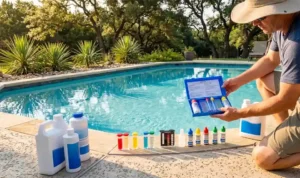
Cause #1 Chemical imbalance: The most common culprit in South Texas
In San Antonio, chemistry-related cloudiness is the most frequent cause of hazy water, and it shows up in several distinct forms that behave differently and require different fixes.
Low free chlorine is the most straightforward chemistry cause. When chlorine drops below 1 ppm (which happens faster in San Antonio’s summer heat than most homeowners expect) organic matter accumulates in the water faster than the sanitizer can process it. Bacteria, body oils, sunscreen residue, and fine organic particles build up, scattering light and creating that milky appearance. This is the scenario where shock treatment is the correct first response, and it typically produces visible improvement within 24 hours.
High pH combined with high calcium hardness produces a completely different type of cloudiness, one that looks almost identical to low-chlorine cloudiness but doesn’t respond to shock at all. When pH rises above 7.8 and calcium hardness is elevated (which is essentially the default state in San Antonio given the hard local water supply), calcium carbonate begins precipitating out of solution as microscopic white particles. The result is a white, milky haze that no amount of chlorine will clear because the problem is mineral precipitation, not organic contamination. This is one of the most frequently misdiagnosed causes of cloudy pool water in the region.
High combined chlorine / chloramine buildup creates a slightly different haze (often accompanied by that sharp chemical smell) and requires shock treatment specifically to break down the chloramine compounds rather than simply boost chlorine levels.
San Antonio’s hard water creates a particular vulnerability to calcium-precipitation cloudiness that pools in softer water regions simply don’t face as often. Angi’s pool cloudiness guide notes that “high calcium levels from hard water” is one of the primary chemical causes of cloudy water, a reality that Bexar County pool owners face as a baseline condition rather than an occasional problem.
Cause #2 Filtration problems: The silent cause that keeps coming back
If you’ve corrected your chemistry, everything tests within range, and the water is still hazy (or if the cloudiness clears briefly and then returns within a day or two) filtration is almost certainly your issue. A filter that isn’t capturing fine particles effectively allows them to circulate back into the pool continuously, creating a cloudiness that chemistry adjustments alone can never fully resolve.
Pool filtration problems in San Antonio manifest in a few specific ways. A cartridge filter loaded with accumulated debris, body oils, and sunscreen residue loses its ability to capture fine particles even when it doesn’t appear dramatically dirty on visual inspection. The microscopic pores clog gradually, reducing filtration efficiency well before the filter looks obviously compromised. Regular cartridge cleaning (every two to four weeks during heavy use periods) is the preventive measure, but many homeowners wait until visual inspection suggests cleaning is needed, which is often well past the point where efficiency has declined.
Sand filters can develop channeling (pathways where water flows through without full contact with the filter media) reducing their effectiveness while appearing to function normally. DE filters that have been backwashed without recharging with fresh diatomaceous earth lose their fine particle capture capability entirely. Both scenarios produce persistent cloudiness that chemistry treatment doesn’t touch.
How long you run your pump daily matters just as much as filter condition. In San Antonio’s summer, a minimum of 8 hours of daily pump runtime is the baseline, and pools with heavy use, significant tree debris, or hard water conditions often benefit from 10–12 hours during peak season. If your pump is running less than 8 hours and your water has developed a haze, extending runtime is often the simplest first fix before reaching for any chemical treatment.
Cause #3 Environmental debris: San Antonio’s specific challenge
The third cause of pool water clarity issues is the one most specific to San Antonio’s environment, and it’s particularly pronounced during certain times of year. Fine environmental particles, oak and cedar pollen, caliche dust from the Hill Country, fine soil particles after storms, and microscopic debris from surrounding vegetation, overwhelm pool filtration systems in ways that produce a persistent, stubbornly hazy water appearance.
Spring pollen season is the most dramatic example. A pool that’s been crystal clear all winter can develop a yellowish-green haze within 48 hours of a high-pollen wind event, even with perfect chemistry and a functioning filter. The volume of fine organic material simply exceeds what the filtration system can process at its normal operating rate. Post-storm cloudiness from heavy rain carrying fine soil particles into the pool follows the same pattern.
The important distinction here is that environmental debris cloudiness usually responds to a combination of extended filter runtime, a pool clarifier product (which coagulates fine particles into larger clusters the filter can capture more easily), and in severe cases, vacuuming to waste rather than through the filter. Shock treatment alone won’t resolve it because the cause isn’t chemical, it’s physical particles the filter needs time and assistance to remove.
The step-by-step diagnosis and fix for each scenario
Your diagnosis sequence, do this before touching any product
This is the part most people skip, and it’s exactly what makes the difference between fixing the problem in 24 hours and fighting it for a week. Before adding anything to your pool, run through this sequence:
- Step 1: Test your chemistry fully. Not just chlorine and pH, test total alkalinity, calcium hardness, and cyanuric acid as well. In San Antonio, calcium hardness and pH are the parameters most likely to be driving cloudiness independently of chlorine levels.
- Step 2: Check your filter. Inspect your filter pressure gauge, elevated pressure indicates a dirty filter needing cleaning. For cartridge filters, physically inspect the cartridge. For sand filters, check when you last backwashed.
- Step 3: Assess your pump runtime. Has your pump been running at least 8 hours daily? Has anything changed recently — a timer setting, a power interruption, a new schedule?
- Step 4: Consider recent environmental events. Did it storm recently? Is pollen count high? Has the pool had heavy use with lots of swimmers?
The answers to these four questions will almost always point clearly to the primary cause, and usually to a single dominant factor rather than multiple simultaneous problems.
Fixing chemistry-driven cloudiness
If low chlorine is your diagnosis: shock the pool with calcium hypochlorite shock at the correct dose for your pool volume, run the filter overnight, and retest in the morning. Visible improvement should appear within 12–24 hours. If the water doesn’t clear after a full shock cycle and overnight filtration, chemistry alone isn’t the only issue.
If high pH and calcium hardness are your diagnosis: add pH reducer (muriatic acid or sodium bisulfate) to bring pH down to 7.2–7.4. Add a clarifier to help coagulate the precipitated calcium particles so the filter can capture them. Run the filter continuously for 24–48 hours. Do not shock during this phase, adding more oxidizer to oversaturated water can make the precipitation cloudiness temporarily worse.
The CDC’s residential pool water treatment guidelines emphasize that proper pH maintenance (specifically keeping it between 7.0 and 7.8) is essential not just for chlorine effectiveness but for overall water clarity and swimmer comfort. In San Antonio’s hard water environment, pH management requires more frequent attention than in softer water regions because alkalinity and calcium levels naturally push pH upward over time.
Fixing filtration-driven cloudiness
Clean your filter first, thoroughly, using the appropriate method for your filter type. For cartridge filters, soak the cartridge in a filter cleaning solution overnight rather than just hosing it down. For sand filters, perform a full backwash cycle. For DE filters, backwash and recharge with fresh diatomaceous earth.
After cleaning, extend your pump runtime to 12 hours daily until the water clears. Add a clarifier to help the newly cleaned filter capture the fine particles more effectively. Retest chemistry after 24 hours, a dirty filter that’s been recirculating contaminated water can also affect chemical readings, so the chemistry picture may look different after the filtration issue is resolved.
If the filter needs cleaning more frequently than every two to three weeks during normal use, it may be undersized for your pool’s actual load, a professional assessment can determine whether your filtration system is appropriately matched to your pool’s volume and use patterns.
Fixing environmental debris cloudiness
Add a pool clarifier at the label-recommended dose, run the filter continuously for 24 hours, then vacuum the pool floor thoroughly, preferably to waste if your setup allows, to remove the coagulated debris rather than cycling it back through the filter. Clean your filter immediately after vacuuming.
For severe pollen cloudiness, a flocculant product (heavier than a standard clarifier) can be used to drop all suspended particles to the pool floor simultaneously, then vacuumed to waste in a single pass. This is the fastest resolution for significant pollen-driven haze but requires vacuuming to waste capability.
The CDC’s swimming illness prevention resources note directly that “cloudy water can be a warning that there are more germs in the water than normal”, which is a good reminder that regardless of the cause, cloudy water is a signal to stay out until the issue is resolved. Clear water isn’t just aesthetically preferable; it’s a basic indicator of safe swimming conditions.
Persistent fix cloudy pool fast situations that don’t respond to the correct diagnosis and treatment within 48–72 hours are worth escalating to a professional. Sometimes multiple causes are operating simultaneously (a filtration issue alongside chemistry imbalance, for example) and untangling them efficiently requires experience and proper diagnostic tools.
For chemistry-related cloudiness specifically, our chemical balancing service in San Antonio handles the full diagnostic and correction process professionally — testing all parameters, identifying the specific imbalance driving the cloudiness, and correcting it in a single visit rather than the trial and error cycle most homeowners go through alone.
And if your cloudy water diagnosis points to phosphates as a contributing factor (particularly if the haziness appeared or worsened after a rain event or during pollen season) our article on phosphates in your pool in San Antonio TX covers that specific issue in detail, including why it’s more prevalent in South Texas than most homeowners realize and how to address it as part of a complete water clarity strategy.
FAQ
1. Why is my pool water cloudy in San Antonio TX even though my chlorine level is fine?
Correct chlorine doesn’t guarantee clear water, there are two other causes that chlorine doesn’t address. High pH combined with high calcium hardness (extremely common in San Antonio’s hard water environment) causes calcium carbonate to precipitate out of solution as microscopic white particles, creating a milky haze that shock treatment won’t resolve. Filtration problems (a clogged filter, insufficient pump runtime, or a filter undersized for your pool’s load) produce the same visual result. Testing your full chemistry panel including calcium hardness and pH, then checking your filter condition, will identify which issue you’re actually dealing with.
2. How long does it take to clear cloudy pool water in San Antonio?
It depends entirely on the cause. Chemistry-driven cloudiness from low chlorine typically clears within 12–24 hours of correct shock treatment and overnight filtration. Calcium precipitation cloudiness from high pH and hard water takes 24–48 hours of clarifier treatment and extended filter runtime to resolve fully. Filtration-driven cloudiness (where the filter itself is the problem) can take 24–72 hours after a thorough filter cleaning and extended pump runtime. Environmental debris cloudiness from pollen or post-storm particles responds fastest to a flocculant treatment followed by vacuuming to waste, typically clearing in 12–24 hours.
3. Can I swim in a cloudy pool in San Antonio?
No, and the CDC specifically identifies cloudy water as a warning sign that germ levels may be higher than normal. Beyond the health concern, cloudy water indicates an underlying problem that will worsen without treatment. Depending on the cause, you may be swimming in water with elevated bacteria from low chlorine, calcium particles from mineral precipitation, or fine debris and pollen that’s overwhelming your filtration system. None of these are conditions you want to expose swimmers to. Resolve the cloudiness and confirm clear water before resuming use, the diagnosis and fix process for most cloudy pool situations takes 24–72 hours.
4. Why does my pool get cloudy after it rains in San Antonio TX?
Rain introduces multiple cloudiness causing factors simultaneously in San Antonio’s specific environment. Rainwater dilutes your chemistry, dropping chlorine and alkalinity while the natural acidity of rain lowers pH. Runoff from surrounding landscaping introduces fine soil particles, fertilizer compounds, and phosphates directly into the pool water. Pollen that’s been accumulating on surrounding surfaces washes in during the rain event. The combination of chemistry dilution and particle introduction overwhelms both your chemical balance and your filtration system at once. After any significant rainfall, test your chemistry fully, shock if chlorine has dropped, add a clarifier, and extend your pump runtime for 24 hours.
5. What is the fastest way to fix cloudy pool water in San Antonio TX?
The fastest fix depends on correctly identifying the cause first, skipping diagnosis and going straight to treatment is why most homeowners spend days fighting the problem instead of resolving it in hours. For chemistry cloudiness from low chlorine: shock and run the filter overnight. For calcium precipitation from high pH: add pH reducer and clarifier, run filter 24–48 hours. For filtration issues: clean the filter thoroughly and extend pump runtime immediately. For environmental debris: use a flocculant, vacuum to waste, then clean the filter. If multiple causes are operating simultaneously or the water doesn’t clear within 72 hours of correct treatment, a professional pool water clarity diagnosis is the most efficient path to resolution.
