
A leaking pool pump motor in San Antonio is almost always caused by a failed shaft seal, a worn or cracked O-ring, or a loose union fitting on the suction side. Shaft seal replacement costs $100 to $250. O-ring replacement is $5 to $15 and fully DIY-friendly. Loose unions are free to fix. But here’s what matters most, if chlorinated water has been leaking into the motor housing, every hour you keep running it is making the repair more expensive.
There’s a puddle under your pool pump. Or maybe it’s not quite a puddle yet, just a wet spot that’s been there for a couple of days, or water staining on the concrete around the equipment pad that wasn’t there last season. A leaking pool pump motor in San Antonio TX sounds like a small problem until you understand what that water is actually doing once it gets inside the motor housing. This guide tells you exactly where pool pump leaks come from, how to pinpoint which one you have, what you can fix yourself, and when calling a professional is the move that saves you money.
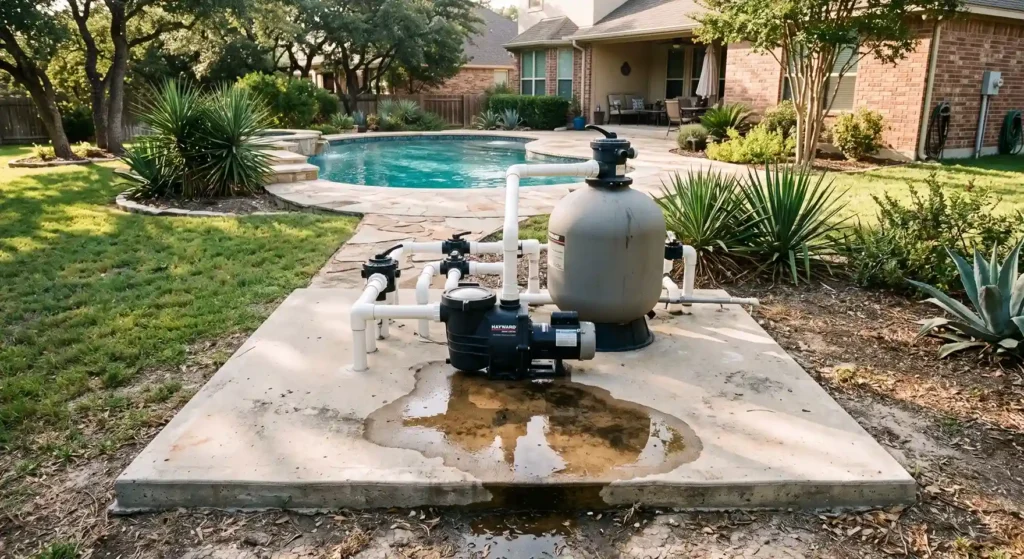
Where pool pump leaks actually come from
The three most common leak sources, and how to tell them apart
Not all pool pump leaks are the same, and treating the wrong one wastes time and money. Before touching anything, watch where the water is coming from during operation. The location tells you nearly everything.
Water dripping from the bottom of the pump housing, right where the motor meets the wet end, this is almost always a shaft seal failure. The shaft seal is a two-part mechanical seal that sits between the motor shaft and the water-filled pump housing. It keeps pool water from traveling up the shaft and into the motor. According to Angi’s 2026 pool pump repair cost guide, “seals keep water from leaking out of your pump and maintain the pressure needed for proper operation” and “most pool pump seals should be replaced every two to three years, or sooner if a leak is detected.” In San Antonio’s conditions, nine months of operation, triple-digit heat stress, and hard water with elevated mineral content working on every rubber component, seal failure often arrives closer to the two-year mark than the three-year mark.
The critical urgency point with a shaft seal leak: according to expert pool technicians on Trouble Free Pool’s community forums, “chlorinated water travels down the shaft to the bearing and will quickly result in a loud motor. When this happens it also often requires a motor change that adds a couple hundred dollars to the repair.” A leak from the shaft seal that’s allowed to continue (especially in San Antonio’s summer heat where the motor is already running hot) turns a $100 to $250 seal replacement into a $350 to $700 motor replacement in a matter of weeks.
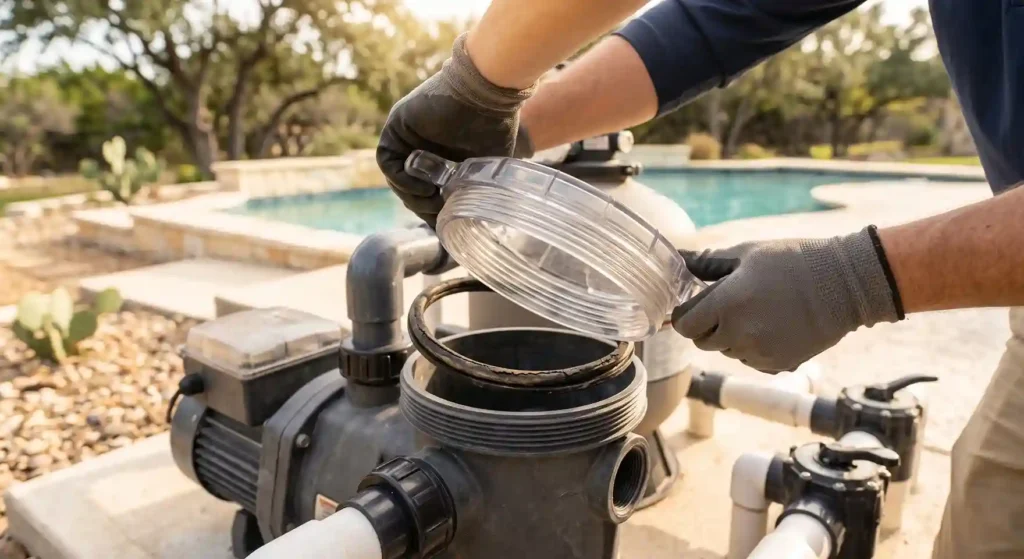
Water leaking from the pump lid or the top of the strainer basket housing points to a lid O-ring failure rather than a shaft seal issue. This is the most DIY-friendly leak of the three, the O-ring is visible inside the pump lid once you remove it, it’s a $5 to $15 part at any pool supply store, and replacement requires no tools beyond hand-turning the lid off and back on. According to Angi’s guide on pool pump problems, “the seal inside your pool pump that keeps water from escaping is called the O-ring. O-rings will wear down over time and are an easy fix when it’s time to replace them.” In San Antonio’s heat, O-rings dry out and crack faster than in cooler climates, inspect yours at the start of each season and anytime after the pump has been off for an extended period.
Water leaking from the union fittings (the large threaded connections where the plumbing pipes meet the pump inlet and outlet) is the third common source and is also frequently DIY-fixable. Over time, the O-rings inside union fittings harden and lose their seal, particularly in San Antonio’s UV and heat environment. Hand-tighten the unions first, sometimes that’s genuinely all it takes. If the O-ring is visibly cracked or flattened when you open the union, replacing it costs $3 to $8 and takes about ten minutes.
How San Antonio’s conditions accelerate pump seal failure
Here’s the local context that most generic pool pump guides don’t address. San Antonio’s combination of hard water, extended operating season, and extreme summer heat creates a seal deterioration environment that’s more aggressive than the national average suggests.
The mineral content in San Antonio’s water (among the highest of any major U.S. city) deposits calcium and mineral scale on every wet component in your pump system, including the ceramic face of the shaft seal. That scale buildup creates surface irregularities on what needs to be a perfectly smooth sealing surface, allowing water to bypass the seal long before the rubber or ceramic components themselves have actually worn out. Regular descaling of the pump’s wet end components, particularly for pools using well water or experiencing very high calcium hardness, extends shaft seal life meaningfully.
The length of the operating season compounds this. A San Antonio pump running nine months accumulates roughly 2,700 hours of operation in a year, almost double what a pump in a northern market accumulates in four to five months. Seal wear is largely a function of operating hours, which means replacing shaft seals on a two-year schedule in San Antonio is approximately equivalent to a three-year schedule in a shorter-season market.
What you can fix yourself vs. when to call a pro
The DIY fix: O-ring and union replacement
If your leak is coming from the pump lid or a union fitting, handle this yourself, it’s straightforward, inexpensive, and doesn’t require any technical background with pool pump internals.
For the lid O-ring: turn off the pump at the breaker, remove the pump lid by unscrewing it counterclockwise, locate the O-ring sitting in the groove inside the lid, inspect it for cracking, flattening, or brittleness. If it’s intact but dry, apply pool-grade silicone lubricant (never petroleum-based products, which degrade rubber) and reseat it. If it’s damaged, take it to your local pool supply store and match the size for a $5 to $15 replacement. Reinstall the lid hand-tight, restart the pump, and check for dripping. This fix takes under 10 minutes and resolves a surprising percentage of apparent “motor leaks.”
For union fittings: turn off the pump, unscrew the union collars by hand (they should be hand-tight, not wrench-tight, overtightening PVC cracks it), inspect the O-ring inside each union, replace if needed with a matched size, apply silicone lubricant, and reassemble hand-tight plus a quarter turn. Check for leaks with the pump running before walking away.
The professional fix: Shaft seal replacement
Replacing a shaft seal involves disassembling the pump’s wet end, removing the motor from the housing, pulling the impeller, extracting the old seal, installing the new one correctly, and reassembling everything. It’s technically possible for a hands-on homeowner with the right tools and patience, but there are two reasons why most San Antonio pool owners benefit from professional service for this specific repair.
First, correct installation matters enormously. The shaft seal has two components (a rotating carbon/graphite face and a stationary ceramic face) that must be installed with the correct orientation, in the correct order, without contaminating the sealing surfaces with oils or debris. Installing the ceramic portion upside down, or contaminating the mating surfaces, results in an immediate leak that looks identical to the original problem. Getting it right the first time is the difference between one service call and two.
Second, the condition of the motor housing and bearings needs professional assessment during the repair. As Bob Vila’s repair guidance confirms, “pool pump failure causes leaks. Because there are several moving parts inside the pump, each part will need to be closely examined to determine if the pump can be repaired or if it will need to be replaced.” A technician who opens your pump for a seal replacement can tell immediately whether the bearings have been wet long enough to develop corrosion, whether the motor windings show heat damage from running with a compromised seal, and whether the repair scope should expand before the pump goes back together.
According to Angi’s 2026 data, professional seal replacement runs $100 to $250, a cost that stays at that level only when the leak is caught before bearing or motor damage occurs. Every week a leaking shaft seal runs unaddressed in San Antonio’s summer conditions, the probability that the repair expands into a $350 to $700 motor replacement increases. The urgency isn’t manufactured, it’s a real function of heat-accelerated corrosion on wet metal inside an operating motor.
For professional diagnosis and repair of a leaking pool pump in San Antonio, including same-week scheduling for situations where the leak is active and the pump is already showing signs of progressive damage, our pool equipment maintenance and repair service in Bexar County covers the full range of pump repairs with transparent upfront pricing before any work begins.
For a broader look at pump repair costs, the repair versus replace framework, and what the warning signs of additional motor damage look like after a seal leak, our detailed guide on pool pump repair in San Antonio TX covers all of that with real 2026 local pricing.
FAQs
How do I fix a leaking pool pump motor in San Antonio TX?
First identify where the leak is coming from, water dripping from the bottom of the pump housing where motor meets wet end points to a failed shaft seal ($100-$250 professional repair). Water leaking from the pump lid is an O-ring issue ($5-$15 DIY fix). Water at union fittings is usually a union O-ring replacement ($3-$8 DIY). In San Antonio’s heat, shaft seal leaks are the most urgent, chlorinated water entering the motor housing corrodes bearings quickly in triple-digit temperatures, turning a $150 seal repair into a $700 motor replacement within weeks if left running.
How much does it cost to fix a leaking pool pump in San Antonio TX?
Pool pump leak repair costs in San Antonio range from $5 to $700 depending on the source. A lid O-ring replacement is $5 to $15 and fully DIY. Union fitting O-ring replacement runs $3 to $8 per fitting. Professional shaft seal replacement costs $100 to $250 when caught before motor damage occurs. If a leaking shaft seal has been running long enough to damage the motor bearings, repair expands to $200 to $500 for motor repair or $350 to $700 for motor replacement. San Antonio’s extended operating season and heat accelerate the damage progression, making early repair significantly less expensive than delayed repair.
What causes a pool pump to leak water at the bottom in San Antonio?
Water dripping from the bottom of a pool pump housing in San Antonio almost always indicates a failed shaft seal, the mechanical seal that prevents pool water from traveling up the motor shaft into the motor housing. Shaft seals typically last two to three years nationally, but San Antonio’s nine-month operating season (nearly double northern markets), hard water mineral buildup on seal faces, and extreme heat stress on rubber components often bring that timeline closer to two years. Ignoring a shaft seal leak allows chlorinated water to reach the motor bearings, causing corrosion that progressively escalates repair costs.
Can I fix a leaking pool pump myself in San Antonio TX?
It depends on where the leak is coming from. Lid O-ring replacement and union fitting O-ring replacement are both DIY-friendly, they require no special tools, cost under $15, and take under 15 minutes. Shaft seal replacement is technically possible for handy homeowners but carries real risk of incorrect installation that results in continued leaking, and the professional assessment of whether bearings or motor windings have been damaged by the leak adds significant value. For any leak where water has been visibly dripping from the bottom of the pump housing for more than a week in San Antonio’s summer heat, professional service is the repair approach that protects the motor.
How urgent is a leaking pool pump motor in San Antonio TX?
Very urgent, specifically because of San Antonio’s climate. When a shaft seal leaks, chlorinated water travels down the motor shaft toward the bearings. In ambient temperatures above 100°F, the combination of water contamination and heat stress accelerates bearing corrosion significantly faster than in cooler climates. A shaft seal leak caught within the first week typically costs $100 to $250 to fix. The same leak running for a month in a San Antonio July can cost $350 to $700 once motor damage is factored in. Turn the pump off when not actively needed for circulation until the repair is completed, and schedule a diagnostic visit within 48 to 72 hours of first noticing the leak.
