
Your Hondo TX pool needs professional service when you notice persistent cloudiness or grayish turbidity from caliche dust, green or yellow-green tinting from algae, orange or brown discoloration from iron in well water, a strong chemical smell, skin or eye irritation after swimming, slippery walls, or equipment that’s running but not keeping up. In Hondo’s rural environment with limited same-day service availability, acting on these signs early matters more than in urban markets where you can call five companies and get help the same afternoon.
If you own a pool in Hondo or anywhere in Medina County, you already know that pool maintenance out here isn’t quite the same as what those online guides written for suburban San Antonio assume. The open land, the wind, the well water, the caliche dust, all of it creates a pool environment with its own specific set of warning signs that don’t always look like what you’d expect. Knowing the signs your Hondo TX pool needs professional cleaning means recognizing signals that are specific to this area, not just the generic green pool equals algae framework that covers maybe half the story out here.
The visual signs: What Hondo pools show that’s different from the generic guides
Grayish or dusty turbidity that isn’t green
This is the Hondo-specific sign that catches most local pool owners off guard, because it doesn’t look like what they expect algae to look like. Your water isn’t green, it has a grayish, dusty, or milky tinge, like someone stirred fine powder into it. On windy afternoons across Medina County’s open ranchland, that’s exactly what happened.
Caliche dust (the fine calcium-rich sediment common throughout this part of Texas) blows off surrounding dry land and deposits into pool water in volumes that urban pools simply don’t experience. Once airborne caliche particles settle into the water, they create a turbidity that looks almost identical to a chemistry imbalance but doesn’t respond to chemical treatment the way chemistry problems do. You can adjust pH, add chlorine, and shock the pool, and that grayish haze won’t budge, because the fix isn’t chemical, it’s physical filtration and clarifier treatment to coagulate the fine particles so your filter can capture them.
According to Aquatech Pools’ professional cleaning guide, “cloudy water often results from a chemical imbalance, which experts can resolve efficiently.” That’s true for urban pools, in Hondo, cloudy or hazy water that doesn’t respond to chemistry correction almost always points to the environmental particulate load specific to this area rather than a chemistry problem, and it needs a different response.
Orange or brown discoloration: Iron from well water
Standard pool guides cover green water from algae and white cloudiness from chemistry. They rarely cover orange or brown discoloration, which is a sign specific to pools on well water, and one that’s common throughout Medina County’s limestone and iron-rich geology.
Iron dissolved in well water oxidizes when it contacts chlorine in your pool, leaving rust-colored staining on surfaces and a brownish tinge throughout the water. This isn’t algae, it isn’t chemistry imbalance in the traditional sense, and standard shock treatment won’t fix it, adding oxidizing chlorine to iron-contaminated water actually makes the discoloration temporarily worse as more iron precipitates out of solution. The correct treatment is a metal sequestrant that keeps iron suspended in solution rather than allowing it to deposit on surfaces and color the water, followed by filter cycling to remove it from the system.
If your pool has taken on any orange, reddish-brown, or rusty tinge (particularly after a significant rain event that stirred up well water sediment) that’s a sign your pool needs professional attention from someone familiar with iron contamination in well water systems. This is not a chemistry problem you solve with more chlorine.
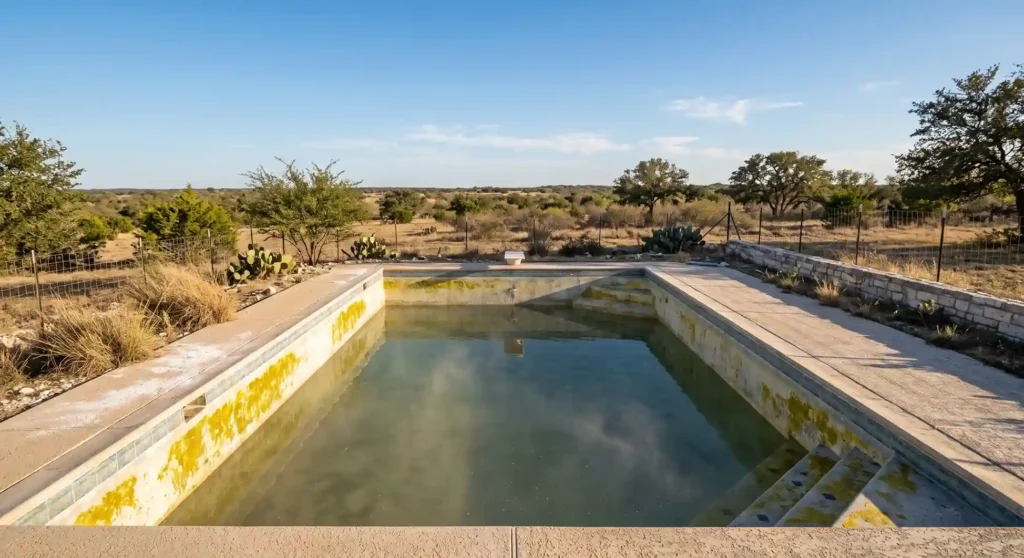
Yellow or mustard algae on walls and in shaded areas
Mustard algae (sometimes called yellow algae) is particularly common in Hondo and Medina County pools, and it shows up specifically in the reviews of pool cleaning companies serving this area. Unlike green algae that suspends in the water column and turns the whole pool green, mustard algae typically appears as yellowish-green patches on walls, steps, and shaded corners where water circulation is slower.
It’s also significantly more resistant to standard shock treatment than green algae, it brushes off surfaces easily but reappears within days because it’s survived in the pool’s porous plaster rather than being eliminated. According to Bluewater Pools’ 2026 Texas pool maintenance guide, “a pool that looks fine on Monday can have visible algae growth by Friday if the chemistry is off.” For mustard algae specifically, standard chlorine shock at normal doses often produces that outcome, the pool looks better for two or three days before the same patches reappear in the same locations.
Professional treatment for mustard algae requires specific algaecide products targeted at this variety, thorough mechanical brushing of all surfaces simultaneously, and a shock protocol calibrated to its greater chlorine resistance. If you’ve been treating what looks like algae and it keeps coming back to the same spots, mustard algae is the likely culprit and it requires a different approach than green algae.
Black spots on pool floor or steps
Black algae is the most stubborn variety and one that Hondo’s plaster pools see regularly, it roots itself into the microscopic pores of plaster surfaces and develops a protective waxy coating that standard chlorine treatment can’t penetrate without physical disruption. As Aquatech Pools notes, “black algae bonds with pool surfaces more aggressively, making removal challenging without specialized equipment and chemicals” and “professionals have access to specific algaecides and cleaning tools that can eradicate black algae completely.”
Black spots on your pool floor or steps that don’t scrub away with a standard pool brush (or that return to the same locations after treatment) are a reliable sign that professional service with a stainless steel brush and targeted chemical application is needed. This is one of the few pool problems where attempting DIY treatment multiple times without success actually makes the final professional fix harder, because partially-treated black algae can spread before proper treatment eliminates it.
The less obvious signs: Smell, skin irritation, and equipment signals
A strong chemical smell after opening the pool or after swimmers leave
A well-maintained Hondo pool should have very little chemical odor, a faint, neutral smell at most. When that changes to a sharp, harsh chemical scent, it’s almost never because there’s too much chlorine. It’s because the chlorine has been consumed, reacting with organic contaminants from swimmers, well water minerals, and environmental debris, and what remains is chloramines rather than active sanitizer.
In Hondo’s rural environment, the organic inputs that drive chloramine formation come from sources that San Antonio pools don’t experience as intensively: organic matter from surrounding ranch land and vegetation blown in on wind, higher mineral content in well water that interacts with chemical treatment differently than municipal water, and the general biological activity of an open, less-sheltered environment.
According to Top Tier Pools’ professional maintenance guidance, “chemical imbalances are not always easy to correct without the right knowledge and tools. Factors such as weather changes, usage levels, and environmental debris” all contribute, a description that fits Hondo’s conditions closely. A persistent chemical smell that returns within days of adding chlorine is a sign that the chemistry needs professional evaluation rather than just more of the same treatment.
Skin irritation or eye redness after swimming
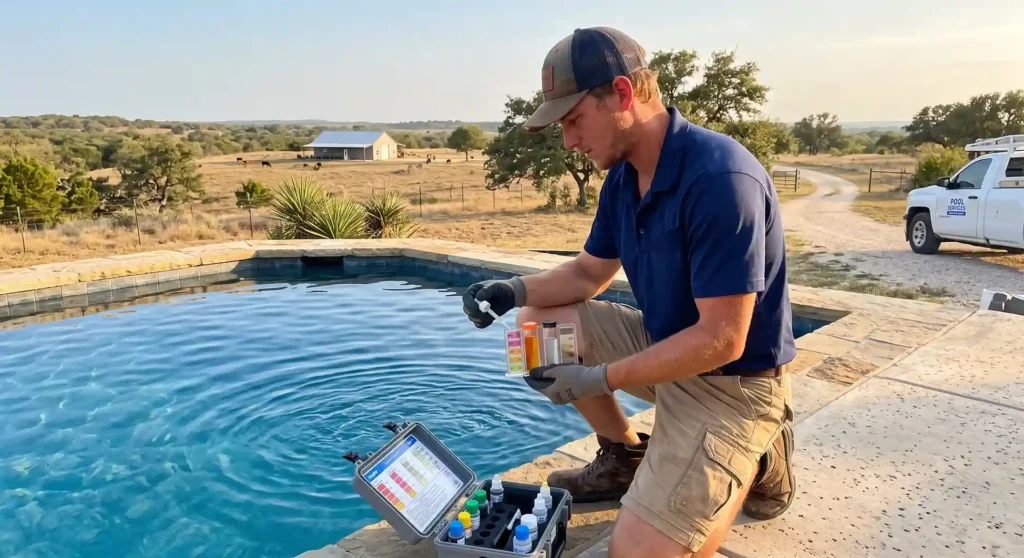
Swimmers coming out of your pool with red eyes, itchy skin, or general discomfort points to water chemistry that’s off in ways that home test strips may not fully capture. In Hondo’s well water context, this sign sometimes points to causes that don’t show up on basic test kits at all, elevated total dissolved solids from well water mineral accumulation building up over a season, combined chlorine levels that a standard strip tests as “chlorine” even though it’s no longer actively sanitizing, or pH that’s drifted higher than the acceptable range and is reducing chlorine effectiveness while making water harsher on skin.
When multiple family members consistently experience discomfort after swimming despite chemistry readings that look normal on a basic home test, that’s the clearest signal that professional water analysis (not just another round of the same chemical adjustments) is what’s actually needed.
Equipment that’s running but falling behind
In Hondo’s rural environment, the consequence of ignoring equipment warning signs carries more weight than in urban San Antonio, because getting professional help out quickly when something fails isn’t always a same-day proposition. A pump that’s developing bearing noise in a suburban San Antonio neighborhood can usually get a technician out within 24 to 48 hours. The same pump failing on a Hondo acreage property might mean waiting a few days depending on scheduling and provider availability.
This is why recognizing early equipment warning signs (and acting on them before they become failures) matters more specifically for Hondo pool owners than for San Antonio homeowners with more service provider access. A filter that’s showing gradually higher pressure readings, a pump that’s slightly quieter or noisier than usual, a salt cell display that’s showing output numbers slightly below where it should be, these early signals are worth professional evaluation before they become the weekend emergency where your family can’t swim because the pool is turning green and the pump just stopped working.
As Bluewater Pools’ research confirms, “ongoing water clarity issues can signal more serious concerns” about equipment performance, and in Hondo’s limited-access market, catching those equipment signals at the early stage is the difference between a $200 service call and a $1,200 equipment replacement while your pool sits unusable for several days.
When to call: The Hondo rule of thumb
For San Antonio homeowners, waiting a few days to see if a pool problem resolves itself is a reasonable calculation, help is close and available quickly if it doesn’t. For Hondo homeowners, the calculation is different. Any of the signs covered above warrants a professional contact within 24 to 48 hours of first appearing, not because the problems are more serious, but because the scheduling reality of rural service means acting early gives you more options and faster resolution than waiting to see what develops.
Our weekly pool maintenance services covers Hondo and Medina County with established local routes, meaning consistent service that catches these signs at their earliest stage rather than arriving to address a situation that’s had a week to develop unchecked in the summer heat.
And for the full picture of what a properly executed pool cleaning service in Hondo should include, and how local factors like well water, acreage debris exposure, and rural service realities shape what “good service” actually looks like out here, our article on pool cleaning service in Hondo TX covers that in detail.
FAQs
What are the signs a pool needs professional cleaning in Hondo TX?
Signs your Hondo TX pool needs professional cleaning include grayish or dusty turbidity from wind-driven caliche particles, orange or brown discoloration from iron in well water, yellow-green mustard algae patches on walls and shaded areas, black spots on floor or steps, a strong chemical smell from chloramine buildup, skin or eye irritation after swimming, and equipment that’s running normally but failing to keep water clear. In Hondo’s rural environment with limited same-day service access, acting on these signs within 24 to 48 hours matters more than in urban markets where help arrives quickly regardless of when you call.
Why does my Hondo TX pool water look grayish or dusty even though the chemistry seems right?
Grayish or dusty pool water in Hondo that doesn’t respond to chemistry adjustment is almost always environmental, caliche dust from surrounding dry ranchland blows into pool water on windy afternoons across Medina County. These fine calcium-rich particles create turbidity that looks like a chemistry problem but doesn’t clear with chemical treatment. The correct response is a pool clarifier to coagulate the fine particles into clusters the filter can capture, extended filtration runtime after windy events, and vacuuming settled particulate from the pool floor. A pool cover when the pool isn’t in use dramatically reduces caliche accumulation.
What causes orange or brown discoloration in a Hondo TX pool?
Orange or brown pool water in Hondo almost always indicates iron contamination from well water. Iron dissolved in Medina County’s limestone-formation well water oxidizes when it contacts chlorine, leaving rust-colored staining on pool surfaces and a brownish tint throughout the water. Standard shock treatment won’t fix this, adding more oxidizing chlorine to iron-contaminated water temporarily worsens the discoloration. The correct treatment is a metal sequestrant product that keeps iron suspended in solution for filter removal, followed by monitoring iron levels with a dedicated metal test rather than a standard strip kit.
Why does mustard algae keep coming back in my Hondo TX pool?
Mustard algae is more resistant to standard chlorine shock than green algae and returns to the same locations because it survives in the microscopic pores of plaster surfaces rather than being fully eliminated by normal treatment. The spots brush off easily but regrow within days because the algae colony rooted in the surface wasn’t addressed. Professional treatment requires specific mustard algae algaecide, mechanical brushing of all surfaces simultaneously, and a targeted shock protocol at higher doses than standard algae treatment. Partially-treating mustard algae with standard chlorine shock and calling it done is the most common reason it keeps coming back through the season.
How quickly should I act when I notice pool warning signs in Hondo TX?
In Hondo’s rural market, act within 24 to 48 hours of noticing any of the warning signs covered above, don’t wait to see if a problem resolves itself. Service provider scheduling in Medina County doesn’t offer the same same day availability as San Antonio’s more competitive urban market. Waiting several days on a developing algae bloom, equipment issue, or chemistry problem gives it more time to worsen in Hondo’s summer heat before a technician can even assess the situation. The cost difference between catching a problem early and addressing it after it’s had a week to develop in triple-digit temperatures is consistently significant.
