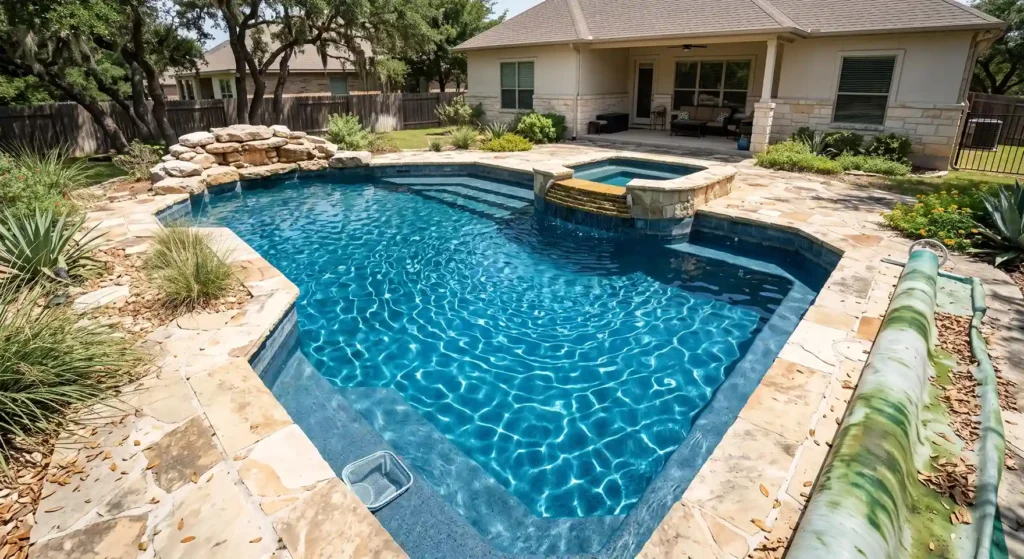
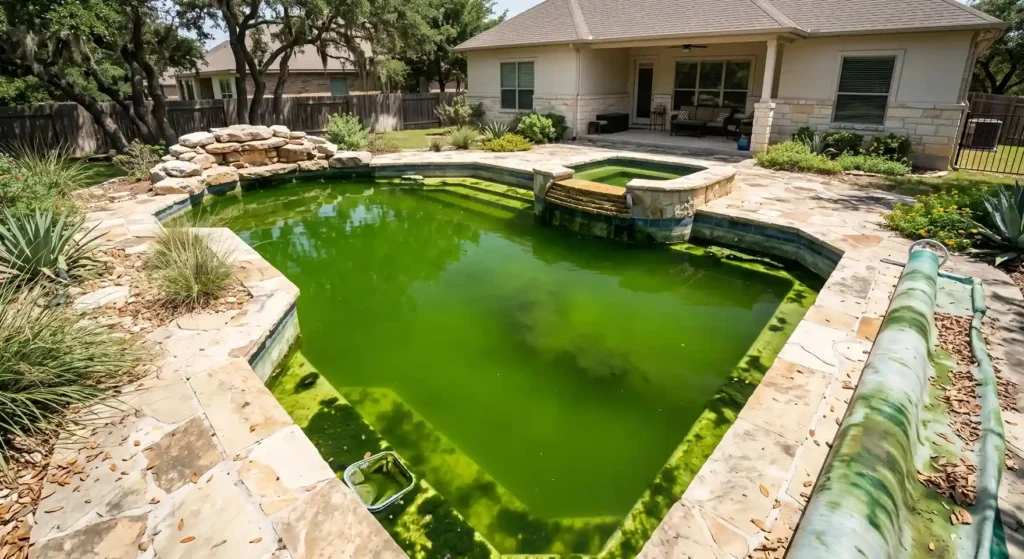
A green pool in San Antonio takes 3 to 7 days to recover depending on severity. Light green pools with visible bottom can often be treated DIY in 2 to 3 days. Dark green or swamp-green pools need professional treatment running $300 to $800 for chemical cleanup, or $500 to $1,500 for severe drain-and-clean situations. The single most important factor: acting within 24 to 48 hours of first noticing the color change cuts both cost and recovery time significantly.
You walked out this morning and the pool that was blue yesterday is now unmistakably green. Or maybe it happened while you were on vacation for a week, and you’re staring at something closer to a swamp than a swimming pool. Either way, green pool cleanup in San Antonio TX is a problem that escalates fast in this climate (faster than anywhere else in the country) and the difference between a two-day DIY fix and a $600 professional recovery job is almost always how quickly you respond once the color changes.
Here’s exactly what to do, in the right order.
Why San Antonio pools turn green so fast, and how to read your situation
Why green pools happen faster here than almost anywhere else
A green pool is an algae bloom. Algae spores are always present in outdoor water — they drift in on wind, wash in with rain, and arrive on every swimmer, leaf, and piece of debris that enters the pool. Under normal conditions, your chlorine kills them before they can establish. When chlorine drops below effective levels (even briefly) algae multiply rapidly. In San Antonio, five specific conditions make this happen more quickly and more frequently than in most other U.S. cities.
According to The Pool Guys’ 2026 San Antonio green pool guide, “San Antonio regularly exceeds 100 degrees during summer. UV radiation destroys unprotected chlorine, a pool without adequate cyanuric acid can lose 90% of its free chlorine in two hours of direct sunlight. When chlorine drops, algae take over within 24 to 48 hours in our temperatures.” That 90% figure isn’t an exaggeration, it’s the physics of UV degradation on unstabilized chlorine in direct Texas sun.
Add San Antonio’s hard water (which makes chemistry harder to balance consistently), the city’s notorious cedar and oak pollen seasons (which load pools with phosphates, algae’s primary food source), and the nine-month swim season that gives algae more annual opportunities to establish than pools in shorter-season markets, and you have the complete picture of why a San Antonio pool can go from perfectly clear to visibly green in a weekend when conditions align.
The triggers that most commonly drop chlorine below the threshold where algae can establish include: a pump that stopped running (a tripped breaker, a reset timer after a power outage, or a clogged impeller); a salt cell that quietly stopped producing without triggering an obvious alarm; a heavy rainstorm that diluted chemistry and introduced phosphates simultaneously; or simply missing a service visit during a week of temperatures above 105°F when chlorine burns off at its fastest rate.
Reading your pool: DIY territory vs. professional territory
Before adding a single chemical, assess what you’re actually dealing with. The severity level determines your strategy completely.
Light green, you can still see the bottom of the pool, at least partially: This is DIY territory if you’re committed to the full process. The algae is still primarily suspended in the water rather than embedded in surfaces. With correct chemistry adjustment, aggressive shock dosing, continuous filtration, and consistent brushing, most light-green San Antonio pools recover in 2 to 3 days.
Medium green, water is murky, the shallow end floor is visible but deep end isn’t: Borderline. A committed homeowner can recover this, but it requires more chemical investment, more filter cleaning cycles, and more patience than most people budget for. If you don’t have 2 to 3 days to stay on top of it daily, this is the point where professional service often costs less in total than the DIY chemical investment plus time.
Dark green, black-green, or swamp-level, you cannot see more than six inches into the water: Call a professional. According to Bluewater Pools’ 2026 Texas green pool cost analysis, “a pool that looks fine on Monday can show visible algae growth by Friday if the chemistry is off. A mild bloom treatable with a single visit can escalate to a $500+ multi-day project within a week of inaction.” At the dark green stage, the chemical investment required to shock the pool adequately, combined with the filter cleaning intensity needed to process dead algae, and the possible need to vacuum to waste rather than through the filter — makes professional service the more economical option for most homeowners.
The step-by-step recovery process, in the right order
Step 1: Test before you add anything
The single most common mistake in green pool recovery is adding chemicals before knowing where your chemistry stands. Shocking a pool with high pH wastes most of the chemical, chlorine is three times more effective at pH 7.2 than at pH 7.8. If your CYA is too low, the shock you add gets destroyed by UV within hours of a San Antonio morning. If your alkalinity is unstable, pH will drift before the treatment takes hold.
Test free chlorine, pH, total alkalinity, and cyanuric acid before starting. Adjust pH to 7.2 to 7.4 first, then alkalinity to 80 to 120 ppm if needed. Don’t shock until these two parameters are in range — the chemistry sequence matters more than the speed.
Step 2: Remove physical debris before chemical treatment
Use a leaf net to scoop out visible debris (leaves, twigs, large algae clumps) before adding chemicals. As Hydra Pool Services’ Texas green pool guide explains, “you’re not trying to make the pool look good at this stage. You’re removing organic matter that would consume your shock treatment before it can kill algae.” Every leaf left in the pool during shock treatment is consuming chlorine that needs to be killing algae.
Also clean your filter before starting, cartridge filters need hosing down, sand filters need backwashing, DE filters need backwashing and fresh DE. A clogged filter going into a green pool recovery is one of the most common reasons DIY treatments fail. The filter is about to do the hardest work it will do all year. It needs to start clean.
Step 3: Shock aggressively, in the evening
For a light-green pool, triple the normal shock dose. For medium to dark green, quadruple it. According to Poolburg’s 2026 green pool recovery research, “triple or quadruple the normal shock dose to overwhelm the algae. The water turns from green to cloudy as the algae dies. This is the turning point in every green pool recovery.” That cloudiness is a good sign, it means the algae is dying and becoming suspended particles the filter can capture.
Add shock in the evening, never midday. San Antonio’s summer UV index during peak hours destroys chlorine faster than you can add it. Evening application allows the full overnight hours to work before UV exposure begins again the next morning, dramatically increasing treatment effectiveness.
Step 4: Brush Every Surface Before and During Treatment
Brush walls, floor, steps, and any surface where algae is visible both before shocking and again after. Algae forms a biofilm, a thin, protective layer that helps it cling to pool surfaces and resist chemical treatment. Physical brushing breaks that biofilm and exposes the algae cells directly to the chlorine in the water. In San Antonio’s plaster and concrete pools, where the porous surface gives algae more grip than smooth fiberglass, brushing is even more critical. This step is where most DIY green pool recoveries lose ground, people shock and run the filter but skip or rush the brushing, then wonder why the algae keeps coming back.
Step 5: Run the filter 24 hours, clean it every 8 to 12 hours
This is the part of green pool recovery that surprises most homeowners with how intensive it is. Run your filter continuously (no timer, no breaks) until the pool is clear. And clean that filter every 8 to 12 hours during the active recovery phase. Dead algae particles are extremely fine and clog filter media fast. A cartridge or sand filter that was running at normal pressure Monday morning may be completely overwhelmed by Monday evening of a green pool treatment cycle.
The filter cleaning frequency isn’t optional and isn’t a sign that something is wrong — it’s the process working correctly. When the pressure gauge rises 8 to 10 psi above baseline, clean the filter immediately and restart. For severe recoveries, this may mean cleaning the filter 2 to 4 times per day. Skipping filter cleaning during this phase is the most common reason green pool recovery stretches from 3 days to a week or longer.
Step 6: Vacuum to waste once algae has settled
Once the water has turned from green to cloudy white or grayish (meaning the algae is dead but still suspended) vacuum the pool floor to waste rather than through the filter. This removes the bulk of dead material directly from the system rather than repeatedly cycling it through filter media. Review our guide on vacuuming to waste for the correct procedure if this is your first time using that setting.
What it costs and what to expect from professional green pool cleanup
For San Antonio pools that need professional recovery, here’s what 2026 pricing actually looks like. According to Bluewater Pools’ market data, “restoring a green pool to swimmable condition in Texas typically costs between $300 and $800 for chemical treatment. Severe cases requiring a full drain-and-clean run $500 to $1,500 or more.” Recovery takes 1 to 3 professional visits for most situations, with light-green pools potentially clearing in a single visit and severe algae blooms requiring follow-up treatment once the initial chemistry reset has worked.
The data also confirms a pattern every San Antonio pool professional observes: “a mild bloom treatable with a single visit can escalate to a $500+ multi-day project within a week of inaction.” Acting the day you notice the color change (not waiting to see if it clears on its own) is the single most impactful decision you make in the entire recovery process.
After recovery, the most important step is addressing why the pool turned green in the first place. If it was a chlorine depletion event from missing a service visit, establishing consistent weekly professional maintenance prevents recurrence. If phosphates from pollen or runoff were the underlying driver, adding monthly phosphate treatment to the maintenance routine is the fix. If equipment failure caused the chlorine drop, repairing that equipment is essential before the next heat wave creates another opportunity.
Our algae removal service in San Antonio handles green pool recovery from initial assessment through full water restoration, including the brushing, chemical treatment, continuous filter management, and follow-up chemistry balancing that complete recovery requires, rather than a single shock-and-leave visit.
And if your pool has been showing early warning signs before the full green bloom (cloudiness, slight color change, a smell that wasn’t there last week) our guide on signs your pool needs professional cleaning in San Antonio covers those early signals in detail, so next time you catch the problem at the $150 stage rather than the $500 stage.
FAQs
How do I clean up a green pool in San Antonio TX?
Clean a green San Antonio pool by testing and adjusting pH to 7.2 to 7.4 first, removing physical debris with a leaf net, then shocking with triple to quadruple the normal chlorine dose in the evening when UV won’t destroy it immediately. Brush all surfaces thoroughly before and after shocking. Run your filter 24 hours continuously and clean it every 8 to 12 hours during recovery. Once algae has died and settled, vacuum to waste. Light-green pools recover in 2 to 3 days. Dark green pools take 5 to 7 days with daily filter cleaning and chemical adjustment.
How much does green pool cleanup cost in San Antonio TX in 2026?
Professional green pool cleanup in San Antonio costs $300 to $800 for standard chemical treatment and recovery in 2026. Severe cases requiring a full drain and clean run $500 to $1,500 or more. Recovery typically takes 1 to 3 professional visits depending on severity. A mild algae bloom caught early can be treated in a single visit for the lower end of that range. Waiting more than a week after first noticing the color change consistently escalates both cost and recovery time, what starts as a $300 job becomes a $600 job within a few days in San Antonio’s summer heat.
How long does it take to fix a green pool in San Antonio TX?
Green pool recovery in San Antonio takes 2 to 3 days for light-green pools where you can still see the bottom, and 5 to 7 days for dark or swamp-green pools with heavy algae coverage. Continuous pump and filter operation throughout the recovery period (not just during day hours) is the single biggest factor in recovery speed. Cleaning the filter every 8 to 12 hours during treatment keeps recovery on the faster end of the range. Professional treatment generally produces the same timeline but with more reliable outcomes because the chemical dosing, brushing, and filter management are handled consistently rather than intermittently.
Why does my San Antonio pool keep turning green even after I treat it?
Recurring green pools in San Antonio despite treatment almost always trace back to phosphates, compounds that enter pool water from cedar and oak pollen, lawn fertilizer runoff, and municipal tap water top-offs. Phosphates are algae’s primary food source and aren’t eliminated by chlorine. A pool with high phosphate levels will develop algae recurrence even with adequate chlorine because the underlying nutrient driving growth was never addressed. Testing phosphate levels and treating with a phosphate remover as part of the recovery process (not just shocking) is what breaks the cycle for pools that turn green repeatedly through a San Antonio season.
When should I call a professional for green pool cleanup in San Antonio instead of doing it myself?
Call a professional when you cannot see more than six inches into the water, the dark or swamp-green stage where DIY chemical costs and filter management intensity make professional service more economical. Also call when you’ve already attempted DIY treatment and the pool hasn’t improved after 48 hours of continuous filtration, when your pool is large (over 20,000 gallons), or when equipment issues like a struggling pump or overloaded filter are complicating the recovery. In San Antonio’s summer heat, a professional assessment that identifies the root cause (phosphates, equipment failure, or chemistry gap) prevents the same recovery from being needed again in two weeks.
