
A grinding or screeching noise from your pool pump almost always means one of three things, worn motor bearings, debris caught in the impeller, or the pump running dry from low water level or an air leak. Each one sounds slightly different, requires a different fix, and carries a very different price tag.
If you’re reading this with your pool pump making that sound right now, you’re already ahead of the homeowner who ignores it for two weeks and ends up with a burned-out motor. A pool pump grinding noise in San Antonio is your equipment telling you something specific, and in most cases, catching it at this stage means the difference between an affordable repair and a full replacement. Here’s how to figure out exactly what you’re dealing with.
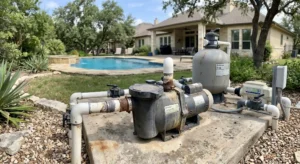
What each sound actually means: Decoding your pump’s warning
Grinding or screeching: The most common and most urgent sound
A metallic grinding or screeching sound coming from your pool pump motor is the noise that most San Antonio homeowners search for first, and for good reason, it’s the one that usually means the clock is ticking. According to Angi’s pool pump noise diagnosis guide, “worn motor bearings create screeching sounds when your pump runs, especially after the motor ages or works extra hard due to blockages or running dry.”
Motor bearings are the small metal components that allow the pump’s shaft to spin smoothly inside the motor housing. When they wear down (from age, heat stress, or running dry) the metal-on-metal contact creates that characteristic grinding or high-pitched screeching that carries across a backyard. The friction generates heat, and here’s what matters most: that heat accelerates the damage rapidly once it starts. A bearing that creates a minor grinding sound on Monday can damage the motor windings by Friday if it runs continuously in San Antonio’s summer heat.
The good news is that bearing replacement is one of the more affordable pump repairs (typically $150 to $350) when caught at the grinding-noise stage. The expensive scenario is the homeowner who hears the noise, figures it’s probably fine, and keeps running the pump for another two or three weeks until the bearing failure causes secondary motor damage that turns a $250 fix into a $700 motor replacement.
Rattling or vibrating usually simpler than it sounds
A rattling or vibrating sound is meaningfully different from a grinding sound, and the distinction matters for diagnosis. According to Angi’s guide on pump problems, “rattling sounds are a sign that your pool pump is not installed in the base correctly”, meaning the pump has shifted on its mounting pad, the mounting bolts have loosened from vibration over time, or the concrete equipment pad itself has developed a crack or uneven settling that’s introduced movement into the system.
This is worth checking first before assuming a more serious internal problem, because it’s the easiest and least expensive thing to rule out. Walk to your equipment pad and look at whether the pump sits level and stable. Try placing your hand lightly on the pump housing while it runs, does the vibration feel external, like the whole unit is moving slightly? Or does it feel internal, like something is spinning unevenly inside? External vibration that changes when you put gentle pressure on the housing typically points to a mounting or pad issue rather than an internal mechanical failure.
San Antonio’s caliche and limestone soil can shift subtly under equipment pads over time, particularly after significant rainfall events or extended drought conditions that cause soil contraction. Equipment pads that were level when installed can develop a slight tilt years later — enough to introduce vibration into a pump that was previously quiet.
Chopping, roaring, or sucking sounds, air in the system
A chopping, roaring, or intermittent sucking sound from your pump is a different category of problem entirely, it usually indicates the pump is pulling in air somewhere rather than a solid column of water. According to Angi, “chopping or roaring sounds may be a sign your pool pump is pulling in air or not priming properly.”
Air enters the system through one of a few specific entry points: a cracked or degraded pump lid O-ring, a loose union fitting on the suction side, a failed shaft seal, low pool water level that’s dropping the skimmer intake below water, or a stuck or damaged skimmer weir door. In San Antonio’s summer heat, when evaporation can drop pool water level noticeably between visits, low water level is a surprisingly common cause of air-related pump noise that homeowners often misdiagnose as a mechanical problem.
Check your pool’s water level first, it should sit approximately halfway up the skimmer opening. If the level looks correct and the sound persists, the O-ring inside your pump lid is the next thing to inspect. Remove the lid, examine the O-ring for cracks, flattening, or brittleness, and lubricate it with pool-grade lubricant if it’s still intact. A degraded O-ring is a $5 to $15 fix that’s fully DIY-friendly.
Debris in the Impeller: The fix that surprises people
One specific cause of grinding or rattling sound that deserves its own mention is debris caught in the impeller, the spinning component inside the pump’s wet end that creates water flow. As Trouble Free Pool’s pump diagnosis community notes, debris in the impeller can sound almost identical to bearing failure from the outside (metallic, grinding, clearly coming from the pump) but is a completely different problem with a much simpler solution.
In San Antonio’s environment, where caliche dust, small acorns, seed pods from oak trees, and debris from the surrounding landscape regularly find their way into pool water, impeller blockage is more common than in cleaner-air suburban markets. The test: turn the pump completely off at the breaker, remove the strainer basket lid, and try manually spinning the impeller shaft at the back of the motor, it’s typically accessible through a small plastic cap. If it spins freely without resistance or grinding sensation, the noise was likely debris rather than bearing failure. If you feel rough, grinding resistance when spinning it by hand, that points toward bearings.
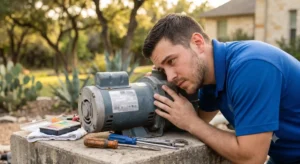
What to do right now: Steps by sound type
If you hear grinding or screeching, act within 48 hours
This is the one sound that genuinely doesn’t benefit from a wait-and-see approach. Every hour of continued operation with worn bearings accelerates friction induced heat damage that spreads from the bearings to the motor windings. The sequence that most San Antonio homeowners who waited too long describe is almost identical: grinding sound appears, seems to come and go, then one morning the pump starts making a louder sound or trips the breaker, and by the time a technician arrives the motor needs full replacement rather than bearing service.
If the grinding is accompanied by heat (if the motor housing feels noticeably hot to the touch after running, not just warm) stop the pump and don’t restart it until a technician has assessed the situation. Running a pump with failing bearings in 100°F ambient temperatures in a San Antonio July compounds thermal damage far faster than the same scenario in a cooler climate.
If you hear rattling, check these things yourself first
Before calling anyone for a rattling pump, work through this sequence: check that your pool water level is correct, inspect the pump mounting bolts for looseness, look at the equipment pad for visible cracking or uneven settling, check that the pump lid is fully seated and the basket properly installed, and inspect your skimmer baskets for debris that might be restricting flow and creating pressure fluctuations that show up as rattling. Many rattling situations resolve with one of these simple checks, and the ones that don’t respond to these steps give a technician much more useful diagnostic information when they arrive.
If you hear chopping or air sounds: Check water level and o-ring first
As noted above, these two checks resolve a surprising percentage of air-related pump noise without any professional service needed. Water level first, then O-ring. If both check out and the sound persists, the suction-side plumbing connections and union fittings need examination, looking for hairline cracks or fittings that have loosened slightly over time. In San Antonio’s climate, where heat expansion and contraction cycles affect plastic plumbing components repeatedly over a season, connection integrity deserves attention even on relatively newer installations.
When the diagnosis points beyond DIY
The honest assessment of pool pump noise causes is that sound-based diagnosis gets you in the right neighborhood, but only opening the unit confirms what’s actually happening, especially for grinding sounds that could be either impeller debris or bearing failure depending on what the hands-on inspection reveals. A technician who does this regularly in Bexar County brings the diagnostic experience to distinguish between those scenarios quickly, the repair parts to address common issues same-visit, and the local knowledge of which pump models and failure patterns are most common in San Antonio’s heat and hard water conditions.
If the grinding noise appeared recently and your pump is under seven years old, the odds favor a repair rather than replacement, catching it now, before bearing failure causes secondary motor damage, is exactly the scenario where a diagnostic visit pays for itself. Our pool equipment repair service in San Antonio handles pump diagnosis and repair across Bexar County, with same week scheduling for noise-related concerns that shouldn’t wait for a routine appointment.
For a complete breakdown of repair costs, what the repair-versus-replace decision looks like for different pump ages and failure types, and what to expect from a professional service call, our article on pool pump repair in San Antonio TX covers all of that in detail, worth reading before you make any decisions about next steps.
FAQ
1. What causes a grinding noise from a pool pump in San Antonio TX?
A grinding or screeching noise from a pool pump almost always indicates one of three causes: worn motor bearings, debris caught in the impeller, or the pump running dry from low water level or an air leak. Worn bearings are the most urgent, the metal-on-metal friction generates heat that spreads to the motor windings if the pump keeps running, turning an affordable $150 to $350 bearing repair into a $700 motor replacement. San Antonio’s intense summer heat accelerates this damage faster than in cooler climates, making prompt diagnosis especially important here.
2. How do I tell the difference between bearing failure and debris in my pool pump?
Turn the pump completely off at the breaker, remove the strainer basket lid, and manually spin the impeller shaft at the back of the motor through the small access cap. If the shaft spins freely without resistance, debris in the impeller is the likely cause — often a twig, small acorn, or seed pod common in San Antonio’s tree-heavy neighborhoods. If you feel rough, grinding resistance when spinning the shaft by hand, that points toward worn bearings requiring professional repair. This simple test takes under five minutes and often narrows the diagnosis significantly before calling a technician.
3. Can I keep running my pool pump if it’s making a grinding noise?
No, and in San Antonio’s summer heat specifically, continuing to run a pump with a grinding noise accelerates damage faster than in cooler climates. Worn bearings generate friction heat that spreads to the motor windings, and in ambient temperatures above 100°F that thermal damage compounds quickly. If the motor housing feels noticeably hot to the touch after running (not just warm) stop the pump immediately. Every additional hour of operation with failing bearings increases the likelihood that a $250 bearing fix becomes a $700 motor replacement or higher.
4. Why is my pool pump rattling in San Antonio TX?
Rattling sounds from a pool pump typically indicate the pump has shifted on its mounting pad, mounting bolts have loosened from vibration over time, or the concrete equipment pad has settled unevenly. San Antonio’s caliche and limestone soil can shift subtly under equipment pads after heavy rainfall or extended drought, introducing movement into previously stable installations. Check mounting bolt tightness, inspect the pad for visible cracking, confirm the pump lid is fully seated, and verify your pool water level is correct, low water level causes the pump to pull air, which can also produce a rattling or chopping sound that resembles a mounting issue.
5. How much does it cost to fix a pool pump making a grinding noise in San Antonio?
Cost depends on the specific cause. Bearing replacement (the most common cause of grinding and screeching) typically runs $150 to $350 in San Antonio. Debris removal from the impeller is a minor service call. If bearing failure has progressed to motor damage from running too long, motor repair runs $200 to $500 and full motor replacement runs $350 to $700. A complete pump replacement costs $700 to $1,300 installed. The single most impactful thing you can do for cost control is act within 48 hours of first hearing the grinding noise, before secondary damage from heat and friction raises the repair scope significantly.
