
There’s a chemical in your pool that most homeowners almost never think about, and yet it might be the single most important factor determining whether your chlorine actually works through the brutal San Antonio summer. Cyanuric acid in your pool in San Antonio TX is one of those topics that sits right at the edge of “too technical to bother with” for most backyard pool owners, which is exactly why so many local pools end up either burning through chlorine at an alarming rate or accumulating CYA levels so high that the chlorine stops working entirely. Both problems are common. Both are entirely preventable. And understanding the difference between them starts with grasping what cyanuric acid actually does in the first place.
What cyanuric acid does and why San Antonio pools need it more than most
The sun is destroying your chlorine faster than you think
Here’s a fact that changes how you think about pool chemistry in South Texas: without cyanuric acid, UV rays from the sun can destroy half of your pool’s free chlorine in approximately 17 minutes of direct sunlight exposure. Not hours, minutes. That’s not a typo, and it’s not an exaggeration. According to Swim University’s cyanuric acid guide, chlorine in water without any stabilizer has a half-life of roughly 35 minutes under full UV exposure, meaning that in less than an hour on a clear San Antonio afternoon in July, your chlorine level could drop from 3 ppm to nearly zero without a single swimmer touching the water.
In San Antonio, where summer UV index readings regularly hit 10 or higher and pools sit in direct sunlight for 8 to 10 hours daily from May through September, that chlorine destruction rate is about as aggressive as it gets anywhere in the continental United States. This is why pool stabilizer Texas conditions aren’t optional, they’re foundational. Without adequate CYA, you’re essentially pouring money directly into the sun every time you add chlorine, because most of it disappears before it has time to do anything useful.
What cyanuric acid does is act as a molecular sunscreen for chlorine. It bonds temporarily with chlorine molecules, holding them in reserve and shielding them from UV degradation. The chlorine is still available to sanitize (it releases from the CYA bond when it encounters bacteria or contaminants) but it’s no longer being destroyed by sunlight at a rate that makes maintaining adequate levels practically impossible. With proper CYA levels, chlorine lasts 3 to 5 times longer in outdoor pool water than it would without stabilization. In San Antonio’s summer, that’s the difference between a pool that requires daily chlorine additions and one that holds its level through a normal week.
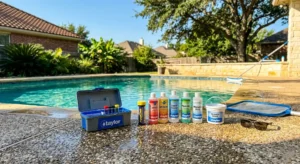
The ideal CYA range and why San Antonio pools often miss it in both directions
The target range for cyanuric acid in a standard residential pool is 30 to 50 ppm. For saltwater pools, the recommended range runs slightly higher (60 to 80 ppm) because the salt cell itself also needs protection from UV degradation. These aren’t arbitrary numbers. Below 30 ppm, chlorine protection is insufficient for the UV exposure levels San Antonio pools experience. Above 50 ppm, CYA begins actively interfering with chlorine’s effectiveness in ways that most homeowners never connect to the stabilizer.
In San Antonio, the two most common CYA problems look like mirror images of each other but have opposite causes:
Too low, the new season problem. Fresh pool water, pools that received heavy dilution from winter rainfall, or pools where the stabilizer was never properly established at season opening will often test below 30 ppm in spring. The symptom is chlorine that disappears almost immediately after being added, regardless of how much you add. Many homeowners in this situation keep adding more and more chlorine, baffled by why the level won’t hold, never realizing the stabilizer deficit is the reason. CYA levels below 20 ppm in a San Antonio summer are essentially the same as having no protection at all.
Too high, the gradual accumulation problem. This one develops slowly and quietly over multiple seasons, and it’s arguably more common in San Antonio than low CYA. Because CYA doesn’t evaporate or break down significantly on its own, and because most standard chlorine tablets (trichlor) and granules (dichlor) contain cyanuric acid as part of their formulation, every chlorine addition made with stabilized products adds a small amount of CYA to the water. Over a season of weekly tablet additions, that accumulation adds up. Over two or three seasons without a partial drain and refill, CYA levels in San Antonio pools frequently climb above 100 ppm, more than double the recommended maximum.
When high CYA becomes a serious problem
This is the part of the cyanuric acid pool conversation that genuinely surprises most pool owners when they first encounter it. The intuitive assumption is that more stabilizer means better chlorine protection. The reality is that above a certain threshold, CYA doesn’t protect chlorine, it traps it.
As Trouble Free Pool’s authoritative CYA research explains, as CYA levels increase, the fraction of your free chlorine that’s actively working (the hypochlorous acid actually killing bacteria and algae) decreases proportionally. At 80 ppm CYA, a significant portion of your chlorine is bound to the cyanurate molecule and effectively inactive. At 100 ppm or above, the active chlorine fraction becomes so small that maintaining truly sanitary water requires free chlorine levels that are practically impossible to sustain through normal maintenance.
The practical result? A pool with 120 ppm CYA and a 3 ppm free chlorine reading isn’t actually sanitized at 3 ppm equivalent. It’s sanitized at a fraction of that, because the overwhelming majority of the chlorine is tied up with cyanurate molecules. This phenomenon is sometimes called “chlorine lock,” and it’s why pools with very high CYA levels can develop algae and clarity problems despite showing what appear to be normal chlorine readings on a test strip. You’re testing the total free chlorine, not the active fraction, and at high CYA levels, those two numbers are very different things.
According to Swim University’s pool stabilizer guide, “if your pool stabilizer levels creep too high, it can reduce the effectiveness of your sanitizer, or in other words, do the exact opposite of what it’s meant to do.” That’s exactly what happens in San Antonio pools where CYA accumulation has gone unchecked over multiple seasons.
Testing, correcting, and maintaining the right CYA balance in South Texas
How to test CYA levels accurately
Standard test strips measure CYA, but their accuracy at higher levels (above 80 ppm) becomes unreliable. If you suspect elevated pool stabilizer Texas levels, a liquid test kit that specifically measures CYA, or a professional water analysis, gives you a more accurate reading than strips alone. Many pool supply stores in San Antonio offer free water testing that includes CYA measurement, worth using at the start of each season and periodically through the summer to catch gradual accumulation before it becomes a serious problem.
Important: if you test with strips and the CYA reading appears to be at the maximum the strip can measure, your actual level may be significantly higher than what the strip indicates. At that point, a lab-grade water analysis is the only reliable way to know where you actually stand.
Fixing low CYA the simple side of the equation
Raising CYA levels in your pool is straightforward. Pure cyanuric acid (sold as pool conditioner or stabilizer) is available at any pool supply store in granular form. Add it slowly, dissolved in a bucket of water first rather than poured directly into the pool, undissolved CYA granules sitting on your pool floor can damage the surface. As a general guideline, approximately 13 ounces of granular stabilizer raises CYA by 10 ppm in a 10,000-gallon pool.
One important caution: because CYA persists in the water for a long time, it’s easier to add more later than to deal with an overshoot. Add conservatively, wait 24 hours for the stabilizer to fully dissolve and distribute, then retest before adding more. Starting the season at 30 to 40 ppm rather than targeting the top of the range gives you room for the gradual accumulation that will occur through the summer with stabilized chlorine additions.
Also worth noting: if you use trichlor tablets or dichlor granules as your primary chlorine source, you’re already adding CYA with every chlorine addition. In that case, you likely need very little or no additional stabilizer at season opening, just test first.
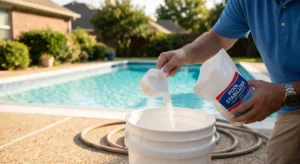
Fixing high CYA the hard truth about chlorine lock
Here’s the uncomfortable reality about high CYA: there is no chemical fix. No product you can add to the pool will meaningfully break down cyanuric acid. The only effective way to reduce elevated CYA levels is to remove some of the water containing the excess CYA and replace it with fresh water, which dilutes the stabilizer concentration back toward the target range.
For a pool at 100 ppm CYA trying to reach 50 ppm, that means draining and replacing approximately 50% of the pool’s total water volume. In San Antonio, where water conservation matters and pool water carries a disposal consideration, this is a meaningful undertaking, but it’s the correct solution, and there’s no practical shortcut.
The CDC’s pool water treatment guidelines emphasize that properly maintained chemical balance (including stabilizer levels) is essential for ensuring pool water actually disinfects effectively. A pool with severely elevated CYA may have perfectly normal-looking chemical readings while failing to provide adequate sanitation protection. That’s not a hypothetical concern, it’s a real public health issue that gets overlooked precisely because the problem is invisible without proper testing.
The San Antonio maintenance approach: Testing CYA seasonally, not just at opening
Given how common CYA accumulation is in San Antonio pools that run year-round with stabilized chlorine products, the most practical preventive approach is testing CYA at three points during the season: at spring opening, at midsummer (late July), and at the beginning of fall. That three-test schedule catches gradual buildup while it’s still in the correctable range with a moderate partial drain rather than requiring the more significant water replacement needed once levels climb above 100 ppm.
Switching from trichlor tablets to liquid chlorine or calcium hypochlorite as your primary sanitizer during the summer months is another strategy that stops CYA accumulation while it’s elevated, since neither liquid chlorine nor cal hypo contains cyanuric acid, switching temporarily stops the CYA input while your existing levels gradually dilute through normal water additions and top-offs.
If your water chemistry has been behaving strangely, chlorine that won’t hold despite regular additions, recurring algae despite apparently normal readings, or persistent cloudiness that doesn’t respond to standard treatment, CYA accumulation is one of the first things worth testing for. Our chemical balancing service in San Antonio includes full CYA testing as part of a complete water analysis, along with professional interpretation of how your stabilizer levels are interacting with the rest of your chemistry, which is often the missing piece when standard troubleshooting isn’t producing results.
And if CYA driven chemistry problems have been contributing to water clarity issues in your pool, our article on cloudy pool water in San Antonio TX walks through the full diagnosis process for hazy water, including how to identify when stabilizer imbalance is the root cause versus filtration or other chemistry issues.
FAQ
1. What is cyanuric acid and why does my San Antonio pool need it?
Cyanuric acid (also called pool stabilizer or conditioner) protects your chlorine from being destroyed by UV rays. Without it, San Antonio’s intense summer sun can eliminate half your chlorine in under 17 minutes of direct exposure. In South Texas, where pools sit in direct sunlight for 8 to 10 hours daily through a season that runs from May through September, adequate CYA levels are essential for maintaining any meaningful chlorine protection. The target range for standard pools is 30 to 50 ppm, below that, chlorine loss is too rapid to manage practically; above it, the stabilizer begins interfering with chlorine’s effectiveness.
2. How do I know if my CYA is too high in my San Antonio pool?
Common signs of elevated CYA include chlorine that appears to test normally but fails to prevent algae growth, recurring water clarity issues despite balanced chemistry, and algaecide treatments that don’t produce the expected results. The definitive answer comes from testing, standard test strips lose accuracy above 80 ppm, so a liquid test kit or professional water analysis is needed if you suspect high levels. In San Antonio pools that have been maintained with trichlor tablets for multiple seasons without a partial drain and refill, CYA above 100 ppm is more common than most homeowners realize, and it’s one of the most frequently overlooked causes of chronic pool problems.
3. What happens if cyanuric acid gets too high in a Texas pool?
High CYA creates a phenomenon sometimes called chlorine lock, where an increasing proportion of your free chlorine is bound to cyanurate molecules and unavailable for active sanitizing. At 100 ppm CYA or above, the active chlorine fraction becomes so small that standard free chlorine levels can no longer provide adequate sanitation, even when the test reading looks normal. The result is a pool that appears chemically balanced but struggles with algae, cloudiness, and bacterial growth. The only effective solution is dilution, partially draining and refilling with fresh water to bring CYA back within the 30 to 50 ppm target range.
4. How do I lower cyanuric acid levels in my pool in San Antonio TX?
The only reliable method is partial draining and refilling, there is no chemical product that effectively breaks down cyanuric acid in pool water. To reduce CYA from 100 ppm to 50 ppm, you need to drain and replace approximately 50% of your pool’s total water volume. After refilling, retest all chemistry parameters and rebalance from your new baseline. To prevent accumulation from recurring, consider switching from trichlor tablets (which contain CYA) to liquid chlorine or calcium hypochlorite as your primary chlorine source during periods when your CYA is already at the upper end of the target range.
5. How often should I test cyanuric acid levels in my San Antonio pool?
For San Antonio pools using stabilized chlorine products like trichlor tablets, testing CYA at three points through the season is the most practical approach: at spring opening to establish your baseline, at midsummer (late July) to catch gradual accumulation, and at the start of fall before reducing your maintenance schedule. This three-test approach catches CYA buildup while it’s still manageable with a moderate partial drain rather than the more significant water replacement needed once levels climb well above 100 ppm. Pools that switched to liquid chlorine or calcium hypochlorite as their primary sanitizer accumulate CYA more slowly and can typically test less frequently.
