
There’s something quietly frustrating about pool stains. You keep the water balanced, you brush regularly, you do everything right, and yet there they are. A brownish smear along the waterline. A dark green patch on the deep end floor. A rust-colored streak running down the wall from a return jet. If you’ve been dealing with pool stains in San Antonio TX and can’t figure out where they’re coming from or how to make them actually go away, you’re not alone, and the answer almost always starts with correctly identifying what type of stain you’re looking at before reaching for any treatment product.
Getting that identification right matters more than most people realize. Treat an organic stain with a metal remover and nothing happens. Attack a mineral deposit with algaecide and you’ll be disappointed. The wrong treatment doesn’t just fail, it sometimes makes the underlying problem harder to address afterward.
Reading your pool’s stains, what color and location are telling you
The two main categories every pool owner should know
Before getting into specifics, it helps to understand that virtually every pool wall stain falls into one of two broad categories: organic stains or inorganic stains. Organic stains come from living or once-living material, algae, leaves, berries, insects, tannins from tree debris. Inorganic stains come from minerals and metals: iron, copper, calcium, manganese. Knowing which category you’re dealing with narrows your treatment options immediately and saves you from wasted effort and money.
The simplest field test you can do right now: take a small amount of granular chlorine and place it directly on the stain (for a plaster or concrete surface). If the stain lightens or disappears within 30 seconds, it’s organic. If nothing happens, you’re likely looking at a mineral or metal stain that requires a different approach entirely.

Organic stains: Green, brown, and everything in between
Organic stains are the most common type in San Antonio pools, and for good reason. The combination of mature oak trees, pecan trees, cedar, and seasonal leaf fall creates a persistent organic debris load that finds its way into pools across Bexar County throughout the year, not just in autumn.
Green or bluish-green stains on walls and floors are almost always algae-related, either active growth or residue left behind after a treatment that killed the algae but didn’t fully remove the organic matter. These respond well to brushing combined with a targeted algae treatment and a follow-up shock.
Brown or yellowish-brown stains typically come from tannins, the natural compounds released by decomposing leaves, particularly from oak and pecan trees. Tannins are notorious in San Antonio pools because they stain plaster surfaces quickly when wet debris sits against the surface overnight. They also consume chlorine, which is why pools with heavy organic debris loads often show lower-than-expected free chlorine readings.
Dark spots or black patches in corners and on steps are often black algae, the most stubborn variety, which roots itself into the porous structure of plaster surfaces rather than just sitting on top. Black algae requires aggressive physical brushing with a stainless steel brush and multiple rounds of shock treatment to fully eliminate.
For remove pool stains Texas situations involving heavy organic buildup, a thorough pool deep clean San Antonio service (including brushing all surfaces, vacuuming to waste, and a full chemical reset) is often the most efficient starting point before attempting targeted stain treatment.
Metal and mineral stains: The ones that confuse homeowners most
This is where pool stains San Antonio TX get genuinely tricky, because metal stains are frequently misdiagnosed. Homeowners see a reddish-brown streak and assume it’s rust from equipment. They see a blue-green smear near a return jet and think it’s algae. In reality, both of those are likely metal stains, and they require a completely different treatment pathway.
Reddish-brown or orange stains are typically iron deposits. Iron enters pool water through source water (remember, San Antonio’s tap water carries a significant mineral load) and through corroding metal equipment components like old ladders, light fixtures, or deteriorating plumbing fittings. When iron oxidizes in contact with pool surfaces, it leaves those characteristic rust-colored streaks that no amount of scrubbing alone will remove.
Blue-green or teal stains near return jets or along the waterline are almost always copper deposits. Copper enters pool water most commonly through corroding copper plumbing, certain algaecide products that contain copper sulfate, or (and this surprises most people) from water that’s too low in pH, which causes acidic water to leach copper directly from plumbing and heat exchanger components. According to the Pool & Hot Tub Alliance, copper staining is one of the most frequently reported pool surface problems in regions with older plumbing infrastructure and hard water, both of which describe a significant portion of San Antonio’s residential pool stock.
Purple or dark brown stains that appear seemingly out of nowhere are often manganese, a less common but particularly stubborn mineral that’s present in some municipal water supplies and becomes visible when oxidized by chlorine. Manganese stains are frequently mistaken for organic matter and treated incorrectly as a result.
Treating and reventing every stain type
How to actually remove pool stains the right way
Now that you know what you’re looking at, here’s how to address each category effectively:
For organic stains (tannins, algae residue, leaf debris) the treatment pathway is: brush the affected area thoroughly, apply a targeted enzyme-based pool cleaner or an ascorbic acid treatment for deeper organic staining, shock the pool that evening, and run the filter continuously for 24 hours. For persistent tannin staining on plaster, a clarifier added after the enzyme treatment helps coagulate remaining particles so the filter can capture them.
For iron stains (those reddish-brown streaks) use a metal sequestrant or chelating agent specifically formulated for iron removal. These products work by binding to the iron ions in your water and holding them in suspension so the filter can remove them, rather than allowing them to redeposit on surfaces. Do not shock your pool immediately before or after adding a metal treatment, the oxidation reaction from shock can actually worsen metal staining temporarily.
For copper stains (blue-green deposits near jets or along tile) an ascorbic acid (vitamin C) treatment is remarkably effective and one of the best-kept secrets in pool care. Rub a vitamin C tablet directly on a small copper stain and watch it disappear within seconds. For larger affected areas, an ascorbic acid powder treatment applied across the surface, followed by a metal sequestrant to keep copper in suspension, addresses the staining without harsh chemicals.
A practical list of what you need on hand for remove pool stains Texas situations:
- Ascorbic acid powder or vitamin C tablets
- Metal sequestrant / chelating agent
- Enzyme-based pool cleaner
- Stainless steel brush (for black algae specifically)
- Standard pool brush for general brushing
- Non-chlorine shock (for use during metal treatment phases)
As This Old House’s pool care guide notes, “identifying the stain type before purchasing any treatment product is the single most important step, using the wrong product at best wastes money and at worst sets the staining deeper into the surface.”
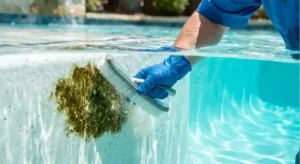
Preventing pool stains from coming back
Treatment gets you back to a clean surface. Prevention keeps you there, and in a city like San Antonio, where the environmental conditions actively work against pool surfaces year-round, prevention requires a deliberate approach rather than just hoping for the best.
For organic stain prevention: skim debris from the surface before it sinks and has contact time with pool surfaces. Brush twice weekly, not just when you notice buildup. Use an enzyme treatment monthly during heavy tree debris seasons, particularly fall and during cedar season in Helotes and the Hill Country areas. Keep your chlorine levels consistently in range so organic matter gets oxidized before it has time to stain.
For metal and mineral stain prevention: test your water for metals at the start of each season and after any significant top-off event. Use a metal sequestrant monthly as a preventive measure, not just reactively after stains appear. Keep your pH on the lower end of the acceptable range (7.2–7.4) to reduce the conditions that cause metal precipitation. If you have older copper plumbing or a copper heat exchanger, inspect for corrosion annually.
Pool deep clean San Antonio services are particularly valuable at the transition between seasons (spring opening and fall closing) because those are the moments when accumulated organic debris and mineral deposits from the previous season are most visible and most treatable before they fully bond to pool surfaces.
According to Bob Vila’s pool maintenance resource, consistent surface brushing combined with monthly enzyme treatments reduces organic staining by a significant margin in pools surrounded by mature trees, exactly the condition that describes a large percentage of San Antonio’s established neighborhoods.
The homeowners who keep consistently clean, stain-free pool surfaces in South Texas aren’t doing anything dramatically different from everyone else. They’re just staying ahead of the problem, identifying issues early, using the right treatment for the right stain type, and building prevention into their regular routine rather than treating it as an afterthought.
If you’ve been dealing with persistent water chemistry issues alongside your staining problems, our article on hard water and pool chemical balancing in San Antonio explains the local water conditions that make staining more likely here than in most parts of the country, and how to adjust your approach accordingly.
FAQ
1. What causes brown stains on pool walls in San Antonio TX?
Brown or yellowish-brown stains on pool walls in San Antonio are most commonly caused by tannins, natural compounds released by decomposing leaves from oak, pecan, and other trees common across Bexar County. Tannins stain plaster surfaces quickly when wet debris sits against them overnight. Iron deposits from San Antonio’s mineral-rich water supply can also produce similar reddish-brown discoloration. The key to correct treatment is distinguishing between the two: apply granular chlorine directly to the stain, if it lightens quickly, it’s organic; if nothing happens, you’re likely dealing with a metal stain.
2. How do I remove copper stains from my pool in San Antonio?
Copper stains (typically blue-green or teal deposits near return jets or along the waterline) respond exceptionally well to ascorbic acid treatment. Rubbing a vitamin C tablet directly on a small stain will make it disappear within seconds, demonstrating the stain type and treating it simultaneously. For larger areas, an ascorbic acid powder treatment across the affected surface followed by a metal sequestrant to keep copper suspended in solution is the most effective approach. Avoid shocking the pool immediately before or after metal treatment, as oxidation can temporarily worsen the staining.
3. Why do pool stains keep coming back even after treatment in Texas?
Recurring pool stains almost always indicate an unresolved source issue rather than a treatment failure. For metal stains, the source is typically ongoing, corroding copper plumbing, old metal fixtures leaching iron, or San Antonio’s hard tap water continuously introducing minerals. For organic stains, the source is usually persistent debris load from surrounding trees combined with chlorine levels that aren’t consistently maintained. Treating the visible stain without addressing the source is like mopping up a leak without fixing the pipe, effective short-term, but guaranteed to need repeating.
4. What is the best way to prevent pool wall stains in San Antonio?
Prevention in San Antonio requires a multi-layered approach given the local environmental conditions. Skim debris from the surface before it sinks and has surface contact time. Brush pool walls and floor twice weekly. Use a monthly enzyme treatment during heavy tree debris seasons, particularly fall and cedar season. Add a metal sequestrant monthly as a preventive measure. Keep pH consistently between 7.2 and 7.4 to reduce conditions that cause mineral precipitation. These habits, maintained consistently through the long South Texas swim season, dramatically reduce pool wall stain formation compared to a reactive-only approach.
5. When should I call a professional for pool stain removal in San Antonio TX?
Call a professional when stains cover a large surface area, when home treatments haven’t produced results after two attempts, or when you’re dealing with black algae, which roots itself into plaster and requires aggressive physical and chemical treatment that’s difficult to execute effectively without professional equipment. Persistent metal staining that returns despite sequestrant treatments often indicates an active corrosion source that needs professional diagnosis. A pool deep clean San Antonio service is also worth scheduling at season transitions, when accumulated staining from the previous months is most treatable before it fully bonds to pool surfaces.
