
If you’ve stared at your waterline and wondered why your once-glossy tile now wears a chalky necklace, the answer is our local water. The best way to remove calcium scale San Antonio pool is to treat the buildup like a stubborn guest—firm, patient, and a little strategic. In San Antonio, hard water is our normal, not an exception, which means scale forms faster, especially where sun, splash, and evaporation meet. You see it first on the tile line and spillways; you feel it later as the surface turns rough and the sparkle fades. Good news: with steady pH balance, thoughtful tile cleaning, and the right descaler, you can send the chalk packing and keep it from moving back in.
What you’re looking at is mostly calcium carbonate, sometimes mixed with dirt, sunscreen, and salt crystals if you run a saline system. It starts as a faint haze, then thickens into flakes that catch the light like frost. On a breezy summer afternoon, you might even hear a slight rasp as your hand glides over the stone. Scale steals the feel of the water—soft becomes gritty, blue becomes tired. The fix doesn’t require heroics; it requires rhythm.
Why does it show up here so fast? Heat and sun drive evaporation, leaving minerals behind. Winds add dust that bonds to wet tile like powdered glue. And when pH balance creeps high for a week or two, calcium gets brave and climbs out of solution. That’s why prevention matters as much as removal. If you keep pH in the sweet spot and calcium hardness within range, you’ll spend more time swimming and less time scrubbing.
The simplest first step is to scan the waterline right after sunset. You’ll see the white edge clearly without glare, and you can hear the tiny “sandpaper” sound if you rub a thumb across the line. If the roughness is new, you’re early—perfect. A light tile cleaning with a gel descaler and a non-scratch pad can erase it in minutes. If the crust is older and crystalline, you’ll need a slower approach and, possibly, a pro finish. Either way, the real win is keeping chemistry steady so the chalk has no foothold.
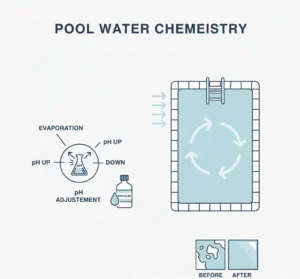 Why remove calcium scale San Antonio pool matters
Buildup isn’t just cosmetic. Thick scale narrows tile grout lines, traps algae, and makes heaters and salt cells work harder. Over time it stains, etches, and turns pretty water features into sputtering, off-key fountains. When you invest a little effort in tile cleaning, tighten your pH balance, and use a smart descaler plan, the whole pool feels new again—steps look brighter, handrails shine, and the water moves like silk instead of sand. Your feet notice first.
Let’s make a practical game plan that respects your weekend and actually works here. You don’t need to memorize chemistry charts; you only need a calm eye and a few steady habits. In our area, winter sun is gentler, but evaporation continues; summer is bold and relentless. Your approach adapts to both with tiny adjustments.
Here’s the heart of scale prevention: water that’s comfortable doesn’t cling to tile. That starts with pH balance. When pH drifts too high—easy to do after big swim days or when you’re using trichlor tabs—calcium is more likely to fall out of solution. Paired with high calcium hardness from top-offs, you’ve built a ladder for scale to climb. Keep pH roughly 7.4–7.6 most days, watch total alkalinity so pH doesn’t yo-yo, and check calcium hardness monthly. Small corrections beat big swings every time.
Prevention also means washing away opportunities. A two-minute brush along the waterline during your regular cleaning is worth its weight in free Saturdays. Those passes break up the earliest haze so your filter can carry it away. If you run a salt system, peek at the cell monthly: scale loves the plates’ tiny edges. A quick rinse and you’re back to efficient chlorination.
Below is a single, simple plan you can tape to the equipment lid—the only list you’ll need.
The One-Page Plan to Keep Scale Away (San Antonio Edition)
• Test and nudge pH balance twice weekly; aim 7.4–7.6.
• Check calcium hardness monthly; if topping off often, test every two weeks.
• Give the waterline a quick tile cleaning swipe during regular brushing.
• After swim parties or windy weeks, run a nighttime circulation cycle to mix and filter fines.
• If haze appears, apply a gel descaler to a non-abrasive pad; work in short sections and rinse.
• For spillways and water features, reduce flow during midday heat to curb evaporation crusts.
That’s it. Do those six things and the crust never gets a chance to become concrete. And the bonus? Everything else behaves better, from heater efficiency to clarity.
Now for the stubborn stuff. When white crust has the confidence of limestone, you’ll need a more deliberate approach. The goal is to remove calcium scale San Antonio pool without scarring tile or soft stone.
Start by softening the bond. Choose a pool-safe descaler—liquid or gel—and let it sit just long enough to loosen, not long enough to etch. Work the tile cleaning in quiet, patient circles with a white (non-scratch) pad. For ceramic tile, a pumice stone can help, but keep it wet and test a hidden spot; for glass tile or glossy ceramics, skip pumice to avoid micro-scratches that attract new scale. Travertine and flagstone need extra caution; gels and soft pads are safer than scraping.
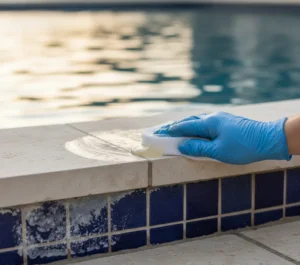 Really thick deposits may need a professional touch like bead blasting with soft media. It looks dramatic, but in practiced hands it’s precise—removing scale while leaving tile intact. Pros typically follow with a sealer on porous stone to slow future buildup. If your spillway roars all day, consider shortening that run time or redirecting the sheet slightly; sheer descent edges are scale magnets because evaporation is constant.
After removal, protect your work. Re-check pH balance the same evening; scaled areas can briefly nudge chemistry. If you used a strong descaler, run an extended filtration cycle and rinse any cartridges the next day. Then restart your calm, twice-weekly routine. You’ll notice swim towels feel softer, and the waterline looks like it did the week you filled.
There’s a quiet satisfaction to this kind of care. On a still morning you’ll see sunlight unzip across a perfectly clean tile line, and you’ll hear only the gentle hiss of returns. If you want to keep that feeling through the hottest months, pair this guide with our article on Pool Water Conservation San Antonio—less evaporation means fewer minerals left behind, which means less scale trying to stake a claim.
FAQs
1. How do I know if it’s calcium scale or just sunscreen gunk?
Scale feels gritty and won’t wipe away with soap; lotion film feels slick and vanishes with basic tile cleaning. A drop of vinegar that fizzes signals mineral scale.
2. What pH target best prevents scale?
Steady pH balance around 7.4–7.6 discourages calcium from falling out. Avoid long stretches above 7.8, especially in heat and high evaporation.
3. Will a descaler damage my tile?
A pool-safe descaler used as directed is fine on most ceramic and glass tiles. Always spot test, keep areas wet, and avoid harsh acids on natural stone.
4. Is pumice safe on every surface?
No. Pumice can scratch glass, glossy ceramics, and soft stone. Use only on suitable tile, keep it wet, and go gently.
5. When should I bring in a professional?
If scale is thick, widespread, or on delicate stone—or if you can’t clear spillway edges without scratching—schedule bead blasting and sealing. Then return to your regular pH balance and tile cleaning routine.
