
There’s a line of thinking in pool care that says a pool is a pool, same chemicals, same schedule, same approach regardless of where you live. Spend one summer managing a pool in Boerne and then one in Leon Valley, and that idea falls apart pretty quickly. These two communities sit on opposite sides of San Antonio’s suburban spread, and the environmental conditions, water sources, neighborhood characteristics, and physical settings they represent are genuinely different from each other, and different from the more central San Antonio neighborhoods most generic pool guides are written for. Understanding what pool maintenance in Boerne TX specifically requires, and how that differs from what a Leon Valley pool needs, is the kind of local knowledge that makes the difference between a pool that’s consistently clear and one that keeps surprising you with problems you can’t quite explain.
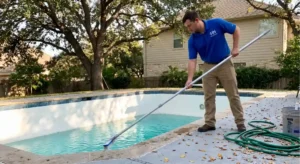
Boerne TX where the Hill Country starts and pool chemistry gets interesting
What makes Boerne pool maintenance uniquely challenging
Boerne sits approximately 31 miles northwest of San Antonio on Interstate 10, right at the point where the San Antonio suburbs transition into the Texas Hill Country. That geographic position isn’t just scenic, it has direct, practical implications for pool maintenance in Boerne TX that distinguish it from pools closer to the city center.
The Hill Country environment introduces conditions that accumulate in your pool constantly and quietly. Cedar, live oak, ashe juniper, and native Hill Country vegetation surround most Boerne properties, and during their respective pollen seasons, those trees deposit significant organic material into pools across the area. Cedar season, which runs from December through February in a typical year, is the most dramatic: cedar pollen loads pool water with phosphates and organic compounds that consume chlorine, feed algae, and clog filter media at a pace that catches homeowners off guard if they’re not adjusting their maintenance schedule for the season.
Spring in Boerne brings a second wave from the live oak and mountain laurel. Tannins from decomposing organic material (leaf debris, seed pods, the general biological activity of a landscape that’s genuinely more alive than a manicured suburban neighborhood) create a persistent organic load in pool water that requires more consistent shocking and enzymatic treatment than a pool in a less vegetated area would need.
According to Swim University’s pool maintenance guide, “the three most important parts of pool water chemistry are pH levels, alkalinity, and sanitizer levels”, and in Boerne’s environment, all three are under more consistent pressure from organic inputs than they would be in a more sheltered urban setting. Maintaining those three parameters requires testing more frequently during high-pollen and post-rain periods, not just on a fixed weekly schedule.
Hard water in the Hill Country Boerne’s persistent chemistry challenge
Boerne’s water supply shares the same geological source as San Antonio’s, the Edwards Aquifer and associated limestone formations that give the entire region its characteristic hard water profile. In Boerne, that hard water reality is compounded by the fact that many properties in the outer areas of the city rely on well water rather than municipal supply, and well water in the Hill Country limestone geology often runs even harder than treated municipal water.
For local pool care in Hill Country Texas, this means calcium hardness management isn’t just an annual consideration, it’s an active, monthly maintenance task throughout the swim season. Calcium hardness above 400 ppm creates conditions where mineral precipitation clouds water, leaves scale deposits on tile and equipment, and makes pH more difficult to stabilize. In Boerne pools that combine hard well water with the organic inputs from surrounding Hill Country vegetation, these challenges interact in ways that require a more comprehensive approach than standard pool maintenance guides anticipate.
The practical response is consistent: test calcium hardness monthly rather than seasonally, use a metal sequestrant as a preventive monthly treatment rather than a reactive one, keep pH at the lower end of the acceptable range (7.2 rather than 7.6) to slow calcium precipitation, and schedule a professional water analysis at the beginning of each season to establish a baseline that accounts for your specific water source’s composition.
Boerne’s weather patterns and what they mean for your pool
Boerne sits at the edge of a weather transition zone that gives it more variable conditions than San Antonio proper. Cold fronts from the north hit Boerne more directly than the more sheltered urban areas closer to downtown, and the city sees more frequent and sometimes more intense storm activity during spring and early summer than the eastern and central parts of Bexar County.
Those spring storms matter for pool chemistry in a specific way. Heavy rainfall over the Boerne area introduces significant runoff from surrounding limestone soil and Hill Country landscape (carrying dissolved minerals, organic matter, and phosphates directly into pool water in volume that can shift your chemistry readings noticeably in a single rain event. Post-storm testing in Boerne isn’t optional) it’s a standard part of the maintenance routine that experienced pool cleaning near Boerne professionals build into their service schedule automatically.

Leon Valley TX older pools, urban density, and a different kind of maintenance challenge
What Leon Valley’s pool landscape actually looks like
Leon Valley is a different kind of community than Boerne in almost every way that matters for pool maintenance. Where Boerne is an expanding Hill Country suburb with newer construction and open landscapes, Leon Valley is a dense, fully built-out suburb of San Antonio that developed primarily in the 1950s through 1980s. Many homes in Leon Valley currently on the market were built during that era, and the pools that come with them reflect that age, concrete construction, older plumbing, equipment that may have been updated but often wasn’t, and plaster surfaces that have accumulated decades of hard water mineral deposits.
For pool service in Leon Valley TX, that older infrastructure profile means equipment-related maintenance considerations show up more frequently than in newer pool communities. Older pump motors run less efficiently and are more prone to developing air leaks through aged O-rings and lid seals. Older filter systems may be undersized by modern standards built for pools used in a different era with different chemical demands. Older plumbing connections can develop slow leaks that aren’t immediately obvious but contribute to water loss and chemistry dilution.
Leon Valley’s position in northwestern Bexar County (near the junction of Loop 410 and Highway 16) also places it in a corridor that experiences significant wind and urban particulate matter from the surrounding metropolitan area. The Texas Commission on Environmental Quality notes that the Leon Creek watershed, which runs through this area, is affected by the highly urbanized residential character of the surrounding communities, a reminder that urban runoff patterns in this part of Bexar County contribute to local water quality conditions that affect residential pools in the area.
The mature tree challenge in Leon Valley neighborhoods
If Boerne has a Hill Country vegetation challenge, Leon Valley has a mature urban tree challenge that’s equally significant in its own way. The neighborhoods that developed in the 1950s through 1980s now have oak, pecan, and elm trees that are 40 to 60 years old — massive, beautiful, and extremely productive in terms of the organic material they deposit into nearby pools through most of the year.
Mature pecans drop not just leaves but also catkins, husks, and tannin-rich debris that stains pool surfaces and consumes chlorine at a rate that newer, less vegetated neighborhoods don’t experience. Large oak trees in Leon Valley are on a year-round debris cycle — leaves, acorns, pollen, and twig debris arrive in different volumes through every season rather than concentrating in a single fall event the way trees in other climates do.
For pool service in Leon Valley TX, managing this organic load effectively requires more frequent skimming and surface cleaning than once-weekly maintenance can always achieve, weekly shocking during the most active debris periods to prevent chloramine buildup, and monthly enzyme treatments to break down the tannin and organic film that accumulates on pool surfaces under persistent tree canopy. Brushing frequency matters more in Leon Valley’s older pools with aged plaster surfaces (twice weekly at minimum) because rough, porous plaster gives organic material and algae more surface area to grip.
The Pool & Hot Tub Alliance recommends that pool owners in high-organic-load environments establish written maintenance schedules that account for debris cycles rather than applying a generic year-round routine, exactly the kind of environment specific approach that Leon Valley’s mature tree canopy demands.
Equipment considerations specific to Leon Valley’s older pool stock
The age profile of Leon Valley’s residential pool infrastructure creates a set of maintenance priorities that differ meaningfully from what you’d encounter servicing a 2019 installation in a new Boerne development. Here’s what experienced pool professionals notice specifically in older Leon Valley pools:
Pump efficiency degrades gradually and isn’t always obvious until something fails. An older single-speed pump that’s running inefficiently isn’t just costing more in electricity, it’s delivering less circulation than your pool needs, which means chemistry distribution is uneven and debris clearing is slower than it should be. Annual pump efficiency checks are worth building into your maintenance calendar if your pool equipment is more than 10 years old.
Filter sizing deserves evaluation in older pools. Equipment that was appropriately sized for a pool used by a family in 1975 may be undersized for the same pool used heavily by a family in 2026, with today’s chemical demands and bather loads. A filter system running at capacity struggles to maintain water clarity through the organic load that Leon Valley’s mature trees create, even with consistent maintenance.
Older concrete pools in Leon Valley also benefit from annual professional equipment inspections that go beyond what’s covered in a standard weekly service visit, checking O-rings and seals, inspecting plumbing connections for slow leaks, evaluating filter media condition, and assessing pump motor health before a problem develops into a summer emergency rather than after.
Regardless of whether you’re in Boerne dealing with Hill Country organic loads and hard well water, or in Leon Valley managing an older pool under mature tree canopy in a dense urban neighborhood, the common thread is that locally-specific knowledge produces better results than generic advice. Our comprehensive pool cleaning service in Bexar County covers both communities with a locally-calibrated approach that accounts for the specific conditions each neighborhood presents, not a one-size-fits-all routine applied regardless of what the pool and its environment actually need.
For a broader perspective on how different San Antonio neighborhoods create different pool maintenance needs, our earlier article on pool maintenance in Helotes, Converse, and Alamo Heights covers three additional communities with their own distinct environmental profiles, worth reading alongside this one if you want the full picture of how location shapes pool care across the San Antonio metro area.
FAQ
1. What makes pool maintenance in Boerne TX different from other San Antonio areas?
Boerne’s Hill Country location creates a combination of challenges that most generic pool guides don’t address: intense cedar and oak pollen seasons that load pools with phosphates and organic matter, hard water from Hill Country limestone geology that’s often harder than San Antonio municipal supply, and spring storm patterns that introduce significant mineral rich runoff into pool water in single events. Pool maintenance in Boerne TX requires more frequent testing during pollen and storm seasons, consistent phosphate management as a preventive routine, and monthly calcium hardness monitoring, a more intensive approach than pools in more sheltered urban areas of Bexar County typically need.
2. Are older pools in Leon Valley harder to maintain than newer pools?
In several meaningful ways, yes. Older concrete pools in Leon Valley often have aged plaster surfaces that are more porous and rougher than newer surfaces, making algae attachment easier and requiring more frequent brushing. Older equipment (pumps, filters, and plumbing) may be less efficient and more prone to developing air leaks or reduced flow capacity over time. Older filter systems may also be undersized by current standards. These factors combine with Leon Valley’s mature tree canopy and persistent organic debris load to create a maintenance environment that benefits significantly from regular professional equipment inspections alongside routine weekly cleaning.
3. How does hard well water in Boerne TX affect my pool differently than San Antonio city water?
Well water in the Hill Country limestone geology around Boerne often runs harder than treated San Antonio municipal water, sometimes significantly so, with calcium hardness levels that can exceed 500 ppm without active management. This accelerates scale formation on tile and equipment surfaces, makes pH more difficult to stabilize, and increases the frequency with which calcium hardness corrections are needed. Monthly testing rather than seasonal testing is the appropriate standard for local pool care in Hill Country Texas well water conditions, along with consistent sequestrant treatment and pH management at the lower end of the acceptable range to slow mineral precipitation.
4. How do the mature trees in Leon Valley affect my pool chemistry?
Mature oak and pecan trees in Leon Valley’s established neighborhoods create a year-round organic debris cycle, leaves, tannins, pollen, and seed material arrive in different volumes through every season rather than concentrating in a single period. Tannins from decomposing organic material stain pool surfaces and consume chlorine consistently, requiring more frequent shocking than pools in less vegetated environments. Monthly enzyme treatments break down the tannin and organic film that accumulates on surfaces under heavy tree canopy. Pool service in Leon Valley TX that accounts for this organic load delivers noticeably better water quality results than a generic maintenance approach that doesn’t factor in the neighborhood’s specific debris profile.
5. How do I find a pool service near Boerne TX that understands local conditions?
Look for a provider with documented experience specifically in the Boerne and Hill Country area, not just the broader San Antonio metro. Ask directly whether they adjust their service approach for pollen seasons, whether they include phosphate testing as part of their routine water analysis, and whether they have experience with well water chemistry management. A knowledgeable pool cleaning near Boerne provider should be able to speak specifically to cedar season chemistry impacts and Hill Country hard water management without you having to explain the local conditions. Ask for references from current clients in your specific area for the most reliable indication of local expertise.
