
Most pool conversations in San Antonio revolve around keeping the water cool enough to enjoy in July and August, not heating it. And that makes sense. When the air temperature sits at 103°F and the water has absorbed a full week of South Texas sunshine, the last thing most people are thinking about is a heater. But here’s the part of the pool heater San Antonio TX conversation that a surprising number of local homeowners haven’t fully considered: the months on either side of summer. March feels like spring everywhere else in the country, but in San Antonio, it’s often perfect outdoor weather (75°F afternoons, clear skies, low humidity) with pool water that’s still sitting in the low 60s. Too cold to swim comfortably, too beautiful outside not to. A pool heater changes that equation in a meaningful way.
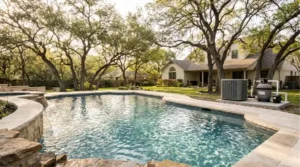
Why pool heating makes more sense in San Antonio than most homeowners assume
The South Texas shoulder season where a heater pays for itself
San Antonio’s climate creates what pool industry professionals call “shoulder seasons”, the weeks and months at the beginning and end of the main swim season where conditions are ideal for outdoor enjoyment but water temperatures haven’t caught up with the weather. In Bexar County, those shoulder seasons run roughly from mid-February through mid-April in spring and from mid-October through late November in fall.
During these windows, daytime highs regularly reach the mid 70s to mid 80s, genuinely beautiful days. But pool water, which takes weeks to absorb and release heat due to its thermal mass, lags significantly behind air temperature. A pool that’s been sitting through San Antonio’s relatively mild but still cool winters typically comes out of January at 58°F to 65°F. By mid-March, it might have climbed to the low 70s. For most adults and certainly for children, that’s the lower edge of comfortable swimming, or below it entirely.
A pool heater targeting 80°F to 84°F in the water extends your usable swim season by four to six weeks in spring and another three to five weeks in fall. In a city where the outdoor conditions genuinely support swimming for much of that time, those eight to ten additional weeks of comfortable pool use represent real value from an investment that, once installed, costs relatively little to operate in South Texas’s mild off-peak temperatures.
According to Swim University’s pool heater guide, heat pumps (the most popular heater type for San Antonio’s climate) “cost less to run than gas heaters” and work particularly well in mild climates where ambient air temperatures stay above 50°F. San Antonio’s shoulder seasons fit that profile almost perfectly, which is why the heat pump is the most commonly recommended option for South Texas pool owners looking to extend their season without dramatically increasing their monthly utility bill.
The three types of pool heaters and how each performs in South Texas
Understanding your options before making a decision is exactly the kind of thing that prevents buyer’s remorse on a $2,000 to $5,000 installation. Here’s how each heater type performs specifically in San Antonio’s conditions:
Heat Pump Pool Heaters work by extracting heat from the surrounding air, the same principle as your home’s air conditioning unit, but in reverse. They don’t generate heat directly; they transfer it from outside air to pool water, which makes them dramatically more energy-efficient than gas heaters when ambient temperatures are above 50°F to 55°F. For San Antonio’s shoulder seasons, where overnight lows rarely drop below 45°F even in January and February, a heat pump operates efficiently for most of the extended season you’re trying to capture.
Installation costs for heat pumps run $2,000 to $5,000 for the unit, plus $500 to $1,500 for professional installation. Monthly operating costs in San Antonio’s shoulder season conditions typically run $50 to $150 depending on pool size and target temperature. The tradeoff is heating speed, a heat pump raises pool temperature gradually, typically 1°F to 3°F per hour of operation, which means planning ahead rather than on-demand heating. For homeowners who use a regular pool schedule rather than spontaneous swims, that limitation is rarely a practical problem.
Gas Pool Heaters (natural gas or propane) generate heat directly through combustion, making them the fastest option for raising water temperature, capable of increasing pool temperature by 30°F in a matter of hours rather than days. For San Antonio homeowners who want true on-demand heating (the ability to decide at noon that you want to swim at 80°F by 4pm) gas is the only option that delivers that responsiveness.
According to Bob Vila’s pool heater cost guide, gas pool heaters typically cost $1,500 to $3,500 for the unit plus installation, making them generally less expensive upfront than heat pumps. The ongoing operating costs run higher (natural gas or propane consumption adds $100 to $300 per month during active heating use) which makes them less economical for the gradual season-extension use case but ideal for homeowners who heat occasionally and on-demand rather than maintaining a consistent temperature.
Natural gas availability is a practical consideration in parts of Bexar County and particularly in more rural areas around San Antonio. If your property doesn’t have an existing natural gas connection near the pool equipment pad, the cost of running a gas line adds meaningfully to the installation budget. Propane is an alternative but carries higher per-BTU fuel costs than natural gas.
Solar Pool Heaters use roof-mounted or ground-mounted solar collectors to capture the sun’s energy and transfer it to pool water circulating through the system. In a sun-rich environment like San Antonio (where clear skies and intense solar radiation are the norm for most of the year) solar heating performs better than in most other U.S. markets. Installation costs run $3,000 to $4,000 including panels and plumbing modifications, and according to Swim University’s solar pool heater guide, they “average between $3,000 and $4,000 to buy and install, but will pay you back over time with energy savings” with an average lifespan of 15 to 20 years.
The meaningful limitation of solar heating for San Antonio’s shoulder season use case is response time. Solar heaters raise water temperature gradually, typically 1°F to 5°F per day depending on solar intensity and panel coverage. For the spring shoulder season when you want to get the pool from 65°F to 80°F quickly, solar alone can take one to two weeks. Many San Antonio homeowners who choose solar combine it with a solar cover to retain heat overnight, which meaningfully improves the effective heating rate.
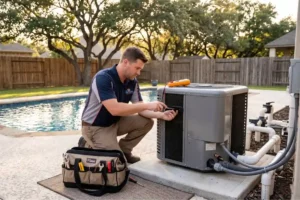
What pool heating actually costs in San Antonio and whether the investment makes sense
The real ROI calculation for San Antonio homeowners
This is the question that matters most, and it deserves a direct answer rather than hedging. Does a pool heater in San Antonio TX pay for itself in practical terms?
For most Bexar County homeowners with families who actively use their pool, the answer leans yes, with the heat pump option delivering the clearest return on investment. Here’s the reasoning: a $3,500 heat pump installation that extends comfortable pool use by 8 to 10 weeks per year adds roughly 56 to 70 additional swim days over a typical San Antonio season. At $75 to $100 per operating month, that extended season costs $150 to $200 annually in additional electricity. Over a 15-year heat pump lifespan, that’s $2,250 to $3,000 in total operating costs beyond the installation, against 840 to 1,050 additional swim days your family wouldn’t have otherwise had.
Put another way: if your family would use those extra weeks regularly (spring break swims, October weekend gatherings, early March afternoons) a heat pump pays for itself in pool enjoyment far faster than the numbers suggest on paper. If you swim only during peak summer and the shoulder seasons go largely unused anyway, the ROI case is weaker and the investment less compelling.
Pool heating Texas also has a secondary benefit that rarely gets discussed: water temperature consistency. During the main swim season, San Antonio pool water can fluctuate significantly between a week of 100°F+ days and a cold front that drops temperatures 20 to 30 degrees overnight. A heater set to a minimum temperature (even just maintaining 78°F as a floor rather than actively heating) reduces those chemistry-affecting temperature swings and keeps your maintenance routine more predictable week to week.
What to know before you install a pool heater in San Antonio
A few practical considerations that affect both the installation process and the ongoing experience:
Equipment pad space is a real constraint. Gas heaters are large and need adequate clearance for both air circulation and service access. Heat pumps need airflow around the unit and perform better when positioned away from full afternoon shade, which in San Antonio means thinking about both summer shade patterns and winter sun exposure when choosing placement.
Your existing pump needs to be sized appropriately for the heater. Undersized pumps can’t deliver adequate flow through a heater, reducing efficiency and potentially voiding equipment warranties. A licensed pool professional should evaluate your current pump before any heater installation, and this is particularly important if you’re considering adding a heater to an older pool system where pump sizing was never optimized.
Calcium hardness management becomes slightly more important with a heated pool. Warm water accelerates calcium carbonate precipitation, one of the primary drivers of scale formation in San Antonio’s hard water environment. A pool consistently maintained at 82°F requires more frequent calcium hardness monitoring than an unheated pool, and keeping pH at the lower end of the acceptable range becomes even more important as a preventive measure against scale buildup on heater heat exchangers.
For professional evaluation of your pool’s equipment readiness for a heater installation (including pump sizing, pad space assessment, and compatibility with your existing system) our pool equipment maintenance and repair service in Bexar County covers the full equipment assessment that makes any heater installation start correctly rather than discovering compatibility issues after the equipment arrives.
And if you’re still evaluating your pool’s overall setup (including whether your current pool type is well-suited for the additional maintenance considerations that come with heating) our article on fiberglass vs. concrete pools in San Antonio TX covers how each pool surface type responds differently to the chemistry and temperature changes that heated pools experience through the extended season.
FAQ
1. Is a pool heater worth it in San Antonio TX?
For most San Antonio families who actively use their pool, a pool heater delivers genuine value by extending the comfortable swim season four to six weeks in spring and three to five weeks in fall, adding up to eight to ten additional swim weeks annually. With San Antonio’s mild shoulder season temperatures, a heat pump heater operates efficiently and economically during those extra weeks. The investment makes the most sense for homeowners who would realistically use those additional weeks consistently, particularly families with children, homeowners who entertain regularly, or anyone who wants to maximize the return on their pool investment year-round.
2. What type of pool heater is best for San Antonio TX?
A heat pump pool heater is the most practical choice for most San Antonio homeowners looking to extend their swim season. San Antonio’s shoulder season temperatures (mild days and nights that rarely drop below 45°F even in winter) fall squarely in the operating range where heat pumps work efficiently and economically. Gas heaters make more sense for homeowners who want on-demand heating capability and don’t mind higher operating costs. Solar heaters work well in San Antonio’s sun-rich environment for gradual season extension but are best combined with a solar cover for faster heat-up times during the spring transition period.
3. How much does a pool heater cost to install in San Antonio TX in 2026?
Pool heater installation costs in San Antonio vary by type. Heat pump pool heaters run $2,000 to $5,000 for the unit plus $500 to $1,500 for professional installation. Gas heaters typically cost $1,500 to $3,500 for the unit plus installation, though adding a natural gas line if one isn’t already present near the equipment pad increases that figure significantly. Solar heaters run $3,000 to $4,000 installed including panels and plumbing modifications. Monthly operating costs range from $50 to $150 for heat pumps during shoulder season use, and $100 to $300 for gas heaters during active heating periods.
4. How long does it take a pool heater to warm water in San Antonio?
Heating time depends on the heater type and how much you need to raise the water temperature. Gas pool heaters are the fastest, capable of raising pool temperature by 30°F in several hours, suitable for on-demand heating decisions. Heat pumps raise temperature more gradually at 1°F to 3°F per hour of operation, meaning bringing a 65°F pool up to 80°F takes roughly 5 to 15 hours depending on the unit size and ambient air temperature. Solar heaters work most gradually, typically raising temperature 1°F to 5°F per day. For San Antonio shoulder season use, planning heat pump operation 12 to 24 hours in advance covers most situations comfortably.
5. Does a pool heater affect water chemistry in San Antonio TX?
Yes, and this is worth knowing before installation. Warm water accelerates chemical reactions in your pool, including calcium carbonate precipitation, which is particularly relevant in San Antonio’s hard water environment. A consistently heated pool requires more frequent calcium hardness monitoring and benefits from keeping pH at the lower end of the acceptable range to slow scale formation on the heater’s heat exchanger. Chlorine also depletes slightly faster in warmer water, which may require modest adjustment to your regular dosing schedule during heated operation. These adjustments are manageable but should be factored into your maintenance routine from the first season you use a pool heater.
