
There’s something about an above ground pool in a Hondo backyard that just makes sense. The space, the budget, the flexibility, for a lot of families in Medina County, it’s the perfect way to get through a South Texas summer without the commitment and cost of a full inground installation. But here’s what most above ground pool guides don’t tell you: maintaining one in Hondo is a different challenge than maintaining one almost anywhere else in the country. The heat out here is serious, the wind picks up without warning, the water is hard, and the UV exposure from May through September is relentless. Above ground pool maintenance in Hondo TX requires a locally-specific approach, not the generic advice written for mild climates with soft water and cool evenings.
This guide is written specifically for Medina County conditions. No filler, no assumptions about your climate, just what actually works out here.
What makes above ground pool care in Hondo different from the generic guides
The heat and UV factor more aggressive than most people prepare for
Let’s start with the environmental reality that shapes everything else about pool maintenance in this part of Texas. Hondo regularly sees temperatures above 100°F for extended stretches during July and August. UV index readings in Medina County during peak summer hit 10 or higher, the same range as regions closer to the equator. For above ground pool owners, that combination creates two specific and persistent problems that inground pool guides rarely address with the same urgency.
First, chlorine loss is dramatically accelerated. Without adequate cyanuric acid stabilizer, UV rays can destroy half your chlorine in under 17 minutes of direct sunlight, and in Hondo’s full-sun summer, that’s not a theoretical concern, it’s a daily reality. According to Swim University’s hot weather pool protection guide, “chlorine is the most affected by heat and sunlight, it breaks down in direct UV rays,” and during heat waves above 100°F, pools require extra attention to maintain adequate sanitizer levels. For above ground pool care in Texas, this means checking chlorine more frequently than the standard weekly recommendation, especially during heat events, when checking every 2 to 3 days is a more appropriate baseline.
Second, water temperature in above ground pools climbs faster than in inground pools. Because above ground pools are smaller and the walls are exposed to direct air and sunlight rather than insulated by surrounding soil, water temperatures can reach uncomfortable and chemistry-affecting levels quickly during a Hondo summer. Warm water accelerates bacteria growth, depletes chlorine faster, and creates algae-friendly conditions even in pools with otherwise adequate sanitizer. Running your pump during the hottest part of the day (rather than defaulting to a nighttime-only schedule) helps circulate and slightly cool the water through evaporation, and keeps your chemistry more evenly distributed through the heat of the afternoon.
Hard water in Medina County the chemical challenge nobody warns you about
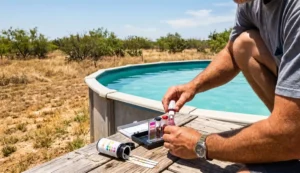
San Antonio gets a lot of attention for its hard water, but Hondo and the surrounding Medina County area face the same challenge from the same geological source, and in many cases, the water coming from wells or local supply in this part of Texas runs even harder than what comes out of San Antonio taps.
For above ground pool owners, hard water creates a specific complication that inground pool owners also face but that affects above ground pools somewhat differently: calcium and mineral buildup accumulates on vinyl liners, on the pump housing, on filter components, and around the waterline in ways that degrade materials faster than soft water would. A vinyl liner in Hondo that’s regularly exposed to high-calcium, mineral-rich water without active chemistry management will develop scale deposits, stiffening, and discoloration faster than the manufacturer’s expected lifespan suggests.
The practical fix isn’t complicated but does require consistency. Test calcium hardness monthly, for above ground pools with vinyl liners, the target range is 175 to 225 ppm, slightly lower than the 200 to 400 ppm recommended for plaster surfaces. Use a metal sequestrant monthly as a preventive measure to keep minerals suspended in solution rather than depositing on surfaces. And keep pH on the lower end of the acceptable range (closer to 7.2 than 7.6) because elevated pH accelerates calcium precipitation significantly in hard water environments like Hondo’s.
Wind and dust the Hondo specific debris problem
Anyone who’s spent a summer in Medina County knows that the wind out here has personality. It picks up in the afternoon, carries fine caliche dust, dried grass, and whatever the surrounding landscape has to offer, and deposits it directly into anything left uncovered, including your pool. For pool maintenance tips in Hondo, managing wind-driven debris is an ongoing task rather than an occasional one.
Fine dust and organic particles introduce phosphates and organic load into the water with every significant wind event. They clog filter cartridges faster than in more sheltered urban environments. They settle on the pool floor as fine sediment that requires vacuuming to remove and clouds the water if disturbed. If you’ve noticed that your pool’s water has a slightly dusty or grayish tinge after a windy afternoon despite otherwise correct chemistry, this is exactly what’s happening, and it’s not a chemistry problem, it’s a filtration and debris management problem.
Skimming the surface after wind events (not just on your scheduled maintenance day) makes a meaningful difference in how quickly the fine particles settle and how much work your filter has to do. Using a pool cover when the pool isn’t in active use is the most effective preventive measure, reducing both debris load and evaporation simultaneously. In Hondo’s summer, where a pool can lose significant water volume to evaporation in a single hot day, a cover does double duty: it keeps the debris out and keeps the water in.
The practical weekly routine and equipment care for Hondo above ground pools
Your weekly above ground pool maintenance checklist for Hondo TX
Generic maintenance schedules aren’t specific enough for Medina County conditions. Here’s what above ground pool maintenance in Hondo TX actually looks like on a week-to-week basis during the active season:
- Test chemistry every 3 to 4 days during peak summer, not just weekly. In Hondo’s heat, chlorine and pH can shift significantly between weekly checks.
- Check and adjust free chlorine, target 2 to 4 ppm for above ground pools according to Bob Vila’s above ground pool maintenance guide. The higher end of that range gives you more buffer against the rapid chlorine loss that South Texas UV creates.
- Test and adjust pH, target 7.2 to 7.4. Keep it on the lower end in summer to maximize chlorine effectiveness and slow calcium precipitation.
- Skim the surface after every significant wind event, not just on a set schedule.
- Brush the walls and floor twice weekly, in Hondo’s hard water environment, mineral films develop on vinyl surfaces faster than in soft water areas, and regular brushing prevents them from hardening into deposits.
- Check and clean the filter cartridge every two weeks during heavy use periods. Fine dust and caliche particles clog filter media faster than standard pool debris, and a partially clogged filter running in Hondo’s heat is a recipe for water quality problems.
- Shock weekly during peak summer season. In temperatures above 100°F with heavy UV exposure, weekly shock treatment is a preventive measure rather than a reactive one, it clears chloramines before they accumulate and resets your sanitizer baseline consistently.
- Check your water level after hot days, evaporation rates in Medina County during July and August can drop pool water level noticeably within 48 hours. Running on low water stresses your pump.
As Swim University’s above ground pool chemicals guide notes, “cyanuric acid helps stabilize your chlorine and protect it from being destroyed by the sun’s UV rays, without it, the chlorine levels in an outdoor pool will quickly drop.” For Hondo pools, this is especially true, establishing proper CYA levels of 30 to 50 ppm at the start of the season is one of the most impactful things you can do for your summer maintenance routine.
Equipment care for above ground pools in South Texas heat
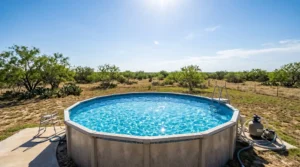
Above ground pool equipment runs harder in Hondo’s climate than the equipment specs anticipate. The pump motor operates in ambient temperatures that can exceed 100°F, which generates heat stress that shortens operating life if the equipment isn’t positioned and maintained properly. A few specific practices make a meaningful difference:
Provide shade for your pump and filter if possible, even a simple shade structure or strategic placement near a wall or fence that blocks afternoon sun significantly reduces the ambient temperature the motor operates in. This isn’t a minor consideration in Hondo’s July and August; heat stress on pump motors is a leading cause of equipment failure in South Texas above ground pools.
Inspect your pump lid O-ring and all connection points at the start of each season and monthly through summer. The combination of heat expansion and contraction from cool nights causes rubber components to wear faster in climates with large temperature swings. A failing O-ring introduces air into the system and causes your pump to lose prime, something that becomes obvious quickly but is inexpensive to prevent and expensive to ignore.
Clean your filter cartridge thoroughly every two weeks, and when you clean it, use a proper cartridge cleaning solution rather than just hosing it off. Fine caliche and mineral dust from Hondo’s environment embeds in filter media in ways that a water rinse doesn’t fully address. A chemical soak every month removes the embedded particles that reduce your filter’s effective pore size and force your pump to work harder to maintain flow.
The CDC’s pool water treatment guidelines emphasize that proper filtration and chemical balance work together, a compromised filter undermines even good chemistry management, and in Hondo’s dusty, high-debris summer environment, keeping the filter clean is just as important as keeping the chemistry right.
When above ground pool maintenance in Hondo needs professional support
Most above ground pool maintenance is genuinely manageable for a committed homeowner. But there are moments in a Hondo summer when the variables stack up (a week of temperatures above 105°F, a dust storm, a family reunion that packed the pool every day) and the chemistry gets away from you in ways that standard home treatment doesn’t fully resolve.
Green water that doesn’t respond to shock after 48 hours. Persistent cloudiness despite correct chemistry readings. A pump that’s running but not moving water the way it should. Filter pressure readings that stay high immediately after cleaning. These are the moments when a professional set of eyes and the right diagnostic tools get you back on track faster and more cost-effectively than continued trial and error in the heat.
For Hondo families who want reliable, clear water through the full summer without spending weekends fighting chemistry problems, our weekly pool maintenance service covers above ground pools in the Hondo and Medina County area, bringing consistent professional care specifically calibrated to local water conditions, local debris patterns, and local equipment needs.
And if you’re thinking about your above ground pool’s long-term condition and wondering when surface or liner issues require professional attention, our article on pool resurfacing and surface care in Hondo TX covers the signs that distinguish normal wear from conditions that need professional repair, useful reading for any pool owner in Medina County thinking about their pool’s long-term health.
FAQ
1. How often should I test my above ground pool water in Hondo TX?
During peak summer in Hondo (especially July and August when temperatures regularly exceed 100°F) test your above ground pool chemistry every 3 to 4 days rather than the standard weekly recommendation. South Texas UV exposure and extreme heat deplete chlorine significantly faster than in cooler climates, and chemistry can shift enough between weekly checks to create algae or clarity problems. Focus on free chlorine and pH as your primary readings, and test calcium hardness monthly to stay ahead of the hard water accumulation common throughout Medina County.
2. What chemicals do I need for an above ground pool in South Texas?
The core chemical kit for above ground pool care in Texas includes chlorine (liquid or tablets), pH increaser and decreaser, alkalinity increaser, cyanuric acid stabilizer, calcium hardness increaser or sequestrant for hard water management, non-chlorine shock for weekly maintenance, and algaecide for preventive treatment. For Hondo specifically, a metal sequestrant is particularly important given the mineral-rich local water supply. Target free chlorine at 2 to 4 ppm, pH at 7.2 to 7.4, CYA at 30 to 50 ppm, and calcium hardness at 175 to 225 ppm for vinyl liner pools.
3. How does Hondo’s hard water affect my above ground pool?
Hondo’s mineral-rich water supply (high in calcium and other dissolved minerals) affects above ground pools in several ways. Calcium deposits accumulate on vinyl liners, around the waterline, and on equipment components, accelerating wear and discoloration. High calcium hardness combined with elevated pH causes mineral precipitation that clouds water and creates scale on surfaces. Monthly metal sequestrant treatment, keeping pH at the lower end of the acceptable range, and testing calcium hardness monthly are the most effective preventive measures for above ground pool maintenance in Hondo TX’s hard water environment.
4. How do I protect my above ground pool pump from Hondo’s summer heat?
Provide shade for your pump and filter whenever possible, even partial afternoon shade from a structure or fence significantly reduces motor operating temperature during Hondo’s hottest months. Inspect the pump lid O-ring and all rubber connection points monthly during summer, as heat stress and temperature cycling cause rubber components to deteriorate faster in South Texas than in cooler climates. Clean your filter cartridge every two weeks using a proper cartridge cleaning solution rather than just water, since fine caliche dust from the Hondo area embeds in filter media in ways that a simple rinse doesn’t fully clear.
5. Can I use a pool cover on my above ground pool in Hondo TX?
Absolutely, and in Hondo’s conditions, a pool cover is one of the most practical investments you can make for your above ground pool. Hondo’s combination of intense UV exposure, high evaporation rates, and afternoon winds that carry fine dust and organic debris means an uncovered pool loses water quickly and accumulates debris constantly. A cover when the pool isn’t in use reduces evaporation dramatically (pools in South Texas summer can lose measurable water volume in a single hot day) and keeps wind-driven caliche dust and organic material out of the water, reducing both chemistry demand and filter load throughout the season.
