
If you’ve ever noticed a white crusty ring forming around your pool tile, or felt like your water never quite looks crystal clear no matter how much you adjust your chemicals, there’s a good chance the answer isn’t in your chlorine bottle. The real culprit is something that flows directly out of your tap every single day, and in San Antonio, it’s one of the most significant and least talked-about challenges of pool ownership. Hard water pool San Antonio TX problems affect thousands of residential pools across Bexar County every season, and most homeowners don’t even realize it’s the root cause of what they’re fighting.
Understanding your local water isn’t just interesting background information. It’s genuinely useful knowledge that changes how you maintain your pool, how much you spend on chemicals, and how long your equipment lasts.
Why San Antonio has some of the hardest water in America
What “hard water” actually means for your pool
Water hardness refers to the concentration of dissolved minerals in your water — primarily calcium and magnesium. When water travels through the limestone-rich geology of the Texas Hill Country before reaching your tap, it picks up those minerals along the way. By the time it flows into your pool, it’s already carrying a significant mineral load that most pool care guides written for general audiences simply don’t account for.
According to San Antonio Water System (SAWS), the local water supply consistently measures in the “very hard” category, with hardness levels typically ranging from 200 to over 400 mg/L depending on the source and season. For context, water above 180 mg/L is classified as very hard by the U.S. Geological Survey. San Antonio regularly sits well above that threshold — which means every gallon you add to your pool is contributing to a calcium buildup problem from the very first fill.
The cascade effect: How hard water disrupts everything
Here’s what makes calcium buildup pool issues so frustrating in this region: it’s not just one problem, it’s a chain reaction. When calcium hardness climbs too high (above 400 ppm, and often well above that in San Antonio pools that haven’t been actively managed) a series of interconnected issues begin to develop.
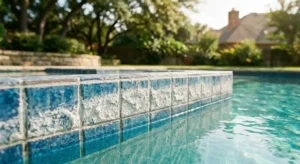
The water becomes what chemists call “oversaturated.” Calcium starts looking for somewhere to deposit itself, and it finds it on every surface it touches, your tile grout, your plaster, your vinyl liner, your return jets, your filter equipment, your salt cell if you have one. That white, chalky crust you see along the waterline? That’s calcium carbonate precipitation, and once it hardens it’s genuinely difficult to remove without the right tools and approach.
But the visible deposits are only part of the story. High calcium hardness also makes pool chemical balancing hard water situations significantly more complex. When your water is oversaturated with minerals, it becomes chemically “aggressive” in a counterintuitive way, it resists absorbing the chemicals you add, making it harder to adjust pH and alkalinity accurately. You end up adding more product to achieve the same result, which increases your chemical costs and makes your readings less predictable week to week.
I’ve seen this play out in pools across Stone Oak, Helotes, and Converse, homeowners who were meticulous about their chemistry, doing everything right by the book, but constantly fighting cloudy water or scale buildup because nobody had told them their baseline water conditions required a fundamentally different approach than what the standard pool care instructions assume.
Reading the Langelier saturation index
This sounds more technical than it is, I promise. The Langelier Saturation Index (LSI) is a simple calculation that tells you whether your pool water is balanced, scale-forming, or corrosive, taking into account not just calcium hardness but pH, alkalinity, temperature, and dissolved solids together.
For water hardness Bexar County pools, the LSI is particularly useful because it reveals what’s actually happening chemically even when individual readings look acceptable. A pool can show perfectly normal chlorine and pH levels on a test strip while still having an LSI that’s significantly positive, meaning it’s actively depositing scale on every surface. According to the Pool & Hot Tub Alliance, maintaining an LSI between -0.3 and +0.5 is the target range for residential pools, and pools in hard water regions like
South Texas require more frequent LSI checks than the national average to stay within that window.
How to manage hard water in your San Antonio pool
Practical solutions for calcium buildup pool problems
The good news is that water hardness Bexar County pools are entirely manageable with the right approach, it just requires being proactive rather than reactive. Here’s what actually works:
- Partial drain and refill: When calcium hardness consistently exceeds 500 ppm, the most effective reset is draining 25–30% of your pool water and replacing it with fresh water. Yes, that fresh water is also hard, but diluting the existing oversaturated water brings levels back into a manageable range. Do this during cooler months to minimize evaporation loss during the refill.
- Sequestering agents: These are chemical products that bind to calcium and other minerals in solution, keeping them suspended in the water rather than allowing them to deposit on surfaces. They don’t remove hardness, but they prevent the scale formation that causes the most visible and damaging problems. Add a sequestering agent monthly during heavy use season.
- Tile and surface cleaning: For existing calcium deposits on tile, a pumice stone or a professional-grade calcium scale remover works on light to moderate buildup. For heavy scaling, an acid wash or bead blasting by a professional is often the only effective solution, and the longer you wait, the harder and more expensive the job becomes.
- Regular brushing: Brushing your pool walls and floor twice weekly isn’t just about removing algae. In a hard water environment, it physically disrupts early-stage calcium deposits before they harden into scale. It’s one of those small habits that makes a genuinely significant difference over a full season.
Adjusting your chemical routine for hard water conditions
Standard pool care advice is written for average water conditions. In San Antonio, you need to calibrate your approach specifically for pool chemical balancing hard water realities:
Keep your pH on the lower end of the acceptable range, closer to 7.2 than 7.6. Higher pH dramatically accelerates calcium precipitation, so giving yourself that buffer makes a real difference. Watch your total alkalinity carefully too; in hard water pools, alkalinity can drift upward faster than in soft water regions, pulling pH with it.
Test your calcium hardness monthly at minimum, not just at the start of the season. Given how quickly levels can rise through evaporation and top-off water additions during San Antonio’s hot summers, monthly monitoring catches problems before they reach the critical threshold. As This Old House’s pool care guide points out, “calcium hardness is one of the most overlooked parameters in routine pool testing, most homeowners check it once at season start and forget about it entirely.”
When to get a professional water analysis
Home test kits measure the basics well, but they have real limits when it comes to hard water pool San Antonio TX management. They don’t calculate your LSI, they don’t detect total dissolved solids accurately, and they can’t identify the specific mineral composition of your water’s hardness. A professional water analysis (the kind run with a full lab-grade test panel) gives you a complete picture that makes every chemical decision more precise and more effective.
If your tile is showing persistent scale buildup, your water looks slightly dull despite balanced chemistry, or you’re constantly fighting the same imbalances week after week, a professional assessment isn’t an extra expense, it’s the most efficient path to actually solving the problem rather than repeatedly treating symptoms.
Managing a pool in South Texas requires understanding that you’re working with a specific local environment, not a generic set of conditions. The homeowners who get consistently clear, well-balanced water year after year are the ones who stopped fighting their water and started working with it, adjusting their approach to match what San Antonio’s water actually is, rather than what a standard pool care chart assumes it to be.
For a deeper look at how San Antonio’s climate affects your chlorine and overall chemical balance beyond just hardness, our article on pool chemical balancing in San Antonio covers the full picture in practical, easy-to-follow terms.
FAQ
1. Why is San Antonio’s water so hard and how does it affect my pool?
San Antonio’s water travels through the limestone-rich geology of the Texas Hill Country before reaching your tap, picking up high concentrations of calcium and magnesium along the way. According to SAWS, local water consistently measures in the “very hard” category, often above 300 mg/L. In your pool, that translates to calcium buildup on tile and equipment, persistent cloudiness despite balanced chemistry, and a harder-to-manage chemical environment that requires more frequent adjustments than pools in softer water regions.
2. What is the ideal calcium hardness level for a pool in San Antonio TX?
The recommended range for calcium hardness in any residential pool is 200–400 ppm. In San Antonio, where tap water already carries significant mineral content, levels frequently climb above 400 ppm, especially during summer when evaporation is high and you’re regularly topping off the pool with hard tap water. Monthly calcium hardness testing is essential for hard water pool San Antonio TX management. When levels consistently exceed 500 ppm, a partial drain and refill is typically the most effective corrective action.
3. How do I remove calcium deposits from my pool tile in San Antonio?
For light to moderate calcium buildup pool deposits, a pumice stone or a calcium-specific scale remover applied directly to the tile works well. Avoid using metal scrapers, which scratch tile surfaces. For heavy, hardened scale that’s built up over multiple seasons, a professional acid wash or bead blasting service is usually necessary, and the sooner you address it, the easier and less expensive the job. Prevention through monthly sequestering agent treatments is significantly cheaper than removal once scale has fully hardened.
4. Can hard water damage my pool equipment over time?
Yes, and this is one of the most underappreciated consequences of water hardness Bexar County pool owners face. Calcium deposits accumulate inside pump impellers, heater heat exchangers, salt cells, and filter systems, gradually reducing efficiency and increasing wear. A salt cell coated in scale works harder to produce the same amount of chlorine, shortening its lifespan significantly. Regular descaling of equipment components and monthly sequestering agent treatments are the most effective ways to protect your investment from long-term hard water damage.
5. Does pool chemical balancing work differently in hard water conditions?
Significantly so. In hard water pools, standard chemical dosing guidelines often don’t apply directly, the mineral saturation in your water affects how chemicals absorb and react, making adjustments less predictable than in soft water pools. Keeping pH at the lower end of the acceptable range (closer to 7.2), monitoring alkalinity more frequently, and calculating your Langelier Saturation Index monthly gives you a much more accurate picture of your water’s true balance. Pool chemical balancing hard water situations benefit greatly from professional water analysis at least once per season.

5 Responses